Music theatre performer, speech pathologist-in-training
Shevaun Pope is a Melbourne based performer who has trained in classical voice and musical theatre under the guidance of Rebecca Jammison at Prime Vocal Studios and Cassandra Beckitt at DPA. Shevaun’s selected theatre credits include Pirates of Penzance as ‘Mabel’, Tinder Tales: A New Australian Musical as ‘Abbey’s Insecurities’, A to Z Cabaret, One Night Only: A Youth Theatre Initiative, Shrek as ‘Gingy’, The Little Mermaid as ‘Andrina’, Return to the Forbidden Planet as ‘Miranda’ and The Sound of Music as ‘Louisa’. Shevaun has most recently played the role of ‘Vicki’ in WMTC’s production of A Chorus Line.
I began my music performance degree at the Melbourne Conservatorium of Music when I was eighteen years old. During the three and a half years it took for me to complete my undergraduate studies in classical voice, it occasionally felt like I had made a turn onto a freeway where all the cars around me were speeding up, forcing me to do the same. There was a collective feeling of urgency in needing to establish a career as a solo singer, despite the fact that most of my cohort (myself included) had voices which were far from complete, in terms of vocal range, stamina, and power. We were passionate vocal students taking our first tentative steps into the world of professional performance, but instead of feeling excited for the all possibilities in my future, I felt slightly stricken and almost certain I was going about things the ‘wrong’ way.
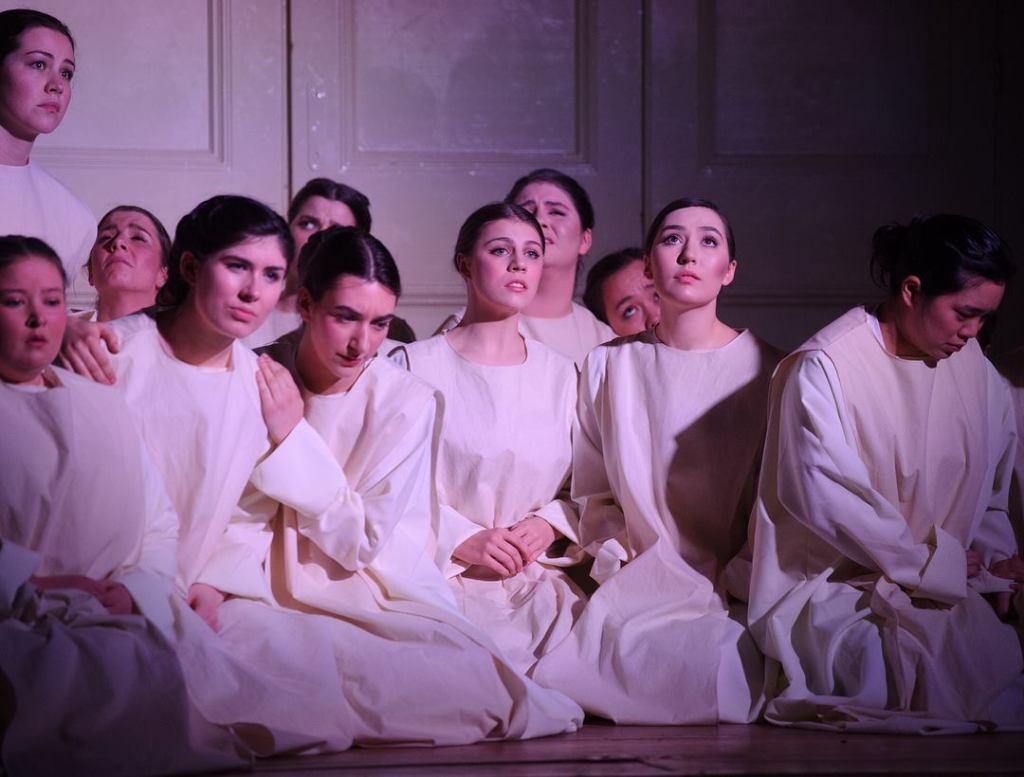
Third from left, front row. Playing the role of Sister Claire in MCM’s 2018 production of Francis Poulenc’s Dialogues of the Carmelites, during my Honours year in Musicology.
The ‘standard’ path to becoming a professional opera singer can probably be described as such: study at a Conservatorium, complete an undergraduate degree and an Honours year, do as many eisteddfods, language coachings and acting coachings as possible, put yourself forward for as many scholarships and young artists programs as possible, do as many shows as possible, go overseas, audition. Rinse and repeat. I became aware of this usual narrative during my first or second year of my degree, from observing Conservatorium alumni, attending concerts and of course, just talking to people.
The idea that every singer should follow the same pathway to becoming a professional performer has some obvious flaws. The main one is that every voice is different and will mature at its own pace. A role which is a satisfying but achievable challenge for one soprano at the age of twenty-five, can be a strained and unhealthy experience for a different soprano at the age of twenty-five. We are also all aware that random life events can completely change our well-laid plans, and that occasionally people fall into performance careers unexpectedly when they were on their way to becoming scientists or lawyers.
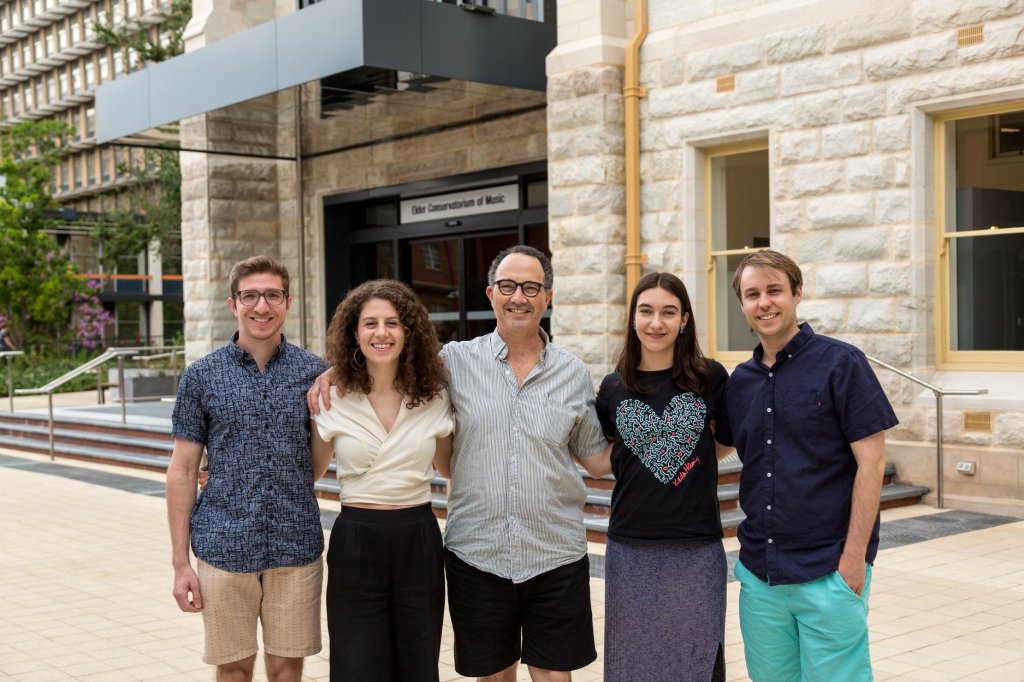
Taking part in the Words About Music program during Australian Youth Orchestra’s National Music Camp 2019. From left to right: Adam Weitzer, Madi Chwasta, program leader Phillip Sametz, Stella Joseph-Jarecki, Chris Healey.
During my undergraduate
degree, I started to feel the strain of constantly pushing myself to be the
best singer I could possibly be. I knew I was incredibly passionate about
singing and wanted to be on stage professionally, but I knew that I was
passionate about other career prospects too.
I soon realised something- if I was burning out already in the safe harbour of uni, a place where nothing is really at stake (in the sense that no one is being paid and you are viewed as a developing student, not a professional), I could not handle the stress of a professional career unless I really changed my attitude. I didn’t want to burn out, because after all, there is no point reaching the Metropolitan Opera if you immediately have a nervous breakdown and never sing again. Performers are constantly riding a rollercoaster, one which peaks with thrilling moments of adrenaline and dramatically plummets during the quieter periods in their careers. A professional performance career will always involve heightened emotions and the possibility of mental strain and illness. You need to have strategies in place, ready and waiting, so you are not taken by surprise each time you feel anxious or depressed in the aftermath of an exhilarating show.
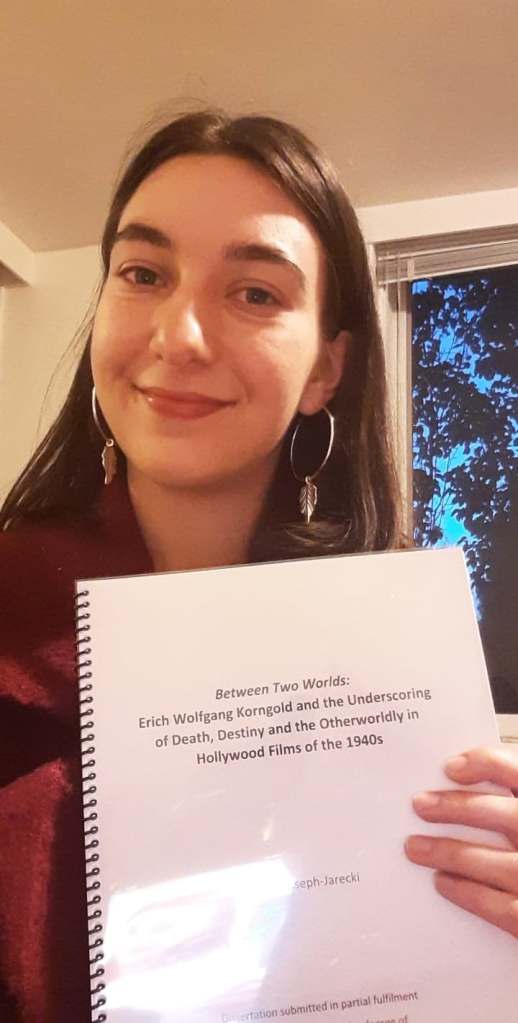
With my 2018 Musicology Honours thesis, entitled ‘Between Two Worlds: Erich Wolfgang Korngold and the Underscoring of Death, Destiny, and the Otherworldly in Hollywood Films of the 1940s’.
This realisation led me to take an extended break from singing, and spend my Honours year at university studying musicology. This was an incredible learning experience, as I wrote over 30,000 combined words of assessment over two semesters. I would love to return to singing in the future, but after three and a half years of it being such an intense focus in my life, it was a relief to devote my time to other skills.
The biggest tactic I have learnt from being in the situation of having many careers call my name, is deliberately not pushing a label on where I am at in my life. Whether I end up singing professionally, singing for fun, combining singing with other careers or not… Whatever happens, I am not forcing myself into a particular path. I am working on things which excite me, letting it happen and embracing the fact that I might end up experiencing quite a different career path than the one I first imagined for myself. I have learnt to sit with the discomfort of not knowing exactly how my career is going to look, or exactly how I am going to combine my skills.
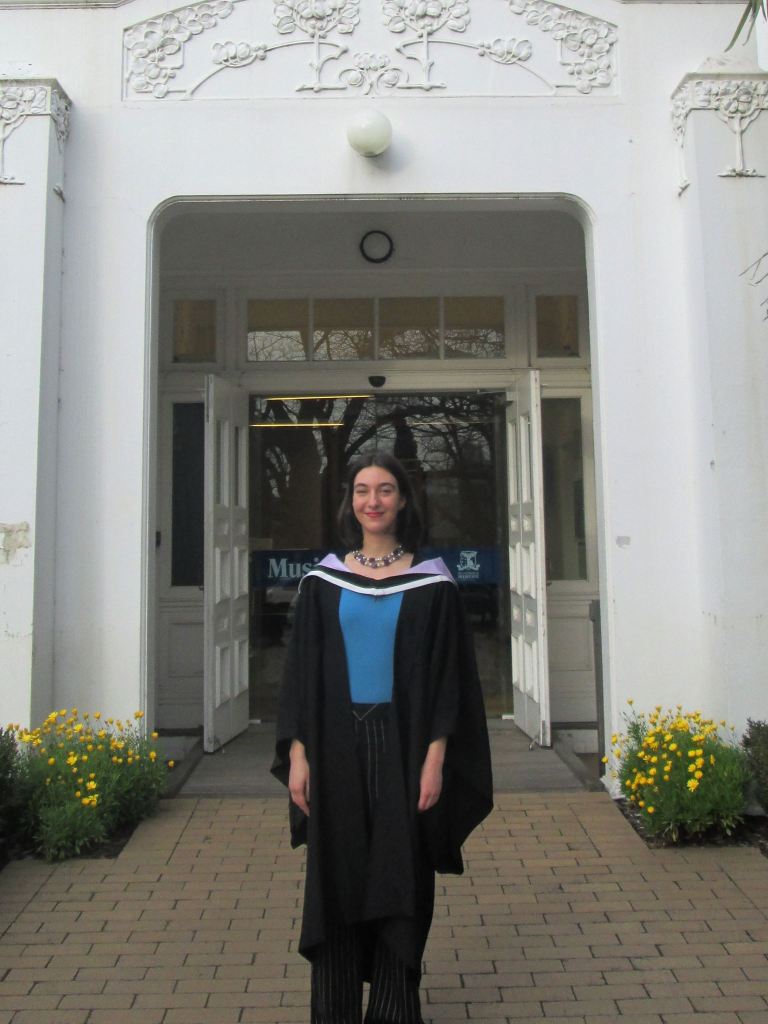
At my graduation for my Bachelor of Music degree in 2017.
A NOTE FROM THE AUTHOR: I wrote the bulk of this article twelve months ago, before I had any inkling that I would create and edit an online music magazine after university. I have found it incredibly cathartic to embrace a ‘go with the flow’ attitude, and understand that things might happen at a completely different pace from what I originally imagined. If you are experiencing major doubts about your creative path, my biggest suggestion is to take things day by day. As scary as it might seem, try to grab the exciting opportunities which come your way.
You can keep up to date with Sean’s composing adventures through his Facebook, Instagram, and website. Sean is the founder of chamber music ensemble Children of the Millennium, which focuses on performing works of the 20th and 21st Century. You can find out more from their Facebook page here, Instagram page here
The world is becoming one of a social hierarchy, which
unfortunately has its bearing on and within the Arts sector of society. We are
often complacent with how we categorise and label parts of that hierarchy, and
can sometimes create a construct built off of popularity rather than
necessarily alternative and innovative thinking. We are constantly debating
about what the ‘norm’ is. But in the contemporary classical world, due to the
diversity of compositional voices, there cannot be a consensus on what is
‘normal’, unless it is one’s own opinion.
I am drawn to the term ‘experimental’, which in most
art-forms, is a vulgar term that is too often synonymous with ‘alternative’,
‘different’ and ‘inaccessible’, and can categorise a composer’s work as
‘obsolete’. Hence why many choose to abandon this term purely to describe their
music as ‘contemporary’. I have personally adopted this due to the attacks I’ve
received over my time for taking an ‘experimental’ approach to parts of my
practice.
Whilst I advocate very much for the new and alternative, and
have dabbled in the “uber-contemporary”, I am a creature of habit and
tradition, and tend to feed off the balance in music that I desire in my own
practice and in the practice of others. I see that ‘balance’ is the key to
evening out the playing field; every musician should have a diverse
practice/range of skills.
It’s not often that I associate myself with any particular
style; sometimes I switch between tonal and atonal, partly contemporary and
ultra-contemporary, and god forbid I even wander into ‘experimental’ territory
occasionally. Many young composers and artists are likely to have a phase in
their life that involves experimenting with new methods, styles and eventually
compositional voices until they find one that is totally them. We as a
community of artists have emerged from the past Renaissances of pivotal
figures, which of course can be examples to us. But let it be said that
discouraging a student from a particular art form due to it being
‘experimental’, ‘old-hat’ or ‘alternative’; this is why this sort of music and
art will never thrive, due to its suppression and suffocation. Of course not
everyone has to be a thorough advocate, but instead be respectful of what people
engage with – it comes down to taste.
‘There is a place for everything, and everything in its
place.’ Something my father has said to me constantly throughout my lifetime,
and I believe fits the music world well. Composers, and artists in general,
should not feel bound by society’s opinion solely, but instead push people to
understand as best they can; and while doing so, respect that new music is not
for everyone. Not all people are going to understand what we do, nor are they
going to like all of it, but someone will, and when they do feel the
satisfaction of being praised. Hold on to that praise, as infrequent as it may
seem.
Without the need for clichés such as “follow your passion” and “do what makes you feel good”; engage with a broad variety of practices is my best advice to any young artist. The art of tomorrow will not be as new if we worry about how the audience of today sees it.
Fever Pitch Magazine enquiries can be sent to Stella Joseph-Jarecki through stellamusicwriter.wordpress.com
Sean Quinn is a Melbourne based composer who is currently in
the midst of his Bachelor of Muisc (perf) at Melbourne Conservatorium of Music.
Since beginning his studies, Sean has been throwing himself into every
opportunity to engage with the community. His desire to learn and create have
driven him to write for unconventional instrumentations of recent, and to
engage with chamber musicians in alternative ways. His works have been
performed at various venues around Melbourne and in Tasmania by groups such as
Allotropy! String Quartet – alongside works by Melbourne based composers Andrew
Batterham, Luke Severn and Joe Chindamo – and Speak Percussion – as part of the
TENOR Network Conference. He has planned commissions with a number of groups,
including cycles for Duo Eclettico (biome tales), Olinda Quartet (morphonos),
Forest Collective (thicket) and many more. Sean’s music is also being
circulated around the Conservatorium, with planned premieres at recitals by a
variety of instrumental students in the next 12 months.
Sean’s main compositional influences include music by Ligeti, Messiaen, Chin and Boulez; as well as American influence from the likes of Cage, Feldman and Wolff. Sean often thinks about space and place being more important that time in music, as it is relative to what occurs within it. He is also deeply influenced by the music of Australian composers Peter Sculthorpe and Ross Edwards.
Keep up to date with Sean’s composing adventures on Facebook here, on Instagram here, and his official website can be found here
Sean is the founder of chamber music ensemble Children of the Millennium, which focuses on performing works of the 20th and 21st Century. Facebook page here, Instagram page here
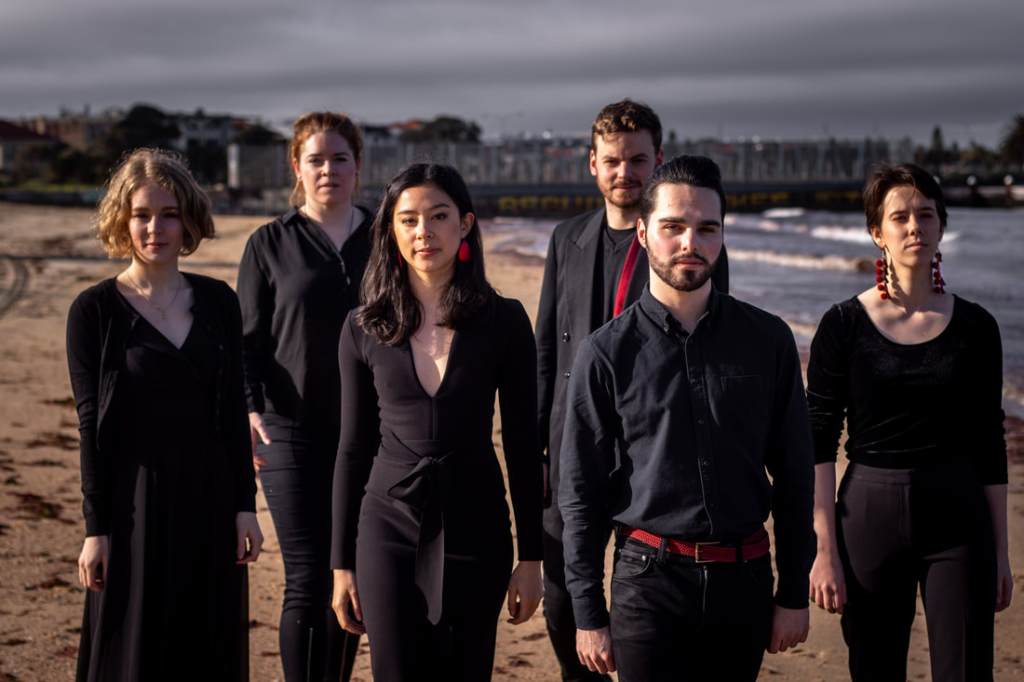
I recently had the chance to chat to Bailey Montgomerie and Alex Gorbatov, two enterprising and passionate music students who established chamber vocal ensemble Divisi Chamber Singers in the early months of 2019. All members of Divisi are in their early twenties, and most are balancing university studies with jobs and other projects. It is fabulous to see young musicians boldly create opportunities for themselves and upcoming composers, so I wanted to quiz these two on all the things they have learnt over a year of running the ensemble.
If you like what you read in the interview below, please consider reading more about Divisi’s upcoming Compose Queer project, currently fundraising on the Australia Cultural Fund page. Divisi will be commissioning pieces from four young queer composers and premiering them in concert in 2020, alongside a premiere of a piece by composer Sally Whitwell. Find out more here
Divisi’s upcoming concert Cecilia will take place on the 22nd of November at Christ Church Brunswick. Entry is by donation and all proceeds will go towards the upkeep of the ensemble and their future projects. The concert will include a new work by young Melbourne composer Max McConnell. Facebook event linked here
Divisi’s website can be found here, and Facebook page here
SJJ:
Why did you both start up Divisi
ensemble? Why did you feel like the world needed another chamber vocal
ensemble?
BM: There are two parts to that answer. The first one is, it was an opportunity for us to develop our own musical abilities and skills. While the Melbourne Conservatorium is great, and the teachers are sometimes walking encyclopedias of musical knowledge, it doesn’t give you everything.
Things like industry experience and industry placement, which the Ignite Lab program at uni is trying to provide to an extent, generally get missed out on by the populace of the Conservatorium. And those things are obviously very, very important to your development as a musician. You can have all the technique and interpretation training you want, but if you don’t have any industry experience, you may as well not be doing it.
SJJ: You can’t be a performer in theory, you have to actually get out there. And it’s scary to get out there, because most of us performers are perfectionists. You don’t want to go out there and do something that’s crap. But I don’t think you ever feel ready.
BM: Exactly. It was also because there was no chamber choral music program at the uni outside of Chamber Choir and Early Voices. It was something that we thought we could create for ourselves… not only would we get experience in managing it, but we’d be able to explore the repertoire in the same way that we get to explore solo repertoire through the Bachelor of Music.
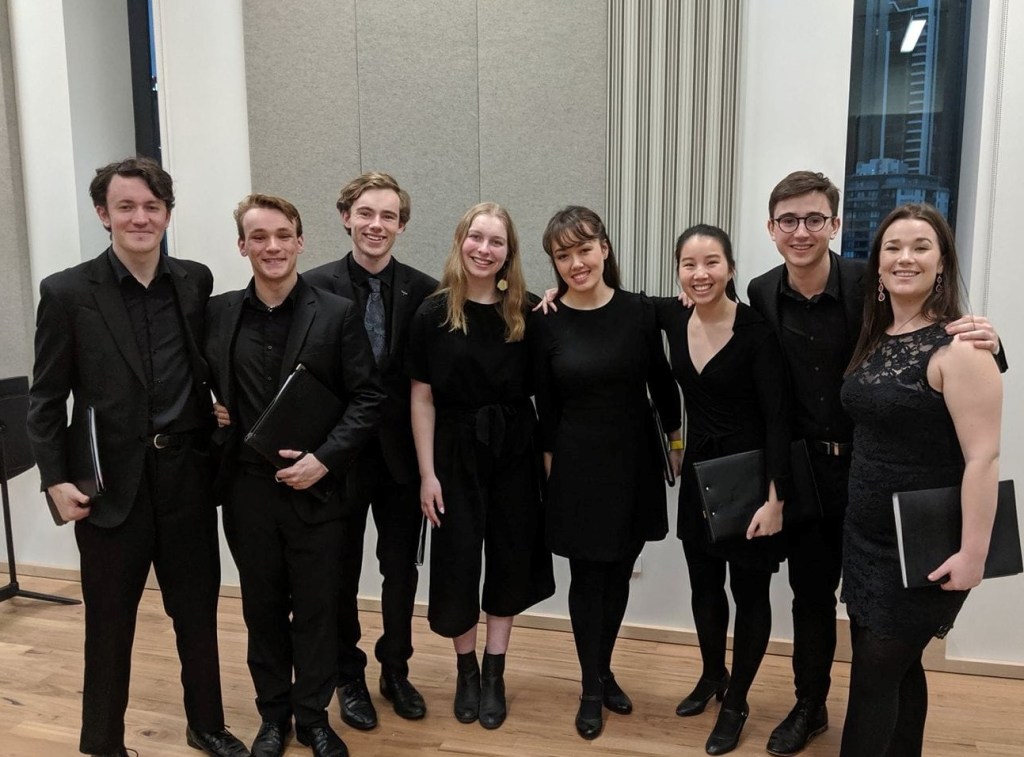
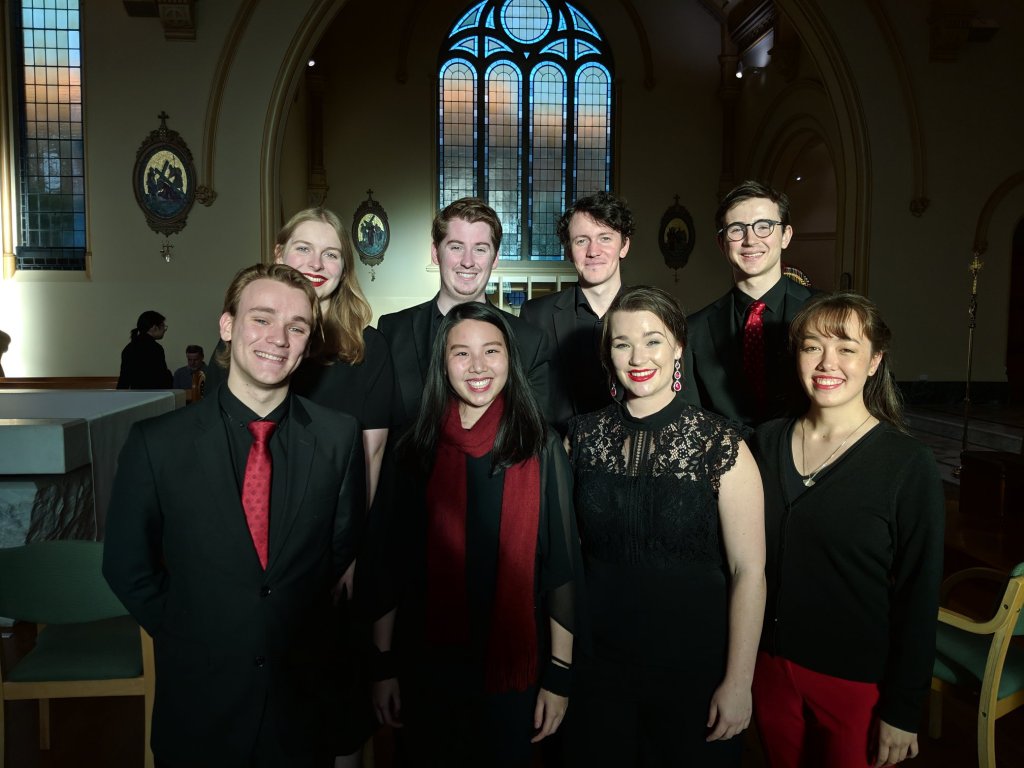
Divisi after singing at the official opening of the new Melbourne Conservatorium of Music building in Southbank. From left to right: Sam Rowe, Bailey Montgomerie, Alex Owens, Julia Krivoshev, Syrah Torii, Lisha Ooi, Alex Gorbatov, Breanna Stuart
We had noticed a rising of little independent ensembles like Luminescence Chamber Singers, run by our friends in Canberra. And we thought, there seems to be a market here that’s untapped. We knew the only way were going to be ready to start up our own ensemble was just to jump in, and make ourselves ready.
Sure enough, we’ve been chatting to some people like the Polyphonic Voices ensemble, and they’ve been saying that there hundred new vocal octets springing up. And they’re not really knowing how to run a marketing campaign. Because while our musical ability is still developing, we’ve learned how to market the crap out of a concert! And in that sense, we’re actually well ahead of a lot of the other chamber singing ensembles.
And the third part of it was that we love it and really wanted to do it.
SJJ: Both of you took part in the Gondwana choir program… can you tell me little about how you ended up singing chamber music?
AG: I was very fortunate to have a principal in primary school who noticed I could sing and pointed me in the direction of Lyn Williams and the fantastic Sydney Children’s Choir, which is under the Gondwana banner, and a mum who really wanted me to have a strong musical education. Even if at times it involved literally (and I mean, quite literally) dragging me to rehearsals. So I’ve been singing in choirs since I was six years old. I also started playing piano at around that time but it’s very much a secondary instrument for me.
Sydney Children’s Choir, and by extension Gondwana, has provided the core of my singing world. Apart from forcing me to sing once a week for eleven years straight, the program exposed me to contemporary Australian music and mandated theory and aural training at a scale I’m only just starting to understand.
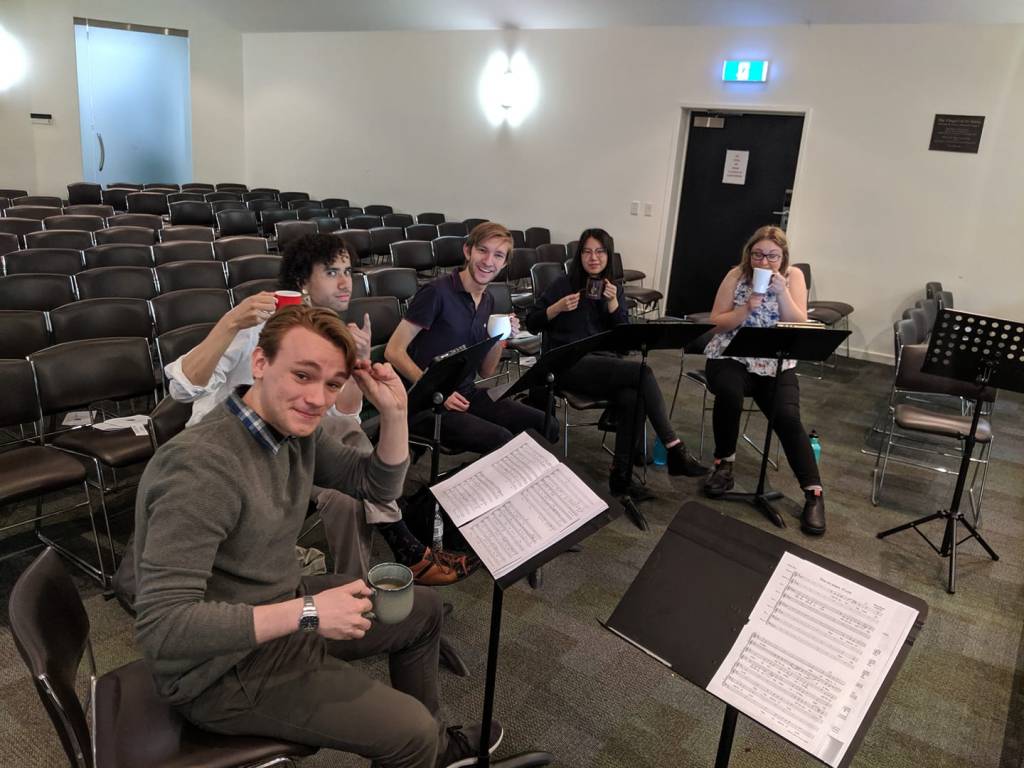
Rehearsing for Tallis To Tavener. From left to right: Julia Krivoshev, Breanna Stuart, Lisha Ooi, Bailey Montgomerie,Syrah Torii, Sam Rowe, Alex Gorbatov
Choirs have always been my focus and in 2015 and 2016 I had the pleasure of touring with Gondwana Chorale as their youngest member. That ensemble showed me a new standard of choral music that I had not appreciated before and also that Australia had the ability to produce the absolute pinnacle of music of this type. It was also in 2016 that I started doing some barbershop repertoire, and listening to groups like Luminescence and The Song Company, which helped me realise that I wanted to sing this music. It was also through Gondwana choirs that Bailey and I (and a few other members of Divisi) really got to know each other.
SJJ: With social media and marketing, what are some things that you’ve picked up through the process of throwing yourself in the deep end, about putting on concerts, marketing concerts, and actually getting people to come?
BM: The biggest thing for me has been discovering the wonderful world of data. We can access certain analytics through our Facebook page for Divisi and the ticketing website Eventbrite. We can see when people are visiting our site, what posts are getting the most engagement, what social media activity is leading to sales… We use this data to refine our marketing strategy and more efficiently translate social media engagement into ticket sales.
Obviously there’s no substitute for just posting and harassing people but you don’t actually have to do that as much produce the same results, if you are able to target people more directly. And analytics and data have been a super wonderful way of doing that.
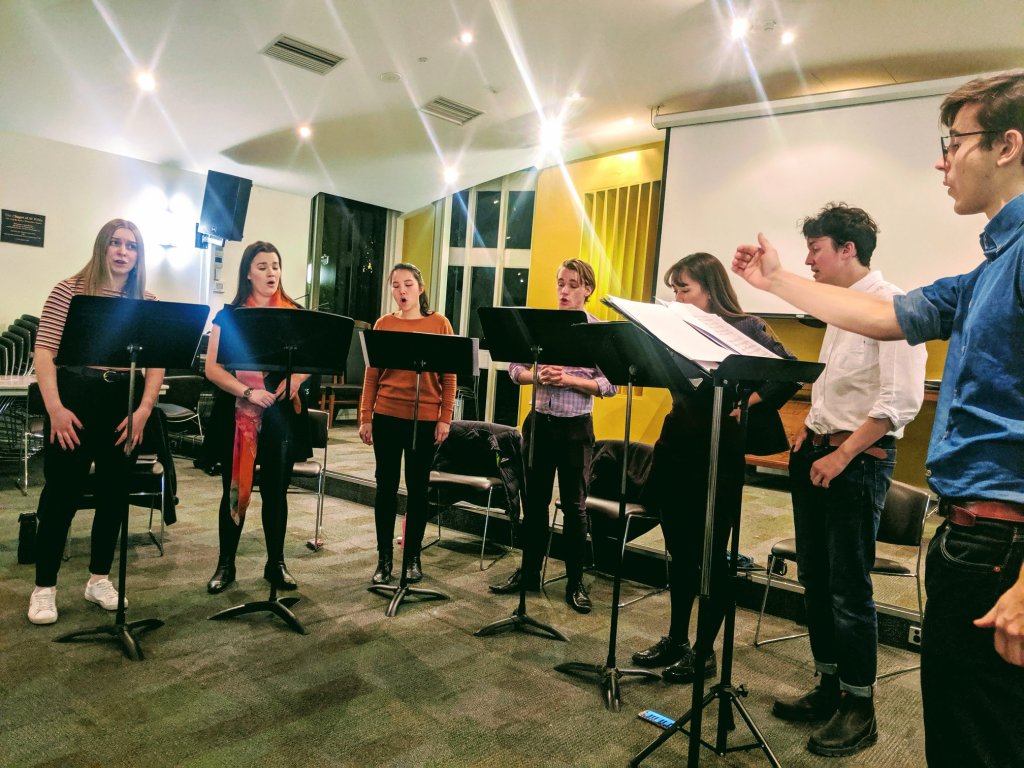
Rehearsing for Cecilia. From left to right: Bailey Montgomerie, Andre Sasalu, Alex Ritter, Lisha Ooi, Marjorie Butcher
SJJ: How do you both approach time management? In regards to social media and having a regular posting schedule, how do you approach that in a sustainable way?
BM: That has actually been really difficult for us over the past few months, especially in the lead up to the last concert. We worked out recently that the method we’ve been following, aka splitting every job between Alex and I, and squeezing them into whatever time we don’t have assessments or work, just isn’t sustainable. It’s been causing us to miss things that we could be doing to maximize the efficiency of the choir and getting bums on seats…
So we had a meeting with the head of Ignite Lab to tackle this [Susan Eldridge, member of staff at Melbourne Conservatorium of Music]. Right now we’re in the process of delegating a couple of roles so we can have a coherent framework of who’s doing what.
Pictured, left to right: Julia Krivoshev, Bailey Montgomerie, Alex Gorbatov
Things like, having an operations manager, someone in charge of managing the finances, someone running marketing, those kinds of roles. Julia Krivoshev, one of our sopranos, will be taking over social media and marketing for us, which will be super useful.
While there have been challenges, the great thing at the moment is Alex and I are totally accountable to one another. We know we’ll get the jobs done. But with delegating tasks and creating a framework, we’ve become aware that it is a fine line, of working out how to avoid micro-managing, while still actually managing.
AG: The more creative part of the planning is split. Often one of us will have an okay idea, and the other will run with it and turn it into a pretty good idea.
Deciding on repertoire is a very collaborative process. We go back and forth between the two of us to make sure the pieces aren’t unrealistically difficult and the right fit for the concerts. This is one of the more time-consuming steps of the preparation, but also one of the most enjoyable. It often involves a bottle of red, very loud choral music, hysterical laughter, and going off track into realms of repertoire we should definitely not attempt in the near future…
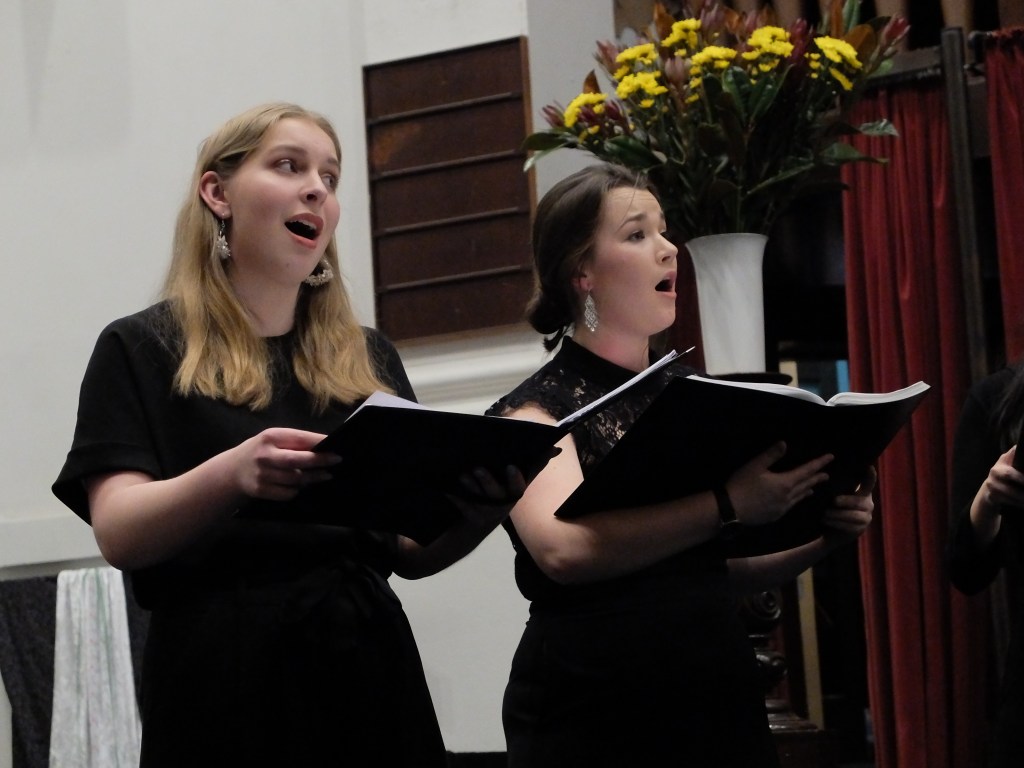
After opening for Candlelight VOX’s concert ‘Ascension’, held in May 2019. Top row from left to right: Julia Krivoshev, James Emerson, Sam Rowe, Alex Gorbatov. Bottom row from left to right: Bailey Montgomerie, Lisha Ooi, Breanna Stuart, Syrah Torii
SJJ:
How do you and Alex approach the curatorship
of your programs?
BM: Aside from the actual rehearsal process, the curatorship is probably the most creative part of the project. Sometimes it’s a name, like Tallis to Tavener, which had such a nice ring to it that we just had to do it. It’s a pretty name which actually created a coherent theme that we could explore. The Divisi in Recital program started with the concept of showcasing what the choir could do, and we also wanted to perform a specific set of pieces by Arvo Pärt.
Often it will emerge from either repertoire that we want to perform and we curate a theme around, or it’ll start with the theme and we’ll curate repertoire around that. The curation process can start from any one point. You work backwards, forwards, sideways, two steps forward, two steps down… It’s very creative. We’ve got so many ideas written down now, it’s frankly crazy.
SJJ: Who are some composers who inspire you both?
AG: That’s a hard question! Firstly, our good friend Johann Sebastian Bach. His vocal music is terribly difficult to sing because he was a bit mean to vocalists, but the result is incredible. If you listen to his motets, although he didn’t really care about them too much, he was doing all this incredibly interesting word painting and textural stuff that was a few hundred years ahead of his time.
Out of the renaissance basket I love singing William Byrd and Thomas Tallis. The masses for three, four, five voices have this incredible rhythmic feel to them which make them so fun to sing. I had the opportunity to sing some of the Eton song book a few months ago and it is like Byrd on crack. More complex, more interesting, more clash, and we know even less about how it was performed.
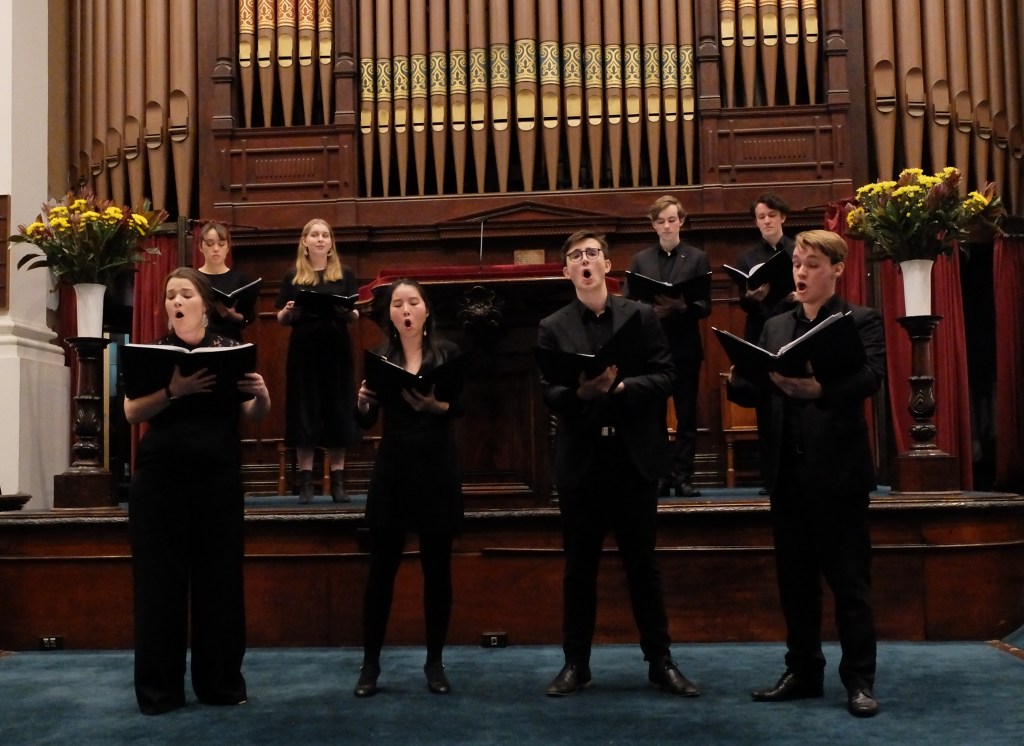
Performing in Tallis to Tavener. Top row from left to right: Syrah Torii, Julia Krivoshev, Alex Owens, Sam Rowe. Bottom row from left to right: Breanna Stuart, Lisha Ooi, Alex Gorbatov, Bailey Montgomerie
While
we are in the British Isles, I’ve been loving Henry Purcell lately. He is so
expressive in his use of dissonance. I won’t keep going, because every times I
say the name a Baroque or Renaissance composer, another one pops into my head…
On the contemporary side, I’ve just become addicted to Gavin Bryars and have been recently singing a bunch of Arvo Pärt. Essentially, anything with a good deal of clashy-ness and some genius and thought apparent in the writing will make me pretty happy.
BM: Yep, Johann Sebastian Bach. He reminds me every day exactly why I love singing so much. His music is just so pleasant to sing, and there’s also an implicit goal. One of the reasons we created Divisi was because we want to perform the Bach motets in concert one day. So that is a future project that we will take on when we’re ready.
I would also name Arvo Pärt. His music is fascinating, in that experimental style. It’s almost like the music was conceived in a slightly different way. Those natural instincts you have about phrasing and dynamics, basically your musical intuition, you have to completely rethink them. His style is informed by a very particular set of factors. Tintinnabuli, the ringing of the bell, is a central idea to his entire musical world. And you have to curate the performance style around that… you try to avoid bringing in your general musical intuition and really approach it from the ground up rather than bringing in outside knowledge.
I
would expand that comment to a lot of other 20th century composers. The
composers pushing boundaries, rethinking music, those composers definitely make
me feel personally like I’m in the right profession. The music is so much fun and
very intellectually engaging, even if their music isn’t as consonant as I might
like.
And Baroque and Renaissance composers generally! Alex and I are early music nerds. For the same reason that we like 20th century composers, those composers were pushing the boundaries of music during their time as well. They actually thought about music in a very different way, in a way that that was in a sense developing the tradition that we have today.
Renaissance composers discovered a whole lot of chromatic music theory, hundreds of years before anyone else did. Because the ways there were conceiving music were so fundamentally different and strange. And it’s really interesting to discover those sort of divergent ways of thinking in the same vein in the world of 20th century composers.
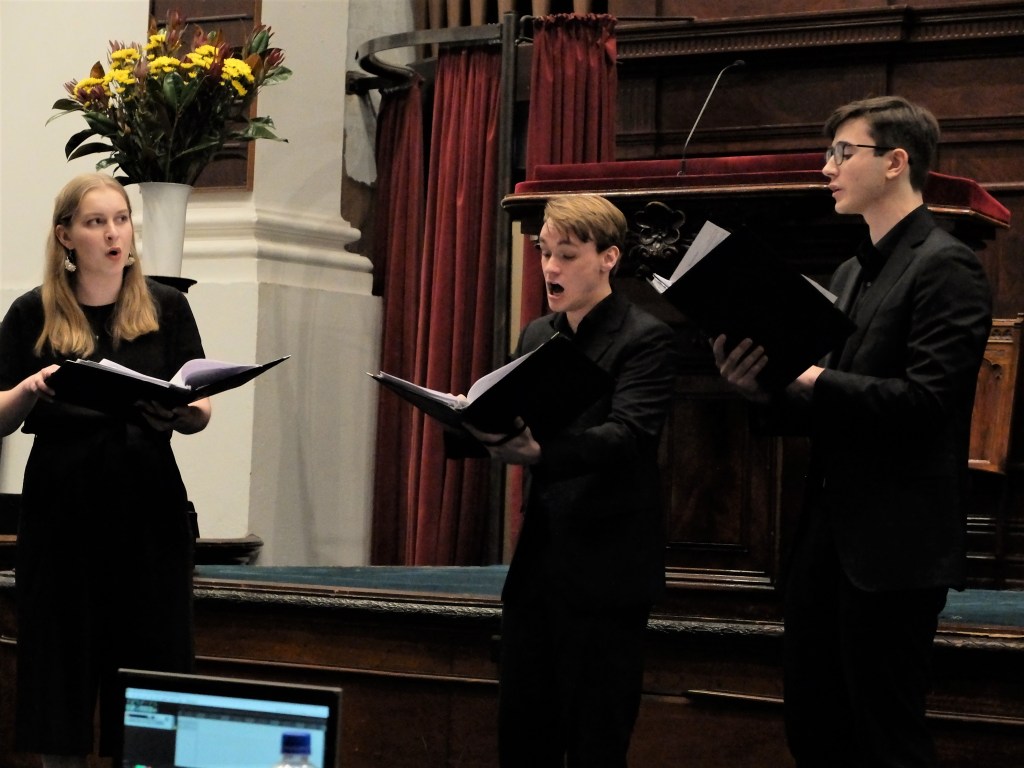
Julia Krivoshev (left) and Breanna Stuart (right) performing in Tallis To Tavener.
SJJ: So what is up next for Divisi?
BM: Once we began programming our own programs, we started to recognize the problem with Western composition being dominated by straight white men. Even though we have geniuses like Hildegard and a bunch of interesting composers from the 20th and 21st century; female composers, composers of colour, queer composers…
Our next project involves something that we are really passionate about- programming composers whose work may not be getting heard, because of social factors that have lasted as long as music has in the western tradition.
The project is called Compose Queer. We’re going to be commissioning a handful of queer composers, preferably young people who are from Melbourne or Sydney, and will be performing their works next year in concert. Sally Whitwell, one of the premier queer classical composers in Australia, is going to come down and headline the concert for us… and hopefully work with the young composers as well! She’s very experienced at choral writing because she’s worked with choirs the majority of her musical career. She’s kindly allowing us to premiere a piece of hers as well.
We want to do our part for the queer classical music community. It’s a community which is very sparse, because it’s such a niche area. And naturally that’s going to turn a lot of people away. Especially people that might have particular barriers to getting into the profession in the first place… generally speaking, those who aren’t expressly fitting in the heteronormative model of personhood in Western society today. And we want it to be more than just an awareness campaign. It’s actually putting money into the pockets, and giving notoriety to, the people who need the money and the notoriety. And hopefully setting a precedent for other ensembles to not just program a bunch of dead white guys, basically.
We’re really keen to perform some new works. Our upcoming concert Cecilia features a new work by Max McConnell, a local composer from the Conservatorium.
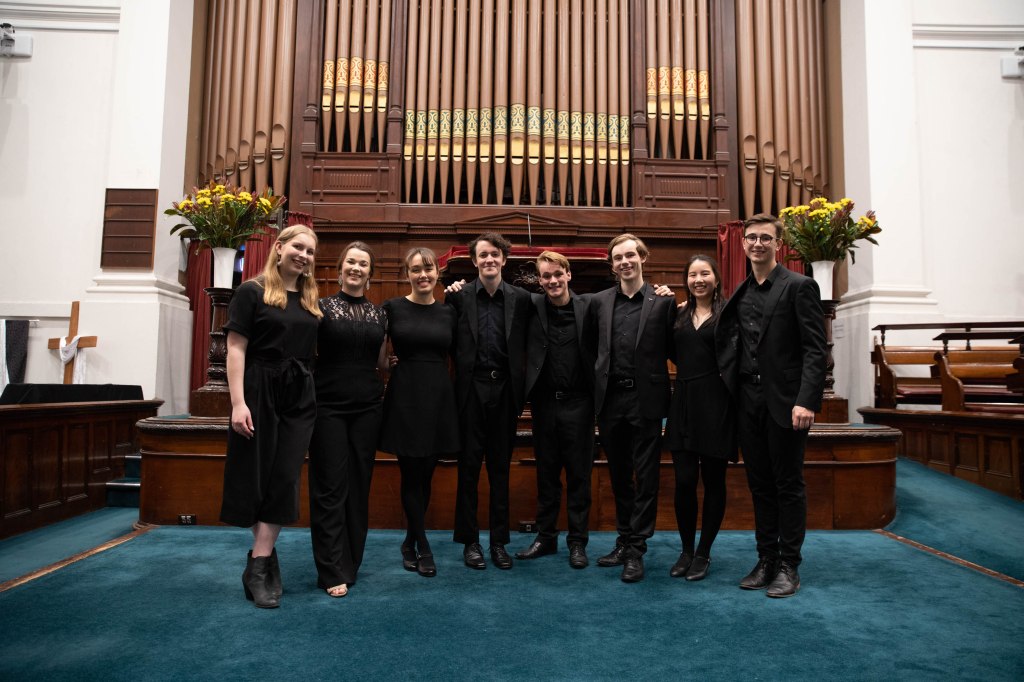
After Tallis To Tavener. From left to right: Julia Krivoshev, Breanna Stuart, Syrah Torii, Sam Rowe, Bailey Montgomerie, Alex Owens, Lisha Ooi, Alex Gorbatov
SJJ:
What is your favourite thing about being
in a chamber music group?
AG: I love large choirs, they produce a fantastic sound, but it is often so safe. There isn’t the same sense of risk, and essentially there’s one uniform sound. If you compare the sound of the world’s best large choirs, the differences are minor. If you listen to Voces 8, The Song Company, Fieri Consort, etc, they produce unique and wonderful sounds with a versatility and agility you can’t get out of large choir. And there is something special about the trust you have between the eight of you. It becomes a very intimate experience.
BM: My favourite thing would be achieving level of ensemble, where you approach a cadence point in a piece of music, and the chord is so perfectly in tune that you just feel it in your bones. And you can hear upper partials as well in the room when the acoustics are good, and you know that that is the exact resonant frequency of the chord and you did it… That feeling is a little bit addictive. And so musically satisfying.
The development of ensemble skills is a big thing for me. One massive reason I like chamber vocal music is the ensemble communication aspect. Developing it in others is another important goal. We’ve had a couple of members of the choir who have just come leaps and bounds in terms of their ensemble skills reading skills, and it’s been really rewarding to see. And the social-ness of it as well…. the reason so many people sing in choirs who aren’t necessarily serious singers, is because it’s a great social experience.
Alex
Gorbatov is an emerging tenor and choral director who pairs his music making
with mathematical and analytical studies.
Alex’s
choral journey began with Gondwana Choirs. After 11 years singing with Gondwana
and other large choirs, he now primarily performs as a chamber musician and
consort singer. Alex has appeared with Luminesce Chamber Singers, Polyphonic
Voices, and with his own ensemble: Divisi Chamber Singers. Alex is also an
emerging musical director. In addition to his work as artistic director of
Divisi Chamber Singers, he has taken up the baton with Apollo Choir, Divisi,
and recently appeared as an assistant conductor under Marianne Rigby-Black for
the University of Melbourne’s All Staff Choir.
Alex is
particularly passionate about creating opportunities that enable young
musicians to perform and have their works performed. He works regularly with
new composers and prioritizes programming of young Australian composers.
Bailey Montgomerie is currently a student of classical voice,
and politics and international relations at the University of Melbourne. A
graduate of Newtown High School of Performing Arts, he currently trains under
Anna Connolly.
Bailey has sung with a number of pronounced Australian
ensembles including the Sydney Philharmonic Choir and the Hamer Singers. He has
also sung with the prestigious Gondwana Chorale during their European tour, during
which he received a master class from a global authority on choral music Stephen
Layton of Trinity College, Cambridge. Currently Bailey sings with Polyphonic Voices
and spends most of his time as co-artistic director of his own chamber ensemble
Divisi Chamber Singers. The octet is steadily becoming a significant group in
the network of Melbourne chamber ensembles.
Our fast-paced society often leaves us feeling stressed, frantic and out
of time. Candlelight VOX presents an antidote with Pause, which focuses on music encouraging stillness and meditation.
Candlelight VOX have gone from strength to strength since their founding
in 2017, and as a student led ensemble have presented a program with plenty to
offer. Set within the Missions to Seafarer’s Norla Dome, the venue choice could
not have been better, allowing the musicians to surround the audience to great
effect. It is important to note that Pause
does come with a ticket price, which makes this a professional offering, and so
this reviewer had a couple of minor gripes that should be addressed. There were
a few missed notes, as well as the interference of two techs that were not in
theatre blacks that changed microphones between each number. However, these are
minor faults when considering the amount of talent on display within Pause.
Pause presents a shockingly large amount of Melbourne musical talent.
Listeners were treated to not only to the music of the choir, but also to the
Storage room String Quartet. Soloists were also in abundance, particular
highlights included singer Lisette Bolton and an exceptional performance from
percussionist Bridget Bourne on the Vibraphone (presenting compositions by
George Cox) which was an absolute standout. Both Lisette and Bridget are two of
the finest young musicians you could hope to hear within Australia, and are
certainly ones to look out for on the professional circuit in the very near
future.
The choir performed at its best when co-artistic director and conductor Grace Gallur was at the helm. Rather than acting as a reserved and pious conductor of choral music, Grace came alive as a visual conduit for the choir to follow; her powerful passion for the music she was conducting was unashamedly on full display, and was an absolute joy to watch as well as to hear. The choir responded in kind, with particular highlights including performances of Tavener’s As One Who Has Slept and Paul Mealor’s Drop, Drop, Slow Tears.
John Cage’s notorious 4’33” was
also included, and within a program emphasising stillness and meditation was a
powerful statement, reminding us to stop, slow down and breathe.
Candlelight VOX should be exceptionally proud of what they have presented here. The amount of musical talent and passion on display for the ticket price is truly exceptional, made even more impressive when reminded that the entire ensemble consists of students. When considering the aim of this choir is to showcase the music of living composers and nurture Melbourne’s up and coming musical talent, Melbourne music lovers should make sure to keep and ear out for Candlelight VOX in the future.
Candlelight VOX’s Facebook page can be found here, their website here
Fever Pitch Magazine enquiries can be sent to Stella Joseph-Jarecki through stellamusicwriter.wordpress.com
I recently had the chance to fire eight questions at Melbourne musician James Seymour, on the highs and lows of being a professional singer-songwriter. James has recently released his debut album Cut Your Teeth, under his moniker Feelds. Listen to Cut Your Teeth on Spotify here, on Bandcamp here
Feelds’ Facebook page can be found here, and official website here
Feelds will be launching his album at the Gasometer Hotel, 8pm, Thursday 14th November. Tickets from $15, can be purchased here
When did you realise you wanted to pursue music performance more seriously in your life?
For as long as I can remember, I’ve been doing some kind of musical performance. I’ve played a handful of different instruments across different projects and setups… And the more music I wrote, the more music performance became a staple in my life. I figure that much like any other musician, I’ve found a way of writing and performing that reflects me, and I suppose as a musician in today’s climate the best way to express that is through live performance.
Your debut album ‘Cut Your Teeth’ was sparked by the discovery of a photo album put together from when your parents met and went on ‘Karate Camp’ in the 80s. Could you tell us a little about how that inspired you?
My parent’s past as athletes wasn’t a world that I had explored much before finding that photo album – mainly, I guess, because they gave those types of things up when they started a family. With that in mind, those amazing photos sparked a desire to elaborate upon the story through songwriting. The album’s journey explores how we respond and react to things around us as human beings, essentially how our own experiences inevitably shape who we are.
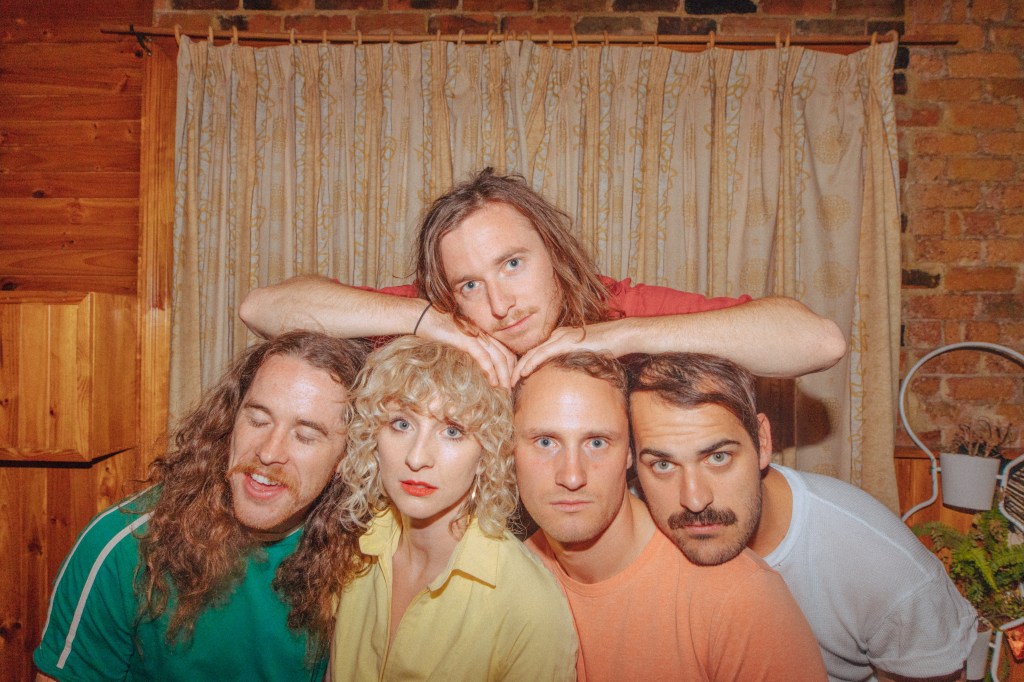
Bottom row, left to right: Daniel O’Keefe,Katie Wighton, Mark Webber, Jarred Young. Top row: James Seymour
How did you find yourself with Fright Night Music management?
Dean Valentino (who runs FN) is a long-time friend of mine. We met over a decade ago when our first band projects used to gig on the same line-ups around Melbourne. Since then, we’ve been through quite a lot together (both musically and otherwise), and when I started the Feelds project, he was right there, eager to give me a hand with whatever I was doing. I guess it snowballed from there, and now, here we are!
Who are some of your musical influences?
The biggest influence on my music and how I think about musicality is Justin Vernon. I really admire not only the way he constantly pushes boundaries and challenges himself, but the way he involves the community around him and the people that inspire him to influence what he does as well. The bands I’m obsessed with at the moment are Pinegrove and Saintseneca.
What are your favourite things about the contemporary music scene in Melbourne?
The community of creatives that surrounds it, undoubtedly. As
an independent artist that lives and breathes music, having a supportive,
collaborative and challenging network of like-minded people is so important –
especially when you’re trying to make a career out of writing and performing
music.
From left to right: Mark Webber, Katie Wighton, James Seymour, Daniel O’Keefe, Jarred Young.
The first and last tracks on the album feature spoken word samples, and the first one is quite a lovely reflection on how we should pursue our individual goals in life despite what others may want. Can you tell us a bit about incorporating those clips into the album?
I met David ‘Papi’ Hunt on a university trip to LA in 2015. He was our guide/bus driver one day on a tour of the city, and I found him to be full of life, experience and insight. Instead of walking off on our lunch break, a friend and I sat down with ‘Papi’ amidst the food court of a bustling Los Angeles street market to pick his brains. We sat and listened for over an hour to his stories and viewpoints on life, being an older, Melungeon-Indian born man raised in the Appalachian Mountains. Snippets and sound bites from this conversation are sprinkled throughout the album – moments and words that really resonated with and stuck with me all this time later.
The album was written, recorded and mixed in your Melbourne studio. Do you think that helped to give it a distinctive character and musical sound?
For sure! The limitation of gear and space had a big influence on the sounds and techniques I developed in my home studio. That situation forced my thought process to be more decisive, less complicated. I loved becoming extremely familiar with my equipment and knowing exactly what each tool could be used for.
What are some of the most rewarding and challenging aspects of gigging and touring?
As simple as it sounds, seeing people getting involved with what we’re doing on stage is pretty darn rewarding! The most challenging thing about gigging and touring would be something along the lines of staying true to yourself, and trying to not let that setting affect how you might usually act. Making sure you’re still reflecting the things you truly believe in.
There is something intriguing around the idea of the unknown. Whether this comes to Feelds as a thirst for exploration or a relentless drive for self-discovery, onward seems to be the only direction.
Since releasing a string of self-produced singles in the latter half of 2016, the Melbourne-based project of James Seymour has grown miles forward into a fully-fledged outfit, defined by clever songwriting used to provoke a dynamic soundscape of honest storytelling. A new level of performance was struck in 2017 with the addition of a live band, allowing the following two singles, ‘Colourblind’ and ‘Crazy Neighbours’ to pave the way for a debut EP release in the early stages of 2018. The self-produced EP, ‘Hunch’, was independently-released to a sold out hometown crowd in Melbourne, has gained national radio success, received over 1.25 Million streams on Spotify, and allowed Feelds to tour across the country in support of the likes of Didirri, Hayden Calnin, Fan Girl & BATTS.










 Fever Pitch Magazine