I have worked out something about my personality. Many of our psychological responses in life are shaped by what motivates us at our core. For example, I am the least competitive person I know. When I took part in team sports during high school PE, I was so apathetic at the prospect of ‘winning’ I could barely be bothered to try my best. (I also didn’t really like sport.)
And hypothetically, if I had been told that every month the top student in English class would earn a trophy, I still wouldn’t have put in any extra effort. I am completely uninterested in trophies. I’m not trying to sound noble, either. I would have tried my best regardless because it’s a personal point of pride that I enjoy writing and work hard at being good at it. But I would have logically understood that there was only one trophy, and that it could easily be won by a member of my class if they submitted better work that month. And that wouldn’t change the fact I am objectively very good at writing.
I don’t want to insult those who are motivated by ‘winning’, or topping a scoreboard. We need all kinds of personalities in this world. And without the kind of scarily disciplined individuals who win Olympic medals, or get up at 5am to train for marathons (and pay money to take part in them!), I suspect a whole lot less would get done.
I think it’s important to work out what motivates you. During a high school psychology unit, we looked at the theory of personality types divided into A, B, C and D. The first two classifications made a lot of sense to me, especially in working out why I have always been so bamboozled by people who are fiercely goal-orientated (I’m more of a Type B personality, happy to chug along in my own lane, and people who are competitive and overtly goal-orientated are usually more Type A). No classification method is perfect though, and the remaining two types seemed to me a strange mix of leftover qualities.
There are many different kinds of personality tests out there. I don’t think there’s anything wrong with picking and choosing elements from the ones you’ve tried, if you’re simply trying to identify characteristics you can relate to. (On that topic, can you tell I’m a Libra, constantly weighing up the different sides of an argument? That even extends to the topic of horoscopes…)
I’ve realised that I am most motivated by a desire to be challenged, and to acquire knowledge. (Sounds lame, but I am a Ravenclaw through and through). That’s why I decided to pursue classical singing, because it allowed me to sharpen different parts of my brain simultaneously. I was learning the sounds and structures of foreign languages, the cultural and dramatic history behind opera, as well as taking on the physical and emotional challenge of the singing itself!
That’s also the reason I am not devoting myself to singing full-time. There are so many other things I want to explore. I want to do a music history research Masters and PhD, something that seems totally normal in my brain, but I suspect most of the singers I’ve met through my studies would rather eat rusty nails.
A characteristic that goes hand in hand with wanting to challenge yourself and fill your brain with more and more information, is a voice inside your head that constantly says “You don’t know enough to express your opinion yet”. It’s not necessarily that I think I’m an impostor, but that I get overwhelmed with all of the things I won’t get a chance to learn.
When someone asks me why I love a particular composer, I’ve realised I usually answer with my emotional responses to their music, not an appreciation of what they achieved with chordal harmony and form. That’s because music theory isn’t my forte. But that makes me doubt my opinions in the area which I am confident in, the relationship between music and drama.
I think it’s a variant of impostor syndrome- when in a room with people who are intimidatingly, amazingly knowledgeable in their field, I don’t doubt that I have interesting things to say, but I definitely wish I that knew more!
But now I have worked this out, I am ready for that voice when it comes. I’m never going to be satisfied with my level of expertise so I am just going to keep ploughing ahead, focusing on the things that I can change.
I hope my indulgent self-reflection has given you cause to navel-gaze upon your own personality and motivations. There is probably no better time to do so, than when we are trapped inside self-isolating.
This article contains general ideas to support mental health. If you are currently in crisis or need immediate assistance, phone services like Lifeline (13 11 14) and Kids Helpline (1800 55 1800; for young people aged 5-25) operate 24/7, and websites like https://www.beyondblue.org.au/ and https://www.healthdirect.gov.au/mental-health-helplines contain additional supportive information.
This article was created as a personal resource for anyone who is feeling emotionally impacted by COVID-19, but the ideas here can be used, altered, or expanded upon in so many ways to support general wellbeing and mental health at any time. You don’t need to be in the middle of a global crisis to want more ideas in your self-care kit!
Brede Davis is a music therapy student with professional and personal experience primarily in fields of disability and mental health. She also plays and writes music as Brede Alanna Music on YouTube, Instagram, and Facebook. For information on music therapy, please see https://www.austmta.org.au/content/what-music-therapy
Covid-19 has been the catalyst for unprecedented changes worldwide. Right now, your life might look entirely different to what you’re used to. Or it might be relatively unchanged. This situation is prompting a range of reactions, thoughts, and feelings. You may feel like you’re thriving, barely surviving, or somewhere in the middle.
There are many valid ways to feel about all of this. With so much change and uncertainty, it can be difficult to know how to look after yourself right now. One way to address this is by considering “What am I feeling right now?” and “What do I need right now?”, then moving to “How can I address that need?”. When considering creative ways to support our wellbeing, music can be an invaluable resource. The following sections include some feelings and needs you may be experiencing, alongside ways you could use music to help address these. As you read, note what feels relevant or useful to you. Or use this as inspiration to develop your own ideas using your preferred ways of engaging with music (eg. listening, playing, composing, recording, producing).
Create a playlist of favourite/familiar songs – consider adding songs which remind you of places or times where you’ve felt safe or comfortable.
Play music you know by heart – music you don’t even need to think about. If comfortable, try closing your eyes to reduce external distractions.
Learn “easy” pieces – music that feels comfortable and not challenging.
Try a guided relaxation or meditation – search through suggestions on YouTube or other platforms and look for something with a voice and background music you find soothing.
Sing anything – anxious breathing typically involves rapid breaths with longer inhalation and shorter exhalation, leading to increased heart rate and adrenaline. Calm breathing involves slower breaths, where exhalation lasts longer than inhalation. This naturally occurs when singing as you typically breathe in quickly, then release air slowly over the length of a phrase. You can use any song you feel comfortable singing. To further encourage calm in your body, gradually slow your singing until your tempo approximately matches your resting heart rate.
Feeling: Uncomfortable or Distressing Emotions
Potential Needs: Emotional expression, Increased understanding of thoughts and feelings, A more comfortable emotional state
Musical Resources:
Songwriting – Songwriting is such a versatile activity: the purpose of your songwriting, the way you write the song, and what you do with the completed song all influence which needs are addressed through songwriting. In this case, turning intangible thoughts and feelings into specific written lyrics can help you understand and process what you are thinking and feeling. Use whatever structure suits the kind of processing you need to do: a single chorus line over and over to emphasise a particular thought? 36 verses because you’ve got a lot to say? There are no hard and fast rules here! If you would like to use a more structured approach, try:
Chorus: emphasise your central theme/feeling/message.
2-3 Verses: expand upon your theme. For example: how do you feel about it? What thoughts are you having about it? How do you want to be feeling instead? What does this theme mean to you?
Bridge: reflect on what you’ve covered in the song and/or consider “where to next?”
You can further personalise your song by using the accompanying music to process or express your thoughts non-verbally. If you’re not sure where to start, try a standard chord progression like I-IV-vi-V, or find a backing track online.
Create a mood-shifting playlist – this playlist starts with songs that reflect your current feelings, and gradually shifts towards songs which reflect your desired feelings. Consider how different your current and desired mood states are, and what states you may need to pass through to get from A to B. For example, moving from “really sad” to “happier” might look like really sad > sad > a little sad > content > a little happier > happier, so your playlist could include a few songs that you associate with each of those mood states. This can be a more tolerable way of changing mood states than trying to force an immediate shift. It might be hard to think of more “positive” songs while you’re feeling difficult emotions, so this could be something you make in advance so that it’s ready to go when you need it.
Musical improvisation – play however you’re feeling. For example, if you feel stressed you might play fast, loud, dissonant sounds to expend some of that stressed energy, feel the physical feedback of the instrument, and hear a representation of how you’re feeling. This may help you transition to a less intense emotional state.
Use someone else’s words – if you’re having difficulty articulating your situation, look for songs with lyrics that resonate with you or reflect what you’re experiencing. You can piece together lyrics from different songs and use these to construct a clearer understanding or expression of your own feelings.
Feeling: Lack of control, Helplessness
Potential Needs: Control, Autonomy
Musical Resources:
Add your influence to existing music – cover a song in your style, remix some songs, re-orchestrate a piece, transpose something to better suit you. Change whatever you want to change: pitch, tonality, instrumentation, harmonic structure, lyrics, genre, etc!
Organise your music library in a way that suits you – for example: clean up weird file names on iTunes, organise your Spotify library, sort that pile of sheet music, rearrange your physical music collection.
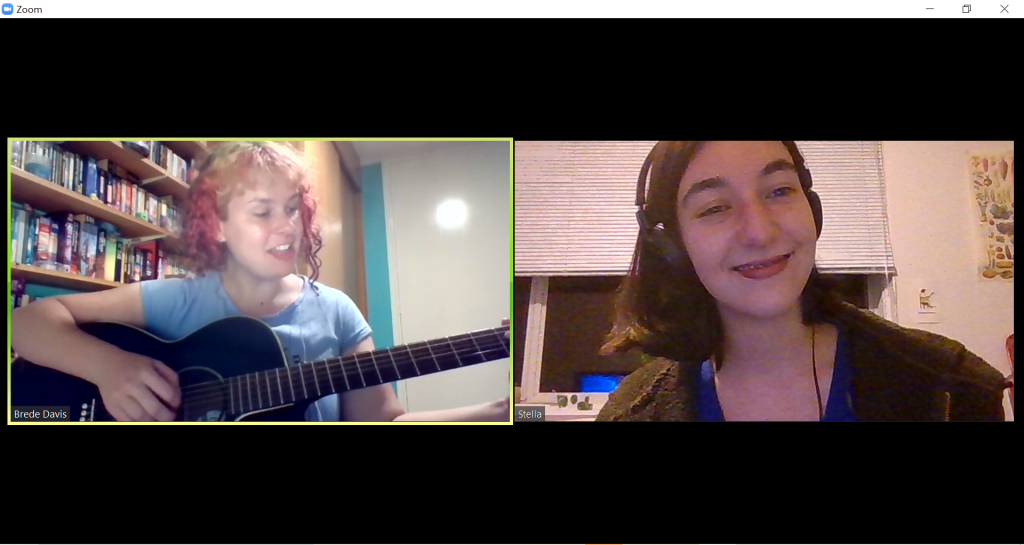
Brede and Stella sharing songs through Zoom
Assert autonomy and experience control through making opportunities for choice – choose what music you want to listen to. Or choose not to listen to music. Choose to play or not play certain pieces. Choose how you engage with music at any moment.
Feeling: Stagnant, Purposeless
Potential Needs: Mastery, Achievement, “Evidence” of progress
Musical Resources:
Play music you know well – remind yourself of skills you have.
Set yourself goals that are achievable over a short timeframe – Learn something that’s just beyond your current ability level/comfort zone. Perhaps it’s a piece that contains mostly familiar chords, but one or two that you’re unfamiliar with; or a passage that’s just a little faster than what you can do easily. This creates opportunities for you to experience the sense of achievement that follows noticeable progress.
Break your songwriting into smaller parts like choosing a genre/style, choosing instrumentation, writing chorus lyrics, choosing verse chords, creating a bassline, etc. For each part of the process, acknowledge your progress and achievement, and recognise that you have created something. You don’t need to save those feelings of accomplishment for when you’ve fully completed the song!
Brede and Stella sharing songs through Zoom
Feeling: Under-stimulated, Bored
Potential Needs: Challenge, Engagement, Novelty
Musical Resources:
Start learning a piece that really challenges you – challenge yourself to increase what you’re musically capable of. This is meant to be a generally enjoyable experience, so if you’re feeling frustrated by the difficulty level, take a break or switch to a different piece!
Learn the basics of a new instrument.
Explore extended techniques on your main instrument.
Learn a song in an unfamiliar language, or a piece from a genre or time-period you don’t specialise in.
Listen to music you haven’t heard before – expose yourself to different sounds.
Explore free music apps like Bandlab (ios and android) or Garageband (ios).
Create music from unconventional sources – for example, sampling and altering every-day sounds for an electronic composition.
Feeling: Isolated, Alone
Potential Needs: Social connection, Shared experience, Community
Note: In line with the current climate, the following suggestions are all distanced ways of sharing music and using music to connect with loved ones.
Musical Resources:
Make someone a playlist – It could be music that you think they’d enjoy, or music which reminds you of them!
Make a collaborative playlist where everyone in the group adds a few songs.
Share an artist you’ve recently discovered or ask for recommendations.
Choose an album to all listen to and then come together as a group online to discuss your favourite songs from it
Play for friends via video apps, or send someone a recording of something you’ve been working on
Join/form an online songwriting group where you share your individual songs, or write together as a group
Follow musicians you like on social media to feel more connected to them and their communities
Talk about music with friends – use music as an excuse to connect and see what you can learn about each other through music-related conversations. What music do they like/dislike and why? How is the music they listen to today different (or similar) to the music they listened to at different life stages? Why are certain songs meaningful to them? What is the last song they listened to?
Join a virtual choir
Watch a livestream – so many artists and event organisers have been running livestreams as a way of engaging in real-time with their communities. To add another dimension of shared experience here, see if any friends want to watch as well. You could have a call running while you watch, or message about the highlights.
Fever Pitch Magazine enquiries can be sent to Stella Joseph-Jarecki through stellamusicwriter.wordpress.com
Music therapist-in-training, singer-songwriter, instrumentalist
Brede Davis is a music therapy student with professional and personal experience primarily in fields of disability and mental health. She also plays and writes music as Brede Alanna Music on YouTube, Instagram, and Facebook.
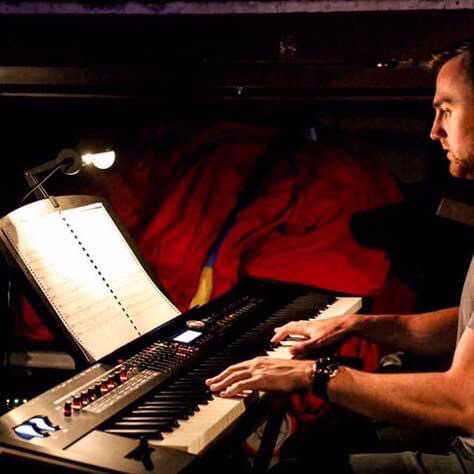
I had the chance to speak to Eric von Ahlefeldt, a music director and pianist who has worked extensively in the community music theatre scene in Geelong. Most recently, Eric was due to be assistant music director of CentreStage Geelong’s production of West Side Story, which will hopefully be staged at a later date.
When did you first begin MD’ing shows? Can you name some of the shows you have worked on?
I first began MD’ing shows in 2015, when I was twenty-two. I started out with small cabaret-style shows (small casts/minimal accompaniment, usually just piano). Eventually I started to gain a reputation for providing reliable piano accompaniment among the local theatre companies. This reputation, combined with having a positive attitude and enthusiasm for every project I was offered, meant that a number of opportunities to accompany rehearsals were coming my way. This eventually grew to gigs as an Assistant Musical Director to more accomplished MD’s, and eventually to MD’ing larger scale musicals myself.
Organisations I have MD’d or Assistant MD’d with include: GSODA Theatre Collective, CentreStage Pty Ltd, Theatre of the Damned, and GLTS. Some of the shows have included: Little Women, Joseph and the Amazing Technicolor Dreamcoat, Little Shop of Horrors. Two shows that were due to go ahead this year which have been postponed are West Side Story and Priscilla: Queen of the Desert.
What have been some show highlights over the last couple of years?
Each project brings with it unique and memorable challenges. Some have been hilarious, some have been incredibly daunting, but all have been a part of the growing experience. The biggest highlights for me have been from productions that brought the music out of the pit and on to the stage. The highlights below have been from shows that I have MD’d as well as productions where I have been in the band/orchestra.
Getting dressed in 80’s glam rock style to be part of the on-stage band for Rock of Ages.
Playing the piano onstage while playing the role of Oscar the Pianist for 42ndStreet. Depending on the scene, I would have to run back and forth from the stage and the side-stage pit.
Playing the role of the MC in Chicago from the onstage baby grand piano, which I was also playing in the orchestra. An amusing challenge of this was that I had lines to deliver while simultaneously playing the piano. I also had a small mirror next the music stand so that I could see the conductor who was positioned behind me.
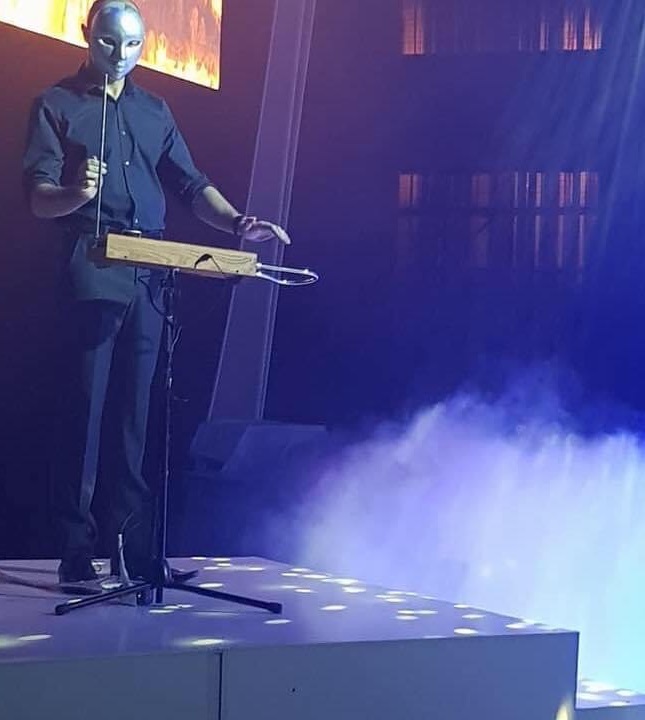
For Song Contest: The Almost Eurovision Experience, I learned to roughly play a little bit of the theremin, which I had to run onstage and play in the middle of a song for a few bars. While wearing an alien mask. You really do get the unexpected with some of these shows.
The most recent highlight was having the opportunity to conduct the full 29-piece orchestra in our final rehearsal for West Side Story. I am hoping to get the opportunity to do it again later in the year if the show successfully goes ahead once the COVID-19 situation has passed.
What are some of the biggest challenges/ learning experiences you have encountered through being in the trenches of the entire rehearsal process?
One of the biggest challenges an MD has to overcome is that of scheduling. When you are MD’ing a musical, some of the tasks you are in charge of include: putting together a cast, teaching a cast their vocal parts (this includes one-on-one work with leads as well as large harmony-heavy ensemble numbers), collaborating with the director and choreographer to ensure you are all following the same vision, rehearsing and assembling the band, and conducting for the run of the performances.
Essentially, there are too many variables in the air over the three or four month rehearsal period for an MD to not maintain a strict sense of scheduling.
Becoming a more organised person has been a real learning curve for me over the years and something I feel far more confident with now. The last thing you want to do as an MD is find yourself unprepared or backed into a corner that is difficult to dig yourself out of. Especially when the production is sticking to a strict timeframe, or when you are conducting in front of a live audience.
Any pieces of advice for aspiring Musical Directors out there, on how they can sharpen their skills and put themselves forward for opportunities?
The first piece of advice I would give to aspiring MD’s is to put yourself forward. A lot of working opportunities for the music side of community theatre, be it MD or pit musician, come from personal connection. Every MD will tell you they started as pit musicians and this is the best place to begin. The majority of musicians I call upon to play in the pit are musicians who I’ve played alongside before, who I know are capable of doing an incredible job and who I have a lot of fun playing alongside. Once your foot is in the door it becomes much easier. Personal connection is key, and no one will call upon you to be a part of the music side of a production if they don’t know your skills and your enthusiasm to join.
The next piece of advice for any MD (or pit musician) is to be a reliable one. Not showing up to a rehearsal without any explanation, is an excellent way to not get called back as it can throw many aspects behind schedule.
The next piece of advice feels like an obvious one, but it is important to know your music prior to rehearsal. If you are running an ensemble vocal rehearsal and you are not 100% sure of how the piece is meant to sound/ the context of the song in the show/who is onstage and offstage, etc, you will be setting yourself up for problems further down the track. Know. Your. Music.
In addition to this, the more intimate an understanding you have of the score, the more you will inspire your cast. The ensemble will work harder if you have a specific vision for the sound, something to work towards beyond just ‘here are your notes’.
The final piece of advice that I would give to aspiring MD’s is probably one of the most important, and that is to approach every new show/cast/production team/band with an enthusiastic and positive attitude. The personal relationship that an MD maintains with their cast and team cannot be understated, especially when it comes to the actual performances. You may have people in your cast who are taking part in their first show, or someone who has scored their first lead role.
Performing onstage is going to be quite intimidating and nerve-racking for some of your cast, and they need to see a familiar and friendly face when they look into the pit. They need to know that the MD/conductor is ‘in the trenches’ with them and has their back. The conductor should be someone they can look at and feel instantly more relaxed. I’ve always said the perfect MD should be someone who can strike the perfect balance of raising the standard of what’s expected, while simultaneously lowering the overall tension of the experience, which as I mentioned can be a daunting one for much of the cast. Community theatre is too personal-based to be making any enemies and is simply not worth it in the long run. Be friendly to each other.
What is the most rewarding thing about being the Musical Director and seeing a show come to life?
There are so many rewarding aspects to being an MD that have kept me doing it for as long as I have, the first one being my own personal musical development. Every musical brings new styles, new genres and new opportunities to implement your own personal touches to many areas of the music. Being able to see your own skills adapt, grow and fine-tune from show to show is certainly one of the most rewarding aspects.
Another element is the people you get to work with. My personal experience has shown that community theatre is one of the most caring, understanding and accepting communities of people to be around. It is so rewarding seeing friendships form, and an army of people work together towards a singular goal, to create the best production that they can.
And finally, getting to see the growth of these people throughout the rehearsal process. Whether it is one cast member’s ability to hold a harmony that they couldn’t at the beginning of rehearsals, or seeing someone who was deathly terrified in their audition go on to shine onstage, or seeing someone who doubted their own acting abilities draw a boisterous laugh or mournful sob from the audience. Seeing my castmates grow in confidence is easily one of the most rewarding aspects.
Any dream shows you’d like to tick off your bucket list?
Quite a few! Some of the shows I have wanted to tick off the bucket list for a long time include: The Phantom of the Opera, Catch Me If You Can, City of Angels, Into the Woods, The Last Five Years and The Prince of Egypt. Among many others!
What are some of your musical goals for the next few years?
My goals are really quite simple. Mainly to continue doing what I’m doing, as it’s what I enjoy doing more than anything. I want to continue working on as many different shows as possible, grow contacts with as many keen musicians as I can, and to get to work with as many theatre companies around Melbourne as possible.
Eric has been involved with amateur musical theatre in Geelong and Melbourne since 2015. His Musical Director credits include GSODA Theatre Collective’s production of Little Women: The Musical (2015) at Shenton Performing Arts Centre, CenterStage’s production of the cabaret, Nunsense (2016) and CenterStage’s Bending Broadway (2017). He also worked as the co-vocal director/rehearsal pianist for CenterStage’s production of Oklahoma! (2016). Eric has also played keys for a number of recent Geelong shows such as Lyric’s Legally Blonde: The Musical (2015), CenterStage’s Chitty Chitty Bang Bang (2017), Lyric’s Joseph and the Amazing Technicolour Dreamcoat (2017), CenterStage’s Oliver (2017), GSODA’s Heathers (2017), and most recently CenterStage’s 42nd Street (2018).
In addition to his musical theatre work, Eric was also the musical director for two recent variety shows last year; FOR GOOD: A Musical Variety Concert for the Good Friday Appeal, and GSODA Theatre Collective’s Lights Up.
In 2016 Eric completed his study at the Melbourne Conservatorium of Music majoring in classical piano performance. Outside of piano, he also enjoys playing the guitar as well as singing. Throughout the week, Eric teaches piano at Oxygen Tuition in Geelong, and through the company also teaches piano and guitar to students in primary schools around the Greater Geelong area such as Leopold Primary and St Aloysius Primary in Queenscliff. Prior to his recent study of music in Melbourne, Eric also completed a Diploma of Music at Oxygen College here in Geelong.
I wanted to write an article about how it has been helpful for me to lead from a more compassionate place with my relationship to music. I hope this is helpful for you as well – I’d love to start a conversation and hear about the ways you are adapting also!
Settling into a new rhythm
Allow yourself to grieve the postponements, cancellations, and changes to schedule
Like many of my peers, I had an intensely busy April coming up – amongst many things, I was looking forward to singing with Divisi ensemble, rehearsing Path of Miracles, singing in two St. John Passions, prepping a third year recital, working on material for opera auditions and masterclasses, studying a script, looking for work, etc etc… it’s fair to say that I felt comfortably busy and very intellectually stimulated! Naturally when everything began to be cancelled, my schedule and the schedule of my peers evaporated over the space of a few days. This was a disorientating week for everyone.
At first I didn’t let myself properly grieve the projects that were either put on hold or cancelled, nor did I allow myself to feel sad for all of the rehearsals I would have enjoyed. My conducting teacher gave me the advice that the best thing I could do was let myself be upset, rather than immediately launching into new things to study. Sometimes, the only way out is through – and the sadness needs to be allowed to run its course. So I took my calendar off of the wall and decided to scale everything back to – simply – one day at a time.
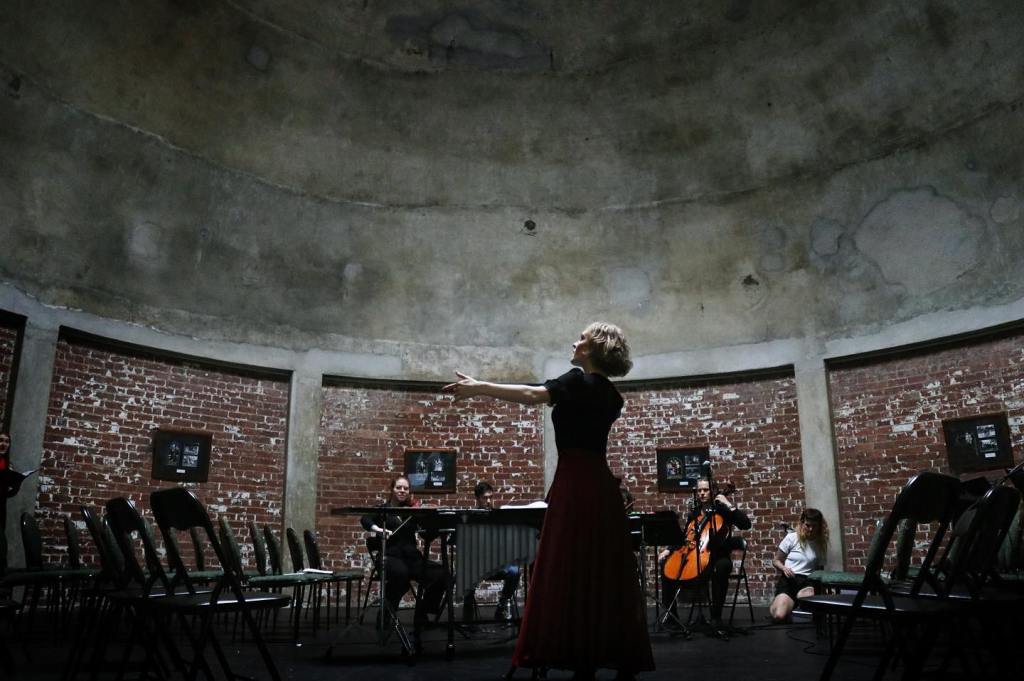
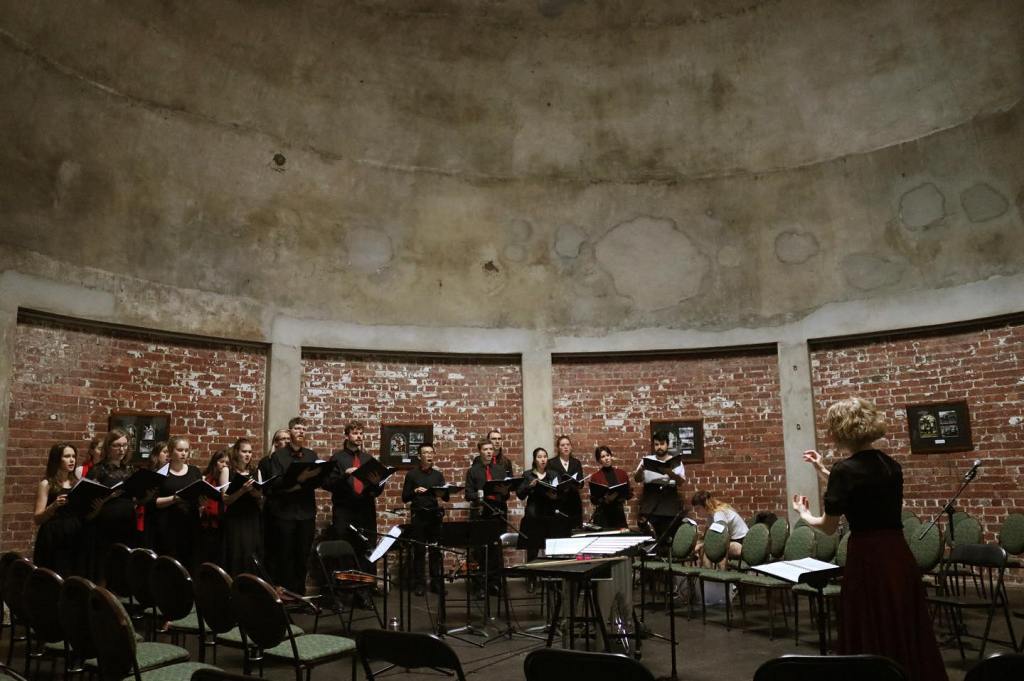
Grace in rehearsal for Candlelight VOX’s ‘Pause’ concert, November 2019.
Acceptance, and letting go of the impulse to be “productive” all of the time
Given that I’m a person who thrives when they are busy (and that the highlights of my social life centre around rehearsal banter), I found suddenly having so little human contact, and much time, astonishingly depressing. I’ve learned that the kindest way to deal with these feelings is to practice acceptance.
Given that the situation is unlikely to change for a while, there is not a lot we can do about the fact that it is going to affect us. And we are going to feel sad about it from time to time. And rather than judging that, or feeling guilty about it, or trying to be combative with it in any way, I find it’s kinder to acknowledge when I’m feeling low and not deny myself these feelings. I know that the feelings will come and go if I don’t hold onto them too tightly.
While I was processing everything in this way, I needed to stop practicing: acting like nothing had changed and that I could steamroll through wasn’t helping anything. Sometimes it’s healthy to take some time away from your instrument, and and come back to all the other parts of you. Other times, it’s good to start practicing even if you don’t feel like it – but only you (the individual!) can learn to know the difference here. The love for your instrument and motivation to practice will come back – you just have to let it fly away and circle back to you. Give yourself some time.
In rehearsal for Candlelight VOX’s ‘Pause’ concert, November 2019.
Check in with your habits, and make a new routine – but be kind
Routines, by definition, are something you create with time. So be kind if it’s taking you a little while to get into a new one. I often find that my practicing is less productive if I’m feeling off-kilter with my routines. You likely know all of this already, but just a gentle reminder – eat some food, get some fresh air if you can, do some exercise, take some time to read a book or do a jigsaw, and sleep at regular times. Check the energy you’re sending to yourself and to your friends, and bring some more self-awareness to your movement if necessary. If it’s a little unbalanced, come gently back to kindness and joy.
Look after yourself like you are a friend that you love dearly. Just start with one habit at a time. I always try to start with sleep. Also, get out of your pyjamas. Honestly, it helps.
Practicing with kindness
Lead with kindness and reconnect with joy – particularly if you’re struggling to “show up to the page”
I’ve had to come back to some habits I built when I was going through a period of uncertainty with my voice. If I’m really struggling to get started, I put my heat-pack in the microwave and flick the kettle on for some tea – and just by doing a couple of nice things I begin to associate the start of singing with kindness.
I used to also have the sound of the rain playing faintly during practice so that I could stop and focus on that if I started to get stuck in a loop of being mean to myself. For particularly foggy days, I keep a straw on my bedside table: if I can’t summon the energy to get out of bed, there’s no rule that says I can’t start warming up in bed. Sometimes the passion and the motivation won’t be around until you get started, and some days it won’t be there at all and it’s just another day in the proverbial office – and that’s okay too.
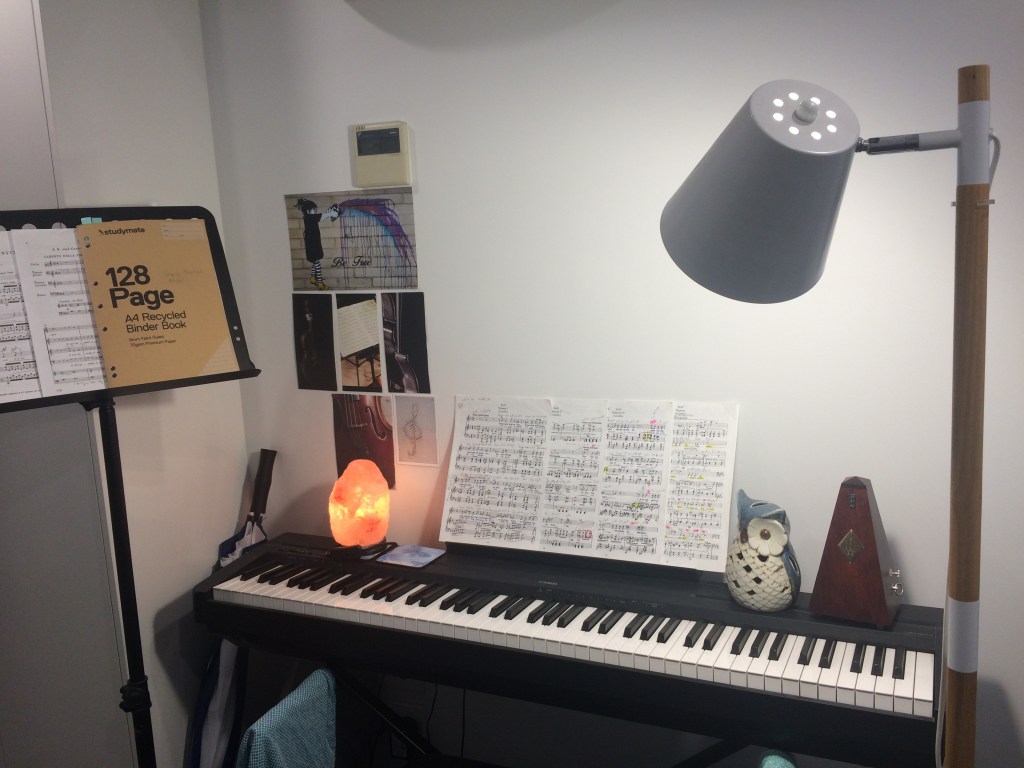
A glimpse into Grace’s personal practice space
I often start practice by lying in semi-supine and bringing my attention to my breath. This can be quite intimidating if I’m holding onto a lot of frantic energy because it means I have to address it head on. However – breathing through it gets it out of the way, so I can practice with calmness and clarity instead. Rather than letting negative thoughts become a barrier to practice, I just changed the way I practiced to anticipate them. The mind affects the body affects the voice, and so on.
It can also be good to give your joy a kickstart! What’s the rep that made you fall in love with your instrument? What music makes you go wow, I want to be able to do that!At the moment, I’ve got Britten’s Cabaret Songs and Andre Previn’s Honey and Rue on repeat. I also adore Vivaldi- that effervescent, champagne, slightly erratic feeling – and as always, anything by Wolf is just delicious to me. Pärt, Monteverdi, and Machaut also never fail to take my breath away.
Like every young, hopeful soprano, sometimes I just need to imagine what it would feel like to sing Sempre Libera or Je Veux Vivre… it really does pay to occasionally drift out of the immediate future, and daydream. It’s just as valuable to reconnect with whatever music made you fall in love with music – it doesn’t have to be classical – I loved Enya as a tiny kid and Adele as a teenager – and I still do.
Remind yourself of what normally helps your practice routine
This is like point 3, but for music practice. For me, I prefer to set my practice goals for the following day at the end of the previous day’s session – that way I still have clarity on both my ongoing goals and what small details still need work at the end of a session, and it’s easier to start with clarity the next day.
I also like to know when I’m working in the land of “building” or “playing” my instrument because each tend to engage two different patterns of thinking. I also find, both for vocal and mental fatigue – it’s more efficient to practice in twenty to thirty minute chunks, walk away, work on something else or do some silent practice, then come back and do another chunk.
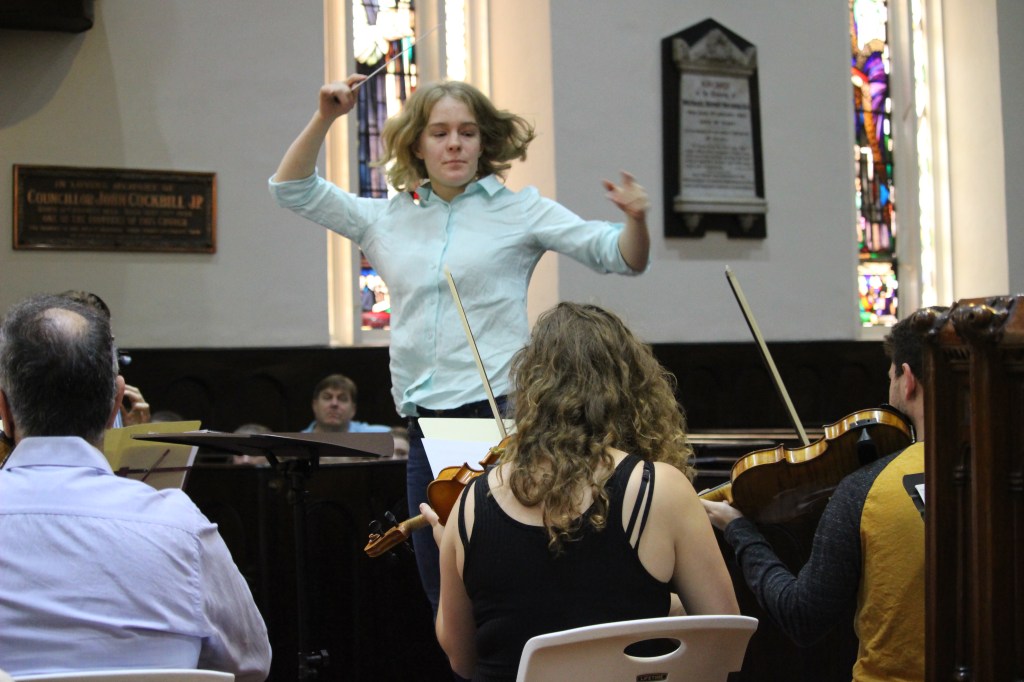
Grace participating in More Than Opera’s Summer Conducting Course, January 2020.
You’ll know what works for you – and if you’re still discovering that, there’s plenty of resources around to help you build a a routine! If anything, now is a good time to refine and experiment.
When you have the energy, engaging with other areas of practice that you might not usually have the time for
The heading pretty much sums it up. Rather than flying into a whole series of new things in one go, once your practice habits find some new equilibrium, ifit would bring you joy – find another part of your craft to tinker away at. I’ve started working on my Italian again, and am laughing at the total brain freeze that comes with beginner-level piano.
I also highly recommend using this time to read Julia Cameron’s The Artist’s Way. I’m re-reading it at the moment with two of my close friends and it is a gift of astute observation and astonishing clarity.
Fever Pitch Magazine enquiries can be sent to Stella Joseph-Jarecki through stellamusicwriter.wordpress.com
Grace Gallur is a soprano, actor, and conductor drawn to work that chronicles small people in grand narratives and champions richly detailed inner lives. Across both music and acting, she is inspired by the catharsis that is gifted to an audience when they recognise a piece of themselves in someone else’s hands. As such, Grace commits herself to the challenge of blending strong vocal technique and a high-fidelity attention to detail with truthful acting and a vulnerable honesty.
Grace is the co-founder and co-artistic director of Candlelight VOX Chamber Choir, alongside Aidan McGartland, which they formed together in order to perform 20th and 21st century works. Highlights with Candlelight VOX include: conducting Paul Mealor’s Stabat Mater for choir and string ensemble in the May 2019 Ascension program at Our Lady of Mt Carmel; and curating November 2019’s PAUSE program at the Mission to the Seafarers’ Norla Dome. In 2020, Grace is thrilled to be joining forces with Divisi Chamber Singers to tackle Joby Talbot’s masterpiece Path of Miracles.
Grace has aspirations to complete postgraduate research in the intersection between operatic singing and 20th century acting pedagogy. She looks forward to bringing her excitement and curiosity to a career in both acting and classical music.
I recently had an unexpected experience- I was genuinely inspired by a reality TV show. I’m not a TV snob, in fact I love trashy dating shows, but I don’t exactly expect my creative fire to be stoked by The Bachelor.
But that is what happened when I watched Netflix’s offering Next In Fashion. I dismissed the show at first because the title reminded me of all the things I dislike about the fashion industry- the ruthless cycle of trends, the hive mentality, an emphasis on capitalising on the latest hot new thing instead of timeless style. I was also cynical about the hosts: Tan France, the resident fashion expert from Queer Eye, and Alexa Chung, ex-model and general fashion darling. As nice as they seemed, their presence made me think the show would be an overly shiny and commercial enterprise.
But after watching the designers work together and churn out impressive creations each episode, I was reminded of some of my favourite parts of the creative process, and the act of joining forces with someone to create something.
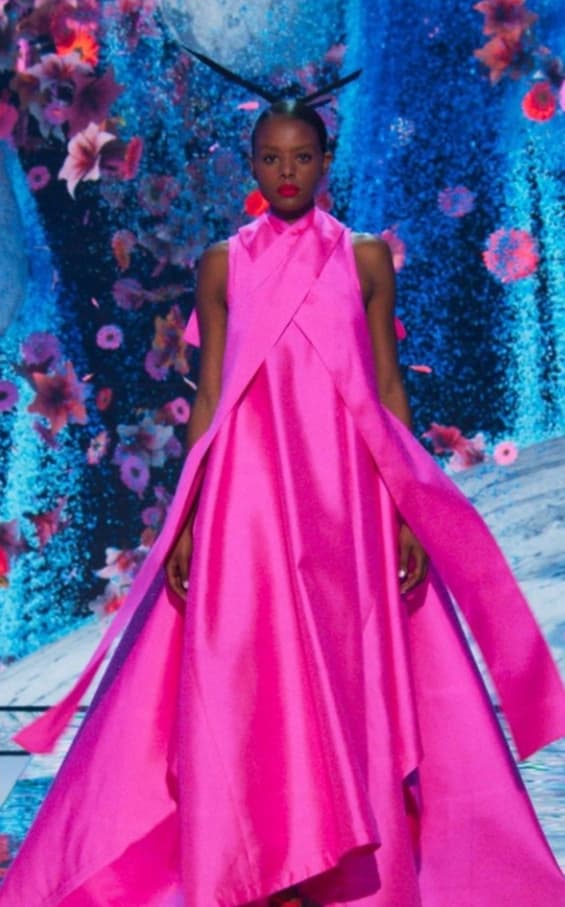
Top row, from left to right: Angel Chen, Ashton Hirota. Bottom row, left to right: Daniel Fletcher, Minju Kim.
The real strength of the show was the casting. The contestants came from all corners of the globe and had experienced varying levels of commercial success. Some owned and managed their own labels, others sold clothes out of their home studio or had only worked under the umbrella of other designer’s brands.
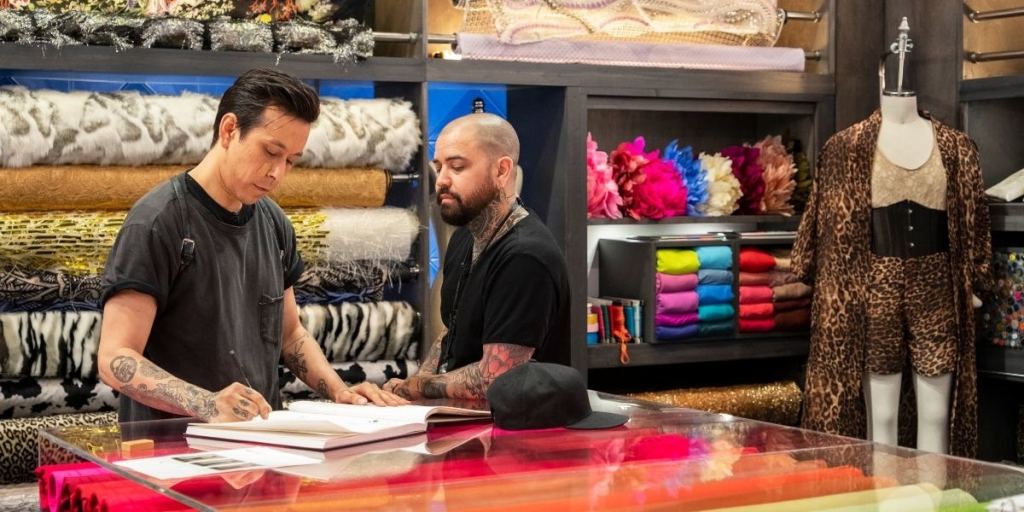
One particularly telling example of this diversity was the inclusion of contestant Angelo Cruciani, a delightfully batty and charmingly upbeat Italian designer. Angelo’s sewing skills were the weakest of all the participants, as he had gained commercial success as the creative director of his brand in Italy, and had never been forced to do the bulk of the own sewing work. Angelo was paired with Canadian designer (and garment-creator extraordinaire) Charles Lu. Angelo’s affinity for styling and developing an overall vision for collections, wonderfully balanced out Charles’ more direct approach.
Pictured: Angelo Cruciani (left) and Charles Lu (right)
It was refreshing to be reminded that there is no one right way to be creative. In the rich ecosystem of artists, we come in all shapes and sizes.
Similar to Project Runway, each episode brought a new design challenge. Each challenge contained a basic brief for two outfits made over two days. Some weeks it was denim, red carpet, military inspired-looks, or streetwear. The simplicity of the prompts meant that it was genuinely interesting to see how they were interpreted by the two-person design teams.
Pictured: Marco Morante (left) and Ashton Hirota (right)
An unforced element which stood out to me, was the camaraderie between the contestants. And not just between the designers who were on the same team. As the show progressed, the group of designers became more close-knit, sharing in the victories and challenges they experienced each week. Beyond a few minor creative disagreements between teammates, there was no sniping, bitching or sabotaging the efforts of the other teams.
This level of support and warmth only increased as the show approached its end. One moment which amazed me, occurred between the two designers who were competing against each other in the finale. One of them had come up against a logistical conundrum in incorporating a grand reveal into one of their pieces. Instead of letting them grapple with this on their own, the other designer quickly pointed out a way they could solve the problem. The incredible effect of this outfit on the catwalk arguably clinched the victory for the designer.
Lastly, as this show was a UK production, the backstories of the contestants were included but not exploited. As one could predict, many of the male designers on the show were part of the LGBTQI community and had their own unique coming-out stories; but these were incorporated as a part of their development as a designer, not juiced for all their sob-story potential. The same went for the equally diverse female designers. Imagine watching a skill-based competition where the skills and artistic viewpoints of the contestants are actually the main focus!
I found Next in Fashion an interesting mix of comforting and inspiring. It was a relief to be reminded that all artists struggle; the thing we love so passionately, often causes us stress and anxiety. I highly recommend it to all who are looking for a colourful and entertaining distraction in these troubling times.
A red-carpet design from contestants Lorena Saravia Butcher and Narresh Kukreja.
I had the chance to speak to Sam Colcheedas, a busy pianist, teacher and composer. I first heard Sam’s work late last year, when I attended New Music Sounds Good, a concert of newly composed music held at Tempo Rubato. Sam’s piece Aromatic String Quartet was played with heartfelt feeling and nuance by Invictus Quartet. You can keep up to date with Sam’s work through his website, SoundCloud, or Facebook page.
When did you decide to pursue music performance more seriously?
It seeped into my life and slowly became my passion, without me realising it at first!
When I was studying engineering, I had about twenty-five hours contact hours a week. And they say as a general rule, you need to add another twenty-five to your week for study. And I was also doing my Diploma of Music, so trying to practice as well… Things were busy! I was still teaching a couple of piano students on the weekends. All the breaks I took from engineering were music related.
I think it was two years into engineering when I realised, oh I actually like music more than this engineering stuff! And I wasn’t seeing results from all my hours of study in engineering. Music just clicked more.
Do you find there’s any cross-over between the disciplines of engineering and music?
The mathematical brain is very similar. I actually love maths, I’ve often considered going back to university to do a maths degree. I like problem solving with equations. You look for patterns in equations and you do exactly the same thing in music. I can hear all the cogs ticking over in my brain when I start looking at music I haven’t seen before.
I learn by memorising patterns and shapes, because I have synaesthesia. [A dictionary definition of synaesthesia describes it as: “the production of a sense impression relating to one sense or part of the body, by stimulation of another sense or part of the body”. The condition varies widely depending on the individual, but for example, listening to a piece of music could produce sensations of particular smells, shapes and colours]
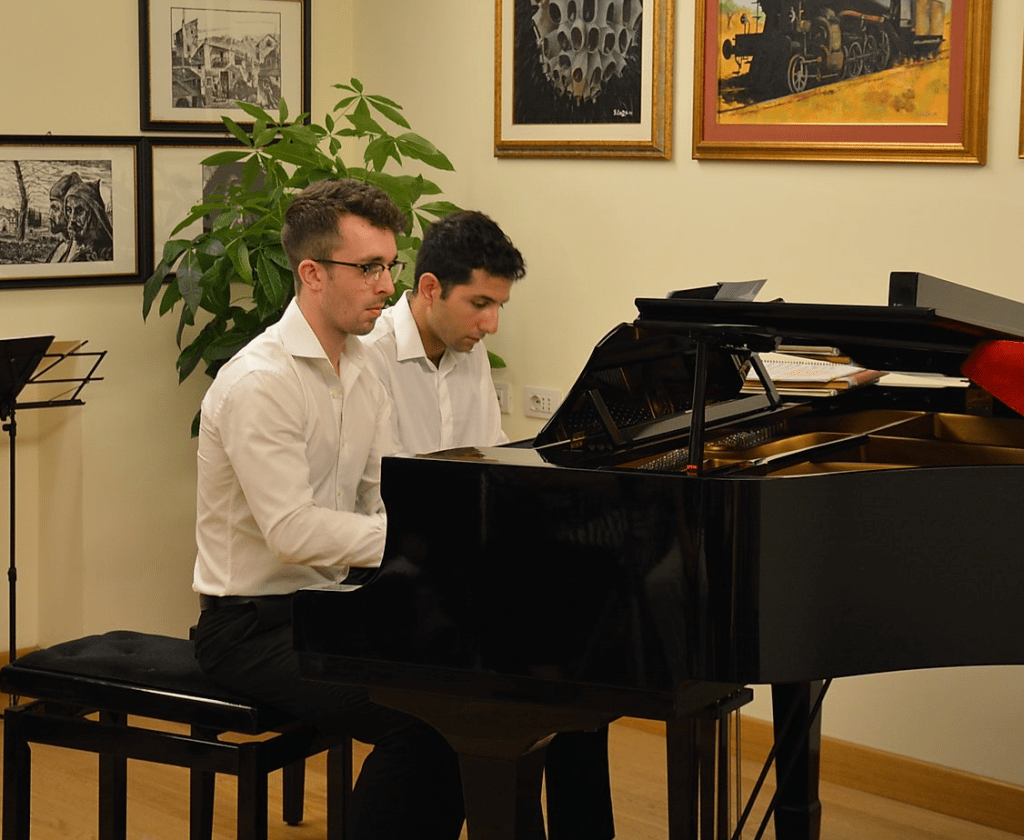
Secondo Piano concert with Edoardo Lenza. Sardegna, Italy, September 2019.
One of my last assessments in my music degree was a scales and modes test for Music Language 3. The day before the test I played through them all, and they all sounded like a particular colour. So I memorised the colours and I was sorted for the test! Synaesthesia is different for each person who has it, it’s so specific to the cross-wires in the brain of each person.
Alexander Scriabin was the same. He actually wrote pieces with the idea that when they were premiered, certain smells would be released to the audience via pipes under the seats, and colourful lights would be projected onto the stage.
So how did you begin composing music, was it a natural progression?
When I was younger, I wrote little doodles which only went for a line or two. I would have these ideas but would never finish them!
I think a lot of pianists fall into composing. A few years ago, I met a woman who was running Carlton Connect Initiative, a collaboration between University of Melbourne and a number of organisations in Carlton.
We had met up to chat about possible future projects, and she mentioned that they were putting together an exhibition called Naturophilia, about sustainability and urban design. I offered to write a piece for the exhibition and they ended up commissioning me! I spent about three or four months on it. It was a fifteen-minute work for solo piano, inspired by wind turbines. (You can listen to A Wayward Zephyr here)
I wasn’t seeking compositional projects for a while. But last year I was commissioned by them again as part of National Science Week. This time I was inspired by the Mars Rover ‘Opportunity’. The premiere was at Parliament House and it went really well! (You can listen to It’s Getting Dark here)
Premiere of It’s Getting Dark at Parliament House, August 2019.
The path to composing has been a really natural progression. I think if I started to force it too much, I wouldn’t churn out the right music. I think about it too mathematically, too systematically… I’ve started to become more comfortable with the idea of waiting for inspiration, and being patient. I’m not a patient person, at all!
When I was writing Aromatic String Quartet, I made a start on it, then left it alone for a month or two. Then I came back to it and finished it two weeks later.
When I was writing It’s Getting Dark, I hadn’t finished it yet and it was the week before it was due to be performed. I had hit a wall with it, I couldn’t figure out a way to transition between two sections of the piece.
I was away at the beach with some friends, and I randomly heard two chords in my head. There was no piano at their house so I had to write down what I thought they were! These chords just came out of thin air, and I checked them as soon as I got home… And they ended up being the perfect solution to that problem!
Who are some composers who inspire you?
I’ve always loved Rachmaninoff. I find him hard to play, because I don’t have large hands! And I don’t think I’m mature enough to properly dive into his music yet. I’ve played some of his pieces but nothing major. His style hasn’t completely ‘clicked’ with my fingers yet. You play a composer enough, your fingers start to get what’s next, you get good at predicting.
More recently, Scriabin has been a source of inspiration.
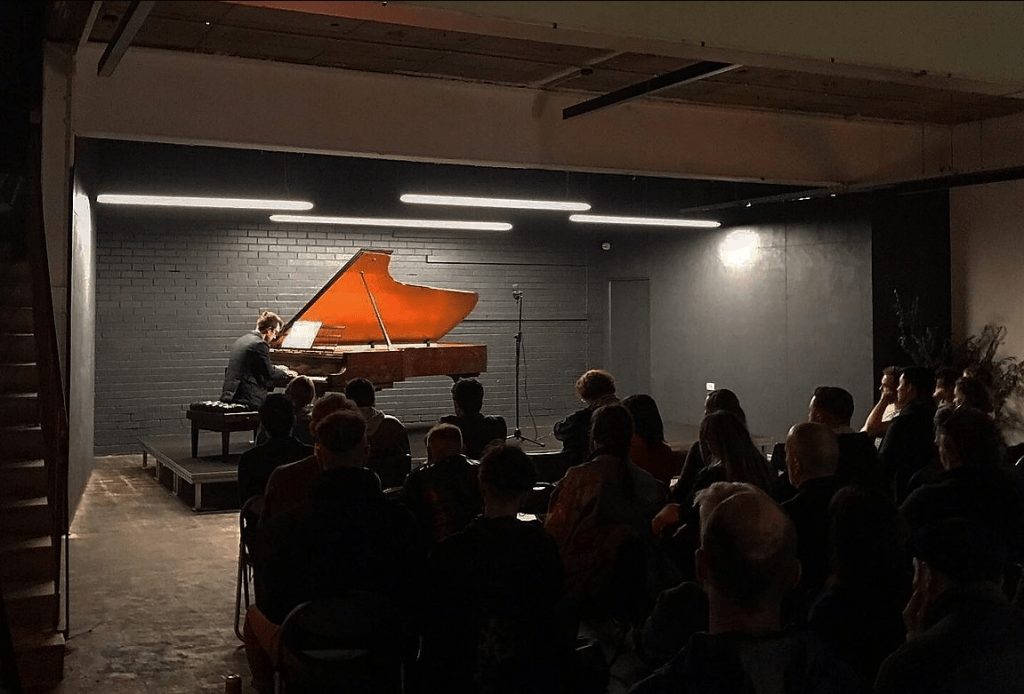
Solo piano recital at Tempo Rubato, August 2019.
Do you think the future is bright for young Australian composers, or do you think it’s a bit of an uphill battle to get new music performed?
I think it’s more of an uphill thing.
I was talking to a friend and fellow composer the other day, about how we thought Australian music has this weird taint to it, when compared to European music. It’s almost seen as ‘nice’ or ‘cute’ and not taken seriously. In Melbourne, I haven’t seen many concerts with all-Australian programs. I haven’t specifically looked, but it’s interesting that by contrast there are so many opportunities to play your music in Europe.
What does an ideal musical career look like to you?
This year I’ve done a lot of re-juggling of the pie chart. It used to be eighty percent teaching.
Now it’s more like sixty percent teaching, and a lot more playing and composing. And it would be great to do even more. I think I’ve found my niche with performing now. I love performing contemporary works and my own compositions, it’s what I feel more comfortable with. But that has also improved my performances of other works, by Beethoven or Rachmaninoff or other composers I love.
I finally understand how picky composers have to be in writing a score if they want other people to play it! I only realised that when I was writing Aromatic String Quartet for Invictus quartet. If I was performing it, I could just play it how I imagined it, but when someone else is performing your works, you have to tell them exactly what is in your head. I have a lot more respect for composers now!
I’d love to perform less selfishly as well. That’s one of my goals. To not be so self-centred and so nervous to share the music. We can definitely fall into this intrinsically inward way of thinking, as oppose to a mindset of just sharing the music.
You’re speaking my language! As a performer, you can get stressed out of your mind because you want do so well… but then you think, actually, the audience just wants to hear the music and have a nice time.
That’s where a lot of my own performance anxiety stemmed from. Thinking, me, me, me… I had an epiphany a few years ago, where I asked myself, why do I actually perform? Not for praise. But to share music I’ve discovered, music I really enjoy playing.
Initially studying Mechanical Engineering for three years at the University of Melbourne in 2014, his underlying passion was always the piano since he began learning the instrument at the age of six. He is currently resident pianist for the South Melbourne Symphony Orchestra. Sam’s first public recital was in 2009 with cellist Joanna Tidy, at the Warburton Arts Centre. Since then he has performed in and around Victoria as a soloist, orchestral pianist and chamber musician and also traveled more recently to Italy to perform alongside highly regarded Italian pianist Edoardo Lenza in a piano duo recital. He also has performed numerous times live on air for 3MBS as a soloist and an associate artist, most notably as a competitor for ‘The Talent’ series 2, 2018.
As an avid chamber musician, he works extensively with other pianists performing and recording the great piano duo repertoire such as Fauré’s Dolly Suite, Rachmaninov’s 6 Morceaux op.11 and Ravel’s Mother Goose Suite. He has performed in masterclasses with pianists such as Geoffry Saba, Professor Ian Holtham, Igor Machlak, Stephen McIntyre, Glen Riddle, to name a few. As a composer he has been commissioned organisations such as The Royal Society of Victoria, where in 2019 he premiered his solo piano work ‘It’s getting dark now’ at Parliament House Victoria for National Science Week. Other works include his climate change inspired piece ‘A wayward Zephyr’ (2017) that was commissioned by The Carlton Connect Initiative for the exhibition ‘Naturophilia’ with artist Peter Sharp. More recently, his Aromatic Fantasy for String Quartet (2019) was premiered by the Invictus Quartet and was said to be “…melodic and stunningly evocative” – FeverPitch Magazine (November, 2019).
He possesses his AMusA, DMus (MCM) and BMus (MCM) of Piano Performance at the Melbourne Conservatorium of Music where he studied under the tutelage of renowned Australian pianist, Caroline Almonte. He currently runs a busy private studio in Melbourne, composes and performs locally and internationally.

















 Fever Pitch Magazine