Mind Over Manuscript: Timothy Mallis

By Stella Joseph-Jarecki (Enquiries: stellamusicwriter.wordpress.com)

I had the chance to speak to Timothy Mallis, an emerging composer and pianist. Timothy is an experienced music teacher, offering lessons in piano, music theory and composition. If you are interested in online lessons, or would like to keep up to date with Timothy’s work, you can refer to his website, YouTube and SoundCloud.

I know it’s hard to sum up your entire sound world as a composer in a few snappy phrases, but what are some styles and genres that you are interested in?

I think the best way to answer this question is to say, I actually try to separate my influences from my style. The reason is, there are a lot of people and a lot of composers that I am inspired by, but I take it with a grain of salt. I think you can always have elements of really interesting compositional things that you are inspired by, such as the rhythm and harmony of Stravinsky, the theatricality of Britten operas… With all of those things, you can take a piece from each of them, and ask, well how can I take this interesting element and turn it into something that’s still going to be engaging for an audience.

My influences are really anything I listen to- anything from Greek folk music to English choral music. I think that question is quite tricky for most composers because the compositional processes is often very intuitive. How do you come up with a melody? It’s a very intuitive process. When you go back and ask, what were my influences in making that melody, it could be said that it’s everything that you’ve ever listened to, and now it’s become a genesis of something else.
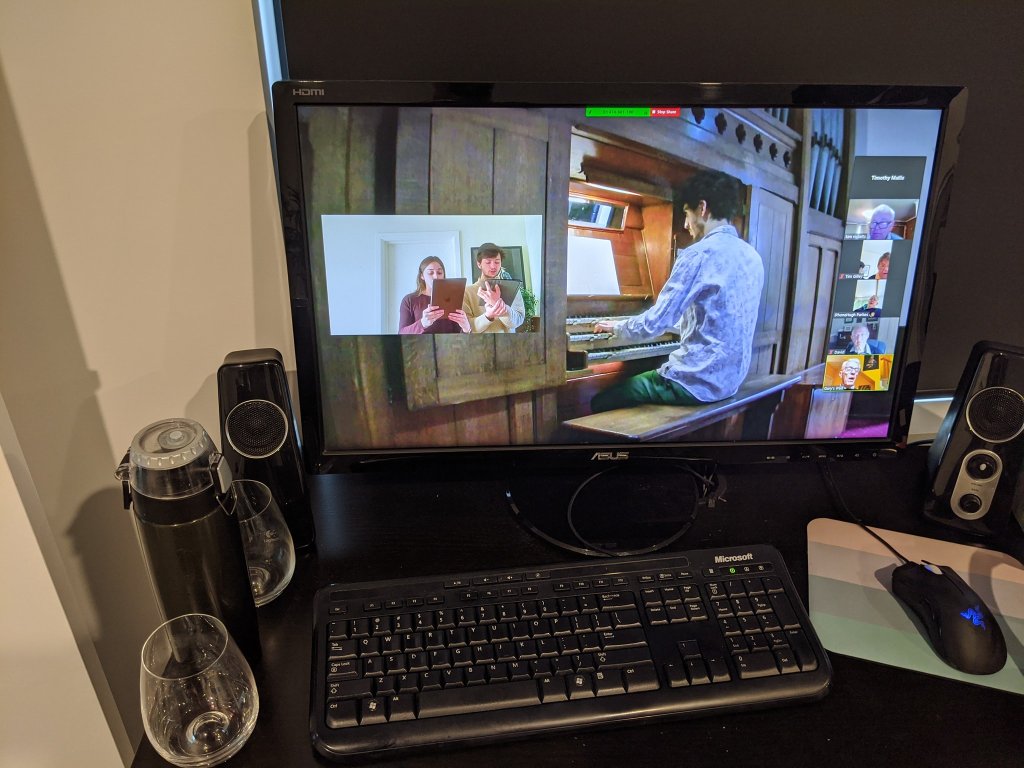
Timothy accompanying singers Jack Jordan and Eliza O’Connor, for a virtual combined St Stephen’s/St Bart’s service. April 2020.

How do you approach balancing teaching and other occupations, with putting time aside for actually writing music?

I work at the Australian Boys’ Choir with a number of different vocal ensembles and choirs. So that gives me an ‘in’ for writing compositions, I write pieces for them to perform. So my routine is really influenced by what they’re doing.

I grew up with the choir, so it has been lovely writing for the training ensembles! Recently the choir had its 80th birthday which was very exciting. I wrote a Sea Shanties medley for a combined training choir as part of the celebrations.

Apart from composing as part of my other jobs, a good tactic for motivating myself to compose, is entering competitions. There are pros and cons with competitions, because they have so much baggage associated with them. You put all the effort into creating something and there’s a competitive air around them… But that being said, it’s a really good thing because you have constraints, and they provide an opportunity for you to compose. And of course, there’s the possibility of a monetary prize or some kind of recording at the end. 

I’m actually writing something for a competition at the moment, for St Mary’s Cathedral in Sydney. As part of their Christmas events each year they premiere a newly composed choral work. We’ve been given a text by Les Murray, Animal Nativity, a very Australian Christmas themed poem which is really nice. Other constraints are the time limit, the choir’s ability, and the fact there is an organ available.

Image by Giovanni Portelli Photography. A Choral Christmas Celebration concert at St Mary’s Cathedral in Sydney, December 2019.

[At the time of interviewing, Tim was in the process of writing his entry for this competition. In the months since, he submitted his piece, and went on to win first prize! His piece was premiered at St Mary’s Cathedral in Sydney during their A Choral Christmas Celebration concert in December 2019. Although I didn’t end up hearing the work, I was certainly not surprised when I found out this good news.]

I actually find as a choral and vocal composer, it’s not the texts that are the challenge, it’s finding the texts. Finding texts that, a) work for voices and b), actually speak to you.  Of course, in addition to having permission to use it or it being out of copyright!

I will only start writing a vocal piece once I have found a text that really speaks to me. My compositional timeline is almost based on the amount of time I spend in the poetry section of bookshops or online. I was in Daylesford a few months ago and found a fantastic series of poems by C. J. Dennis, which I’d love to turn into something. As far as I know, the collection hasn’t been set to music before. That’s another thing, I think it’s important to try to find things that haven’t been set to music before, to bring to life.

Beyond browsing and book shops, which is a very sensible way to find texts, how do you go about finding texts, digging into texts, working out what you might use in your next project?

I’m a sucker for metre in poetry, so I tend to lean towards a particular kind of poetry. Australian Poetry Library is a great online resource. But I find it much more enjoyable just to walk into a bookshop or into a library.

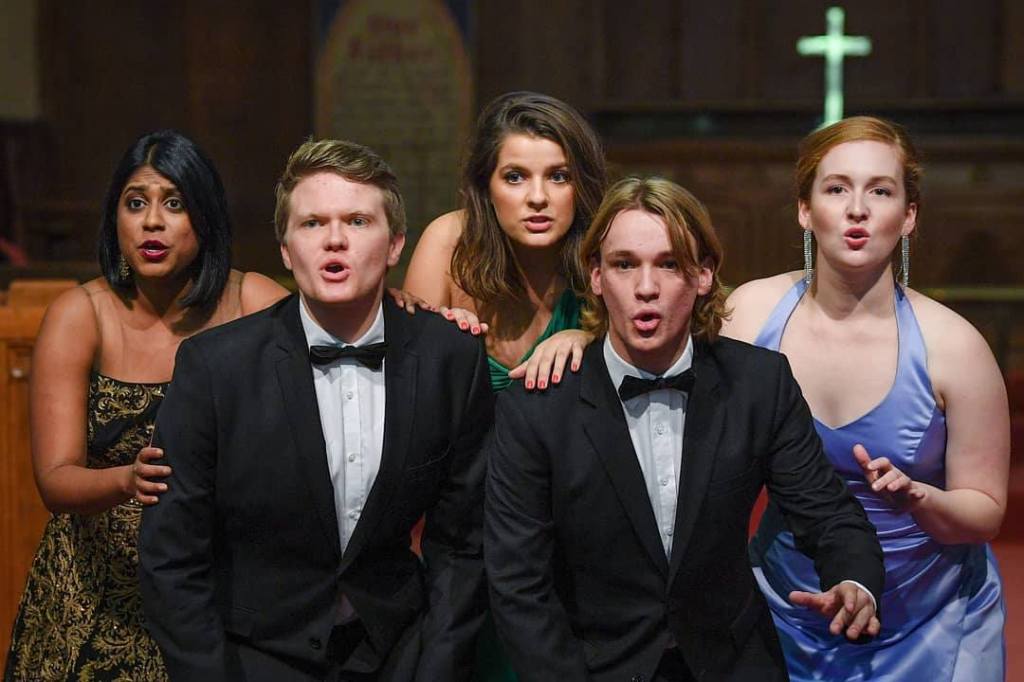
But texts can find their way to you in surprising ways. I once came across a passage from a book by Aristotle. It was such a nonsense piece, and a brilliant look at what we have achieved in the fields of biology and science! It was Aristotle trying to figure out why fish don’t sleep… It was such a bizarre piece of text. But I thought, wouldn’t it be great to take it completely out of context, so I wrote an acapella arrangement of the text for a quintet of singers.

On a more serious note, I am very aware as a white male, there is a potential for cultural insensitivity in the way you approach certain texts. So I stay conscious of that. When it comes to the collaboration side of things, I think it’s important to be open to collaborating with a wide range of people. People who may not otherwise get a chance to be heard, or may be disadvantaged in some way. To not only be open to collaboration, but to actively pursue it.

Timothy accompanying tenor Douglas Kelly in a masterclass run by Elly Ameling in Baden, Austria. 2018.

I was involved in a project organised by the Arts Centre called 5x5x5. It was a collaborative project where five composers collaborated with five poets, to create pieces that were five minutes long. We were assigned the poets. I was really fortunate to work with writer Morgan Rose, who was initially based in the States but now works in Melbourne. Her poem was quite a brutal feminist work and it was really fantastic to work with. That’s another wonderful thing that’s happening in the Australian music scene: social progression through music.

[The Arts Centre has uploaded the pieces from 5x5x5 to their website for us all to enjoy. You can listen to Tim and Morgan’s creation Soapbox here]

What do you think are the essential qualities needed to persevere as a composer? Not to necessarily churn out work constantly, but to hang in there and continue to create, while obviously having other commitments.

Composing is a lot like literary writing. It’s not really that we’ve chosen to do it. It’s something that we have to do, an outlet of some kind. I think part of what keeps us going, is that we would be lost if we didn’t write!

If you’re feeling stuck, I think it’s important to remind yourself why it’s so essential to your being.  

How do you approach having different works at different stages of development?

I was taught as a composition student that it’s better to have a few pieces in the works at the same time, ideally at different stages of the writing process, than just work solely on one piece. The reason is, you’re going to have an editing brain, a composing brain, an orchestration brain, maybe also a typesetting brain…

You can always tackle a different part of the composition process. You may be focusing on how the piece looks on the page, or just trying to come up with the initial genesis of ideas. The expansion of the ideas is usually the hardest part of the process.

I suppose time management in that sense, is making sure that you have explored each avenue of your time in your composition time. That helps a lot. That being said, I am a very deadline-oriented person and will finish about 50% of a project in the immediate lead up to the deadline. But I am aware of that, and I know that it helps me to work that way.

Photo credit: Jane Kupsch

How do you see the future of newly-composed, classically influenced works in Australia? Especially in terms of works composed by young musicians like yourself.

I think there are several elements to getting your works out there. One of them is your craft, one of them is the people you know and one of them is the marketing that you can do, how you can actually get your works performed. A lot of focus is on the first two, generally, with young composers such as myself. There’s a sense of craft because we go to university and get some training, and in the process you meet people who might want to perform your works.

But the third element, having your music heard by an audience who might not normally want to listen to it, so not your friends, is the challenge.

I think there is such a value in interdisciplinary performances, bringing together creatives from different areas. Even if a project isn’t a complete success from a craft perspective, there is always the sense that we’ve connected with a new audience who might come to another concert.

While I was still at university, I took part in a project organised by a fellow student Andrew Groch, which was a collaboration between creatives and the Ian Potter Gallery in Parkville. As part of the project, a number of us were able to perform inside the space, works which were inspired by the artworks in the gallery. The first part was more of an improvisatory installation inside the gallery, and the second part was a concert of five pieces which had been written for that specific concert. And a number of people came up to us after the performances and said that they had really enjoyed it, and would not have normally attended a concert like that.

Another good example would be the collaboration between Victorian Opera and Circus Oz, with the 2016 production of Pagliacci (pictured below).

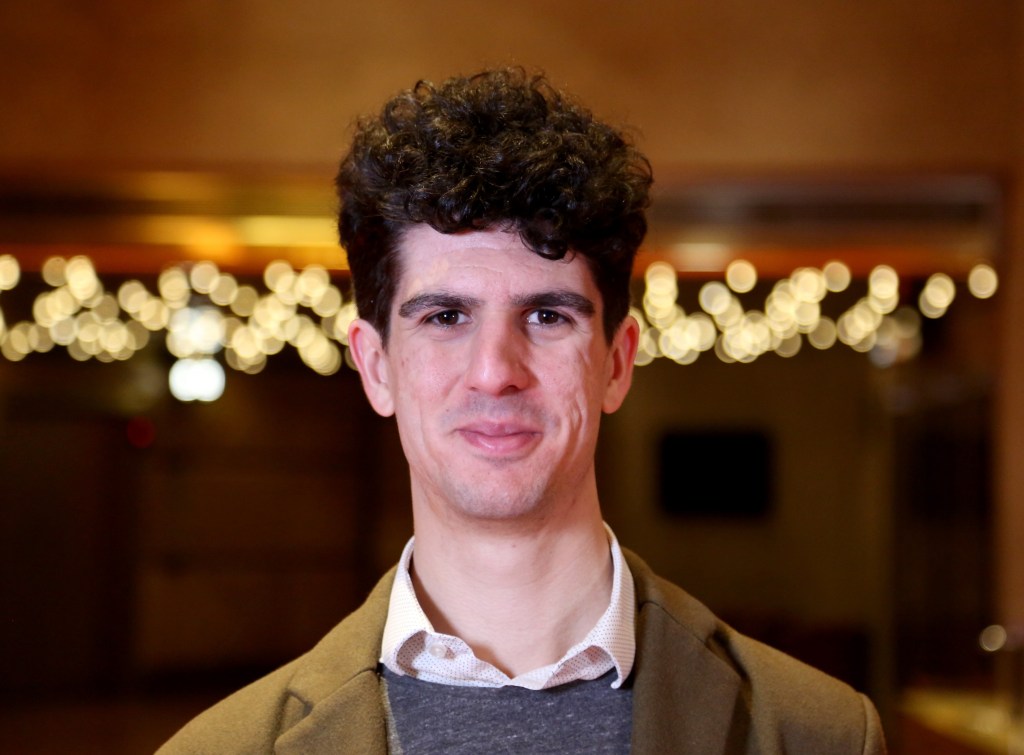
Timothy Mallis

Composer, pianist, organist

Timothy Mallis is a Melbourne-based, multi-disciplinary musician specialising in composition and piano accompaniment. Timothy is a passionate advocate for bringing new Australian compositions to life.

As a composer and graduate of the Melbourne Conservatorium of Music, Timothy has written for some of Australia’s finest choral and instrumental ensembles and is frequently commissioned for works by local artists. His music has graced the stages of the Melbourne Recital Centre and Melba Hall, and has cultivated a digital presence with more than 70,000 views on his YouTube channel. He has maintained a partnership with Melbourne-based composer Juliana Kay to create music for the award-nominated Stories from the Choir as well as educational music for Australian children’s choirs.

Timothy teaches privately from his Melbourne-based studio. As well as piano performance, he has an intimate knowledge with the most recent AMEB, VCE, and Melbourne University curricula. His students have achieved outstanding results in all fields.

HyperDynamic Studio

Alex Olijnyk (left) and Hamish Keen (right)

By Stella Joseph-Jarecki (Enquiries: stellamusicwriter.wordpress.com)

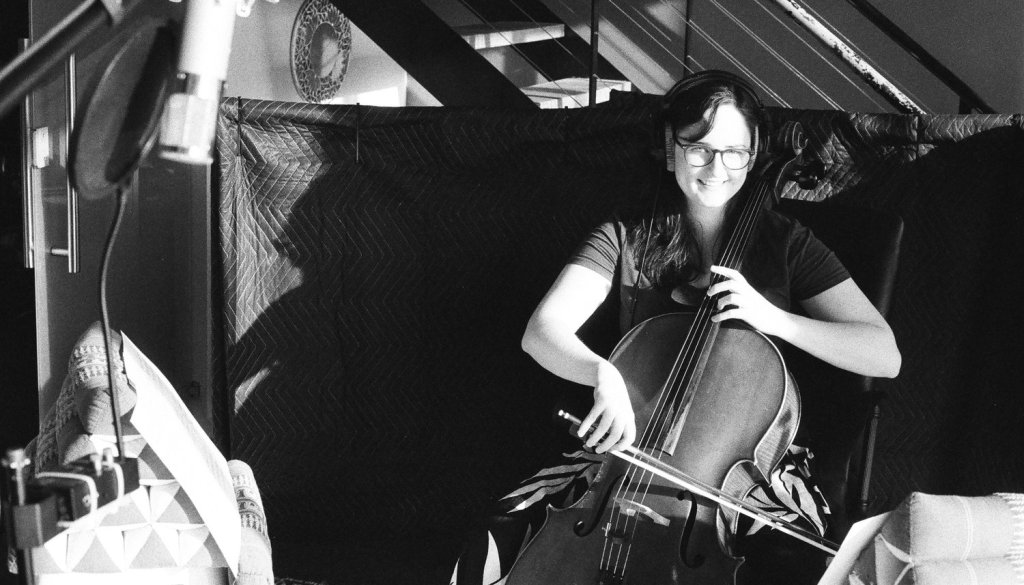
I had the chance to speak to the co-directors of HyperDynamic studio, emerging composers Alex Olijnyk and Hamish Keen. Alex and Hamish describe HyperDynamic as a ‘collaborative audio creations agency’, which can produce all the sound-related work needed in audio-visual projects, not only the score or the sound effects. Alex is a classically-trained cellist and Hamish approaches composition from a sound design background. You can keep up with HyperDynamic’s work through their website, Facebook and Instagram.

How did you two meet?

HK: We met while we were studying interactive composition at the Melbourne Conservatorium of Music, although we didn’t start working together outside of uni until the beginning of second year. I had just been commissioned to write my first orchestral film score and I had always been interested in using improvisation as a form of composition. Cello fit the bill, so I dragged Alex into the studio with the director for five hours. While the director described scenes over the talkback, we wrote and recorded the score. I guess for me this was an introduction to both working with Alex and to a new style of writing.

AO: It was similar experience for me too. I had previously only worked on documentaries, and composed mostly through notation, so this was a huge new step, in collaborating, working in an improvisatory style and composing for narrative film. When Hamish invited me onto the project I was thrilled. In the end, we both found the project very rewarding and have continued to work together since.

For those who aren’t familiar, what distinguishes an interactive composition degree?

AO: Interactive Composition, as opposed to a traditional compositional degree, is more about collaboration than anything.

HK: Yeah, it’s a really personal answer, because everyone gets something quite different from it, but at its core, it’s a degree that teaches how to respond with music. When you make a film, a theatre work or even art more generally, you’re asking a question, providing a brief. When you write music for media, it’s about helping to answer that question…

AO: Interactive Composition really teaches you to respond to a brief, or maybe even just to think about the context in which your music sits. What is the role of your composition in a project, how is it being heard, when, where etc, how can you make a more holistic experience.

HK: Context and collaboration is the key.

What prompted you both to start HyperDynamic?

HK: I can’t really think of a moment when it was decided that we would start a company.

AO: It was an idea that evolved over time as Hamish and I worked together.

HK: But there was a point when we called it HyperDynamic. We saw gaps in the way that sound for media was being created around us. We would often get projects with a disconnect between sound and vision where foresight could have made a huge difference to the film.

AO: There is so much to sound within a film that a lot of people rarely think about. Most of it’s not taught and much of it is invisible. You often don’t know precisely what it is you don’t know. We believe we can bridge those gaps.

For those reading who don’t know- what services do you offer through the studio?

HK: HyperDynamic takes care of everything that you hear in the projects we work on. At the most basic level, films have three kinds of sound: what we hear from the characters, what we hear in the world, and music that accompanies the story. Between these is a complex system of fundamental links in the chain; location recording, dialogue editing, sound design, music direction and scoring. When these links fail or don’t exist, the magic of film can disappear. At HyperDynamic, it’s our job to plan, forge and maintain these links to build beautiful sound worlds that elevate every film.

AO: On a typical project this means we’re engaged from script to screen. We listen, advise and match the people to the project, from location recordist to sound designer, composer to re-recording mixer. During the process we work hard to make sure everyone is on the same page, working towards the same goal.

HK: We advise on location, script, budget and post-production workflows as they relate to sound. We want clients to be able to work freely and creatively, inspired by ideas and the film, knowing that everything else is taken care of.

AO: This collaboration is a big part of what we do; however, we are also working composers and sound designers and we love to create. We have been the primary composers and sound designers on many of our projects.

What excites you most about sound production/composition?

HK: I’ll take sound production, though I do love to compose. For me, it’s about world building. Sound is our first and most primary sense, it can move us beyond words and it can disturb us beyond image. This primacy is so important to film. The sounds we create around an image can change everything; a bright field with terrifying music can be just as unsettling as a murder set to a nursery rhyme. This malleability, sound’s ability to play with subtext, can create truly incredible cinematic experiences. Music and sound elevate film, sure, but film also elevates music, and that’s what excites me most about producing sound and music for film. It’s amazing to be able to play a role in bringing affecting stories to life.

AO: My answer is actually be very similar to Hamish’s. Musical scores take us into the hearts and minds of the characters. They tell us about the world – when or where we are. They can reveal secrets and unveil themes. They can reinforce an emotional moment, or change it completely, or maybe even lead the entire film in a slightly different direction.

An interesting part of composing for film, is watching films without any music at all, before anything has been written. I don’t think many people would realise how strange it is, how much we rely on the music to tell us what is going on, to understand the implication of certain moments, to fill out the world itself. What I love about composing for film is being able use all these musical possibilities to tell a story and bring every moment to its full potential. I love being able to work on a narrative bigger than any one person could have created alone – a culmination of the quirks and inclinations of all the people who have worked on it. 

How do you determine the division of labour/creative direction of commissions?

AO: It differs from project to project. Sometimes I’ll take on the role of composer and Hamish will be the sound designer. Sometimes I will be the music director, and Hamish will compose. Sometimes our roles are simply to find people that fit the brief for these roles and simply make sure everyone is on task. Creatively, we often work together quite closely.

HK: It must be funny for directors to sit in the room with us when we’re composing together because we’re very open and honest – lots of agreeing, but also lots of challenging each other. The good thing is that we have very similar sensibilities when it comes to sound, music and what the project needs.

AO: When it comes to running a project from a technical standpoint, we have different roles. I’m in charge of finding, hiring and organising session musicians, while Hamish takes on the role of recording engineer and mixer etc. Musically, I will often work with theme and harmony, while Hamish works on timbre and design.

HK: Exactly! I guess I generally I take care of nitty-gritty technical work whilst Alex works more with score/notation. Where Alex grew up in orchestras, I learnt my trade staring at computer screens. We balance each other out.

For someone wanting to begin experimenting with sound mixing/ sound production, are there any beginner online courses/ particular software programs that you would recommend to start with?

HK: Sound is a very practical discipline. Often the best way to start is by choosing whatever program you can afford and just spend the time to get to know it. When I was thirteen, I downloaded Ableton LIVE and pressed all the buttons until sounds I liked came out! There are however many structured courses around to help give you a head start. If you can access a face to face class, that can be a very good way of staying motivated (structure always helps).

How do you tackle time management, with both of you having other jobs, and perhaps not always being able to predict how many hours of work a new commission will involve?

AO: At the beginning, there were a lot of late nights! We both worked during the day, and often went straight from work to the studio. The nature of working in film, is that thing itself is always changing, which means that something always has to be done. The trick is being there from the start of the project. If you are on the same page as the director, and are in constant contact, you can respond to complications much more easily that if you just come onto the project once the final cut is finished.

HK: Learning to anticipate the workload is something we have become a lot better at, but that comes with time and practice. New jobs present their own unique issues. Becoming more adaptable is a big part of meeting these demands. As we’ve grown, we’ve put systems and processes in place to help streamline the process.

Have you got any projects coming up?

HK: There are always a few things coming up and we’d love to keep it that way! We have a South Australian short film currently in pre-production and a variety of corporate and advertising work to keep us busy.

AO: We’re also in the process of mixing and mastering scores from previous projects that we will be releasing as original sound tracks, which is exciting! We also have some personal work in the pipeline.

HK: Obviously, recent developments around COVID-19 have had significant impacts across the arts sector which will delay film productions for a number of months. Once this all clears up, we look forward to things returning to normal.

AO: I think this crisis has made a lot of people realise how important film and television is to their lives. I know so many people self-isolating who rely on movies to keep them entertained throughout the day or take their minds off the news. It’s a good reminder that when this is all over, we should all to go to the cinema and support an Australian film.

Hamish Keen

Composer, sound engineer

Hamish Keen is a contemporary film composer based in Melbourne, Australia. His deeply rooted musical background sparked a journey that has taken him through cathedral choirs, orchestras, jazz, classical theory, vintage gear and every instrument family he could get his hands on.

Having scored a feature film, several short films, stage productions, installation, sound design, animations and independent work of his own, Hamish is a versatile producer and engineer skilled working with or without picture.

A specialist working from unique and improvised recorded samples, Hamish’s workflow allows him to produce everything from heart warming concerto’s to slick pop music in commercial time frames without the cost usually associated with large scale live recordings. He will soon be a graduate of the Victorian College of the Arts specialist Interactive Composition program.

Alex Olijnyk

Composer, cellist

Alex Olijnyk is a contemporary classical composer based in Melbourne, Australia. With a background in orchestral and chamber music, Alex is frequently commissioned by organisations such as Arts Centre Melbourne, New Stage, Leicester University and the University of Melbourne.

Alex specialises in multimedia/sensory works and has collaborated with extraordinary creators such as visual artist Roman Schöni and head chef of Matilda 159, Tim Young. Alex is also an experienced short film and documentary composer – films she has composed for have gone on to win prizes at festivals.

Outside of composition, Alex is a professional cellist, having played with multiple orchestras and ensembles around the world. As a cellist, she is an expert in writing for strings; however, her work is versatile, and includes everything from classical to pop, folk, and electronica.

Apollo Music society

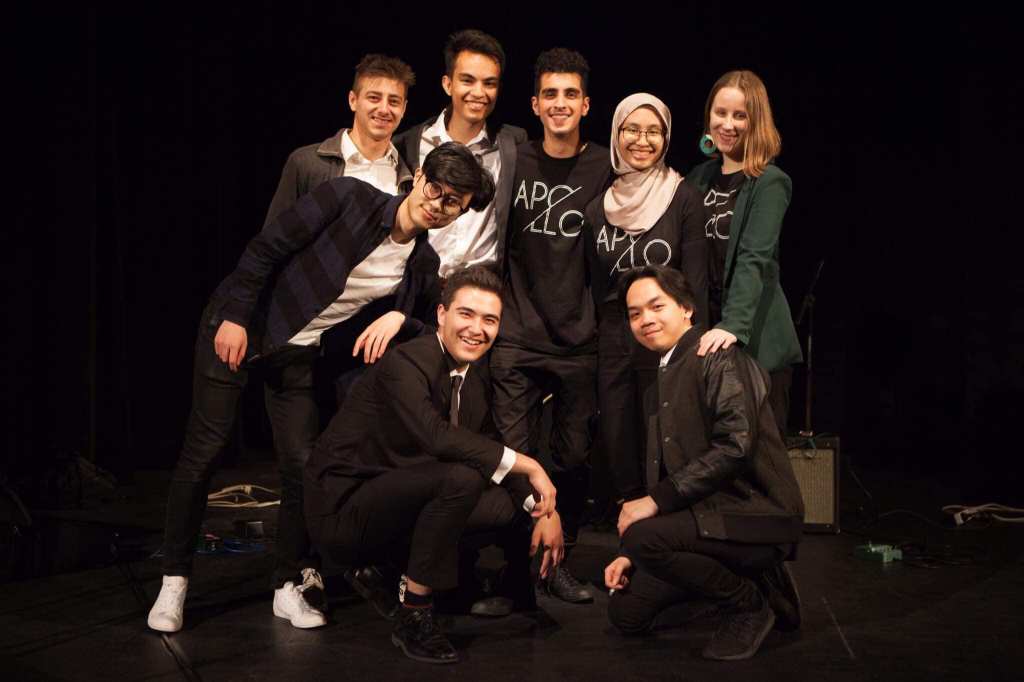
Apollo Music Society is a music society at the University of Melbourne. We have a diverse range of ensembles open for anyone of all levels of experience to join!

From our humble beginnings as a small string orchestra, Apollo has flourished to become a well-established member of the cultural life at the University of Melbourne. Our membership includes students from all faculties as well as students from other tertiary institutions.

Since our inception in 2002, we have also seen the birth and growth of several ensembles such as our acapella choir Acapollo, a fusion band, choir, and a snazzy jazz band! Why not try us out?

What do we do?

We at Apollo strive to pursue two main goals, as embodied in the namesake of our society: Apollo, the ancient Greek deity of Health and Music:

Music: Yes, as a music society we do indeed make music! We aim to unite students together in their musical interests, enhancing your university experience while also making good friends!

Health: Playing music is healthy, and using our musical talent we promote health through music, by means of (but not limited to) holding concerts and donating to health-related causes, and performing at hospitals and nursing homes.

As a society, we have a variety of social events through the year whether it’s going out for a meal or drinks after rehearsal, excursions to chocolate factories or our biannual camps!

Ciara Walsh- president of Apollo Music Society (Melbourne University)

Ciara performing at the Apollo Music Society POPS concert, October 25th 2019.

By Stella Joseph-Jarecki (Enquiries: stellamusicwriter.wordpress.com)

I had the chance to speak to Ciara Walsh, president of Apollo Music Society at Melbourne University. The Apollo Music Society is a music club with a health and charity focus. Their last event in February was a fundraising concert, with proceeds going to the Gippsland Emergency Relief Fund in the wake of the devastating Victorian bushfires.

While there are no physical events scheduled for the foreseeable future, the Apollo Music Society will be having a virtual open mic night, where members and friends can contribute pre-filmed or live-streamed videos of their musical performances. The event will be taking place via Zoom on April 17th, and submissions are due by April 15th. Event is linked here. You can learn more about the work of Apollo Music Society through their Facebook page, YouTube channel, and website.

What are you studying at Melbourne University?

I’m currently completing an arts degree, I’m a politics major. So nothing to do with music!

What prompted you to join the Apollo Music society?

The main thing I did back in high school as an extra-curricular was music. I learnt French horn from year seven, and I got a French horn for my eighteenth… It’s like, instead of a car, my parents bought me a French horn! They’re quite expensive, and I’d never had my own, only rented ones from the school. I really wanted to make use of it, and the first thing people say to do when you start uni is to join clubs. So I thought, the best thing for me to do is to join a music club, so I can do the thing I love and meet new people.

I chose Apollo Music society because of the health and charity side of it, which sets it apart from other music clubs. Also, they had a broader range of ensembles. The French horn is a bit of a niche instrument, and I didn’t just want to play in an orchestra, but other straight stage bands don’t accommodate French horns.

At the moment the society has eight ensembles running. A choir, an acapella group, two rock bands, a ‘fusion’ band, which is an adapted concert band where any instrument can join, and was the first ensemble I joined. (I’m in four now.) And rounding out the list is the jazz ensemble and strings ensemble.

I’m currently president of the committee. During my second year in the club I was voted in to the committee as performance officer. I was in charge of organising the events. At the start of semester two last year I was elected president.

So how do you manage all of your commitments at once?

I study part time. I wouldn’t be able to do this if I was studying full time. It’s a lot of work. And I have a part time job.

If I didn’t have the passion for the club, it would be a lot harder. It is a lot of work, but because I’m happy to do it, it makes it a lot easier to not put things off, and just stick to it and do it! Last semester, I was doing twelve hours of rehearsal a week, as well as committee meetings, and all of the organisational stuff that goes into it. It was taking up more of my time than study or work.

But having the balance of everything helps. I have work at a specific time, I have rehearsals at a specific time. I know there are certain tasks for the club I have to get done on a daily basis… I deal with the assessments as they come. That’s probably the worst part! Just keeping up with the university assessments. I guess I’m extremely busy, but it’s manageable.

[At the time of interviewing, Apollo Music society had recently had their end of semester POPS concert]

It’s only performance event which includes all of our ensembles. It’s the opportunity each semester for everyone to perform together, and you can invite all your family and friends and showcase what you’ve been preparing all semester. With each concert we hold, we pick a charity to dedicate all our proceeds to. We try to make it a charity that’s relevant to us, whether that’s because someone in the club has had personal experience with it, or because we think it would be relevant to a lot of our members. We’ve picked a lot of mental health charities in the past. Another example is JDRF, a charity focusing on helping young people with Type 1 diabetes, because some of our members have had experiences with that.

We also have a big bake sale. Because we need to cover the costs of holding the event, we make sure all of the proceeds from the bake sale solely go to the charity.

Are the members of the club predominantly non-music students?

Yep, the vast majority are not music students. Obviously because when you study music full time, you don’t tend to need music performance as a release in your spare time as well!

The Apollo Music society is a very inclusive club. The ensembles are only auditioned when there’s room for only one instrument of the type, like keyboard. Otherwise the groups are open to whoever wants to join. But the standard is really impressive actually.

What have been some of the most rewarding moments during your time as president of the Apollo Music society?

It has been really nice watching the other committee members grow into their roles. Before I joined this round of the committee, there was a high turnover, so a lot of people were elected who had never been part of a committee before. And a lot of those people were people I encouraged to join because I thought they would be good for it.  

The choir performing at the Apollo Music Society POPS concert, October 25th 2019.

And of course, pulling off events… it feels different when you’re in charge of things, a lot of responsibility falls on you. But it’s a really nice payoff when things when work out. Not that everything has been perfect, everything’s a learning experience. And my executive team is all fresh, none of them had ever been in an executive position before. Usually there would be one or two people on the committee who had served before.

You gain a lot of leadership skills you wouldn’t get elsewhere. And it’s such a learning experience liaising with external parties, venues, etc…

How did you begin playing French horn?

In year seven, we had a music club where you could try different instruments out, and for some reason I picked French horn! Not only did it look really cool, but the teacher was really lovely. I learnt from her during my first three years of the instrument. I owe a lot to her. It is a difficult instrument, and it does sound terrible for a while! It’s not like piano, where even if you hit the wrong notes, it’s still going to sound pretty because the tone is good. With the French horn it’s a struggle to get anywhere with sounding good and it’s hard to stay motivated…

But she was so encouraging, one of those teachers who end up really inspiring you, and you never forget them. She took her music students to see the MSO, stuff like that. Even though she left after those three years, it was enough to ground my love for the French horn and push me to continue playing throughout high school.

Apollo Music Society POPS concert, October 25th 2019.

What kind of music do you like playing on the French horn?

I love jazz. When played well, the French horn has a lovely, warm sound. Gershwin’s style of jazz is a great fit for French horn. With my ensembles, they are all student arrangements, and no one knows how to arrange for French horn, which is totally understandable, I don’t expect them to… I end up playing parts that would not normally be given to a French horn, and don’t necessarily suit the instrument. But it’s also kind of fun to do things that you wouldn’t normally do. I’ve played bass parts or guitar parts on the French horn.

But when I play at home or by music, I have a big book of Gershwin tunes which I love.  

What makes Apollo Music Society unique?

The club was started by medical students. The idea was to promote health through music and utilise the healing potential of music, for both physical and mental health. We try make sure we’re always incorporating a charity element to our events. Aside from our concerts, we also have a camp every year, where we do a trip to a nursing home and perform for the residents there.

We try to actively help other societies or groups with charity gigs, often other clubs will approach us to help them hold a charity gig. They may be a not-for-profit society but without the musical element, so we might perform at their event or help raise additional funds through a bake sale. It’s really rewarding to see music bring so much enjoyment to other people.

Most of the other music clubs on campus, don’t have the breadth of ensembles that we do. We really offer something for all kinds of music performance. Even if you can’t be in an ensemble because of other commitments, we have so many social events which all members can be a part of.

Apollo Music Society semester two POPS concert, October 25th 2019.

The ensembles are super collaborative. The fusion band, which is the bigger band, is probably the most challenging, because there are so many instruments to arrange for, and we don’t have a conductor when we perform as a concert band. Everyone is very supportive and collaborative, people jump in during rehearsals to direct different parts of the pieces. Every ensemble has its own culture. Being in a lot of them, it’s really interesting to experience the different vibes!

Voice Notes: Leah Phillips

By Stella Joseph-Jarecki

I had the chance to speak to Leah Phillips, a multi-talented creative who currently works full time for Australian Music Education Board in marketing and communications. She is also an emerging soprano who has taken part in youth artist programs such as Opera Scholars Australia and performed in productions staged by Babirra Music Theatre. Leah’s career path is a great example of the advantages of versatility in the arts industry.

When did you realize you wanted to pursue music more seriously?

Throughout high school I was part of a choir which was really well run. I’m still friends with the choral director, a lovely woman named Beryl. We hang out from time to time! The choir was more classical and provided amazing choral training. During my year eleven and twelve music subjects, I sang more contemporary repertoire, so jazz, music theatre…

When I finished year twelve, I applied for a few different degrees (not including a music degree). I began an arts degree at Monash, and started taking subjects from a whole bunch of different disciplines to see what I liked the best: Japanese, theatre studies, music electives, business subjects and marketing subjects.

After about six months I realised that music was the subject that excited and motivated me the most. So I started having one-on-one lessons with the head of vocal studies at the time, Loris Synan. And after about six months of lessons with Loris I auditioned for the Bachelor of Music degree. After finishing the undergraduate degree at Monash, I completed my Honours year at Melbourne Conservatorium of Music.

So tell me a little bit about where you’re working now, and the role that you’re currently in.

I currently work for AMEB, Australian Music Education Board, in their federal office. The federal office handles the publishing of all the syllabuses, and the requirements for the exams that the state offices then run. I’m the Marketing and Communications Officer. I started in more of an administration role and moved my way into this. I’ve been there about two years now.

I work underneath the Marketing and Sales Manager who’s based in Sydney, so we work together by correspondence. Which is an interesting relationship but it works really well for us… we’re constantly doing zoom meetings or emailing each other or on the phone.

So it’s just us, but a few months ago we hired someone to help us out two days a week with social media scheduling and that side of things. I take care of all the email communications, website communications.  

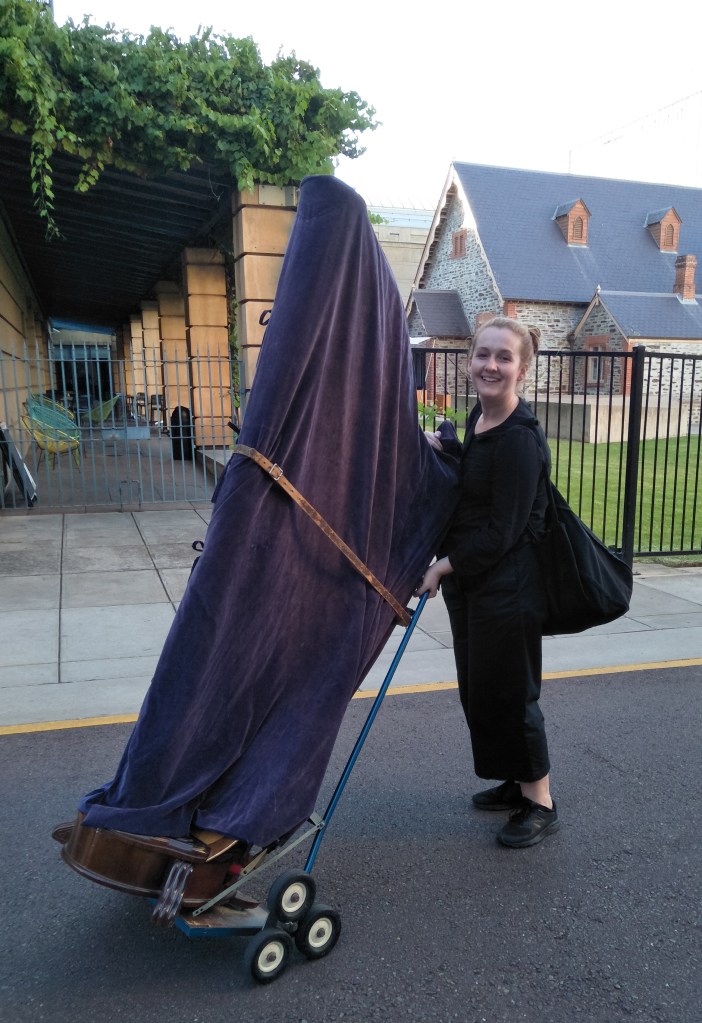
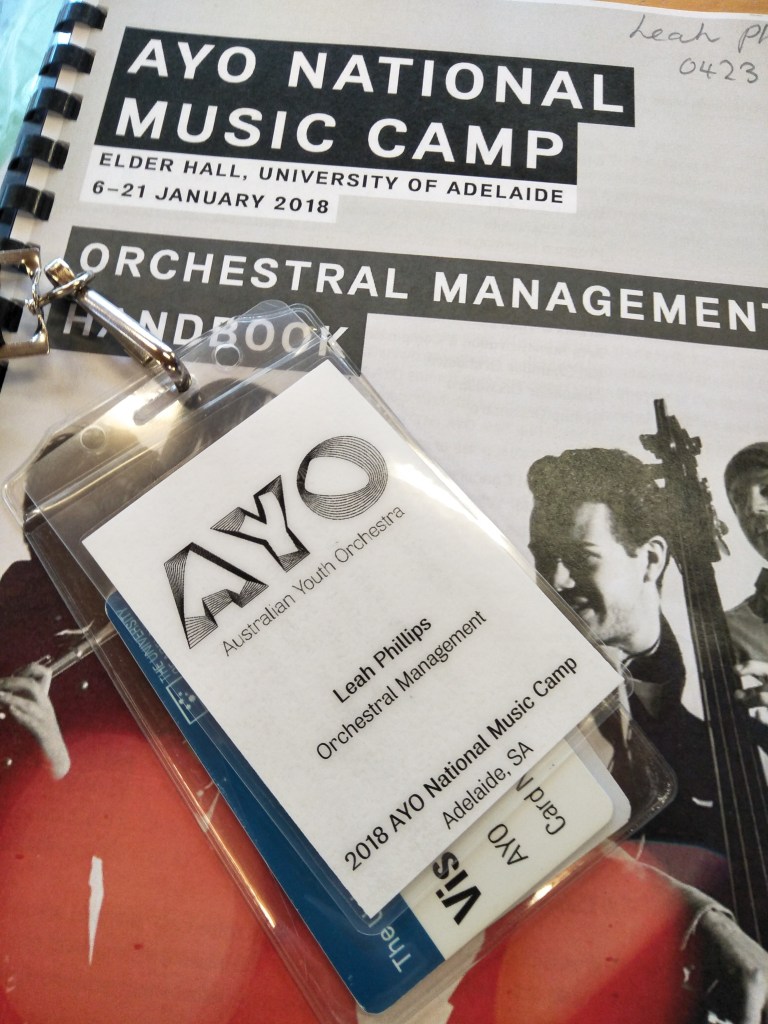
Leah transporting a harp during her time at Australian Youth Orchestra’s National Music Camp 2018. Leah took part in the orchestral management program.

AMEB has been a really good place to start working, my first role at AMEB was my first official role in arts management. I also had a really positive interview experience. AMEB recognized that I had lots of different skills, because I had done a range of marketing things, admin things, sales stuff through my retail job… Of course, as an artist you’re often forced to be resourceful and pick up lots of different employable skills.

They saw that and said, let’s just see where this goes, and it naturally evolved into the position that I am in today.

What would you say is the most rewarding aspect of your current job?

I would say it’s rewarding to see music affect people. We do events and launches and things like that, and we recently launched a theory book.

It’s a ‘how to do theory’ book, it’s not that amazing or glamorous, but the launch was attended by a big group of teachers and students. It was lovely to see how engaged the students were. They were so interested, coming up to our theory expert after the presentation, asking questions like, ‘I’m learning violin now, I’m currently at grade five, should I start learning this particular kind of theory?’ Some of them even had the theory book signed by the presenter, it was really sweet.

We run other engagement projects such as the online orchestra, where students can submit videos of themselves playing a particular song, and we combine them all. It has been really cool seeing entries come in of musicians playing their instruments in amazing locations. The human interaction side of it is really rewarding.

This is the 101st year of AMEB. So we’ve been working at modernising the reputation, slowly but surely. Getting up with the times, seeing it evolve and people taking notice of that.

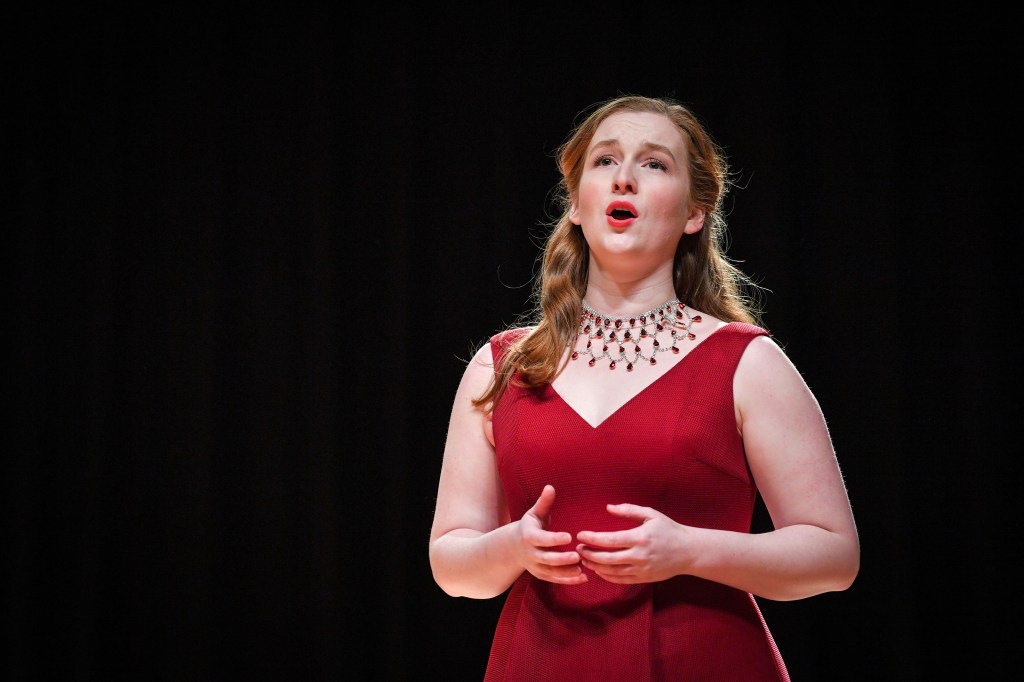
Leah performing at Opera Scholars Australia Aria concert in 2018.

How did you end up in this position? Were you casting your eye over management jobs during your Honours year, or did the opportunity suddenly pop up?

The second half of 2017, my Honours year in Music Performance, was pretty hectic! I had all my assessments, and I took part in a university show outside my subject load, along with my final Honours recital.

I did keep my eye out for jobs in the industry, and applied for a few things at that time, positions at places like the Arts Centre. I had a few volunteer projects under my belt at the time, but not so much actual experience in the industry. So it wasn’t quite enough.

Then I applied for the Arts Management program at Australian Youth Orchestra’s National Music Camp. [National Music Camp is a two-week program run by AYO, involving multiple student orchestras, and programs in composition, music journalism, sound production, and orchestral management]

It’s a fantastic program, and was the biggest launching pad ever. Everyone has gone on to do the most insane things only a few months out from the program. I applied for it at the end of 2017, did another season of retail over the Christmas period, and then went on camp at the start of 2018. It was the most intense, hot, crazy, amazing, rewarding, fun time ever.

After the camp I applied for a fellowship role at Opera Australia. As part of National Music Camp, you could apply for a handful of fellowship programs in the arts management industry. There was one offered at Musica Viva, Opera Australia, and somewhere else I believe…

So I applied for the Opera Australia one. At the same time, I was applying for jobs at other organisations, which was when I applied for the job at AMEB. I went through two rounds of interviews and then I got offered the job!

As soon as I got the job at AMEB, I found out that I had gotten the fellowship at Opera Australia as well… I ended up being able to take it, because AMEB was so flexible. Six months into my brand new job, I left for the six week fellowship at the Opera Australia office in Melbourne. I left AMEB tentatively, they had said that I was welcome to come back, and I didn’t know what the fellowship would lead to.

During the fellowship, I worked with the philanthropy and fundraising team, as well as the commercial team who work on staging the musicals. They were planning Evita when I was working there, as well as the production of West Side Story which happened a few months ago. After the fellowship ended, I was able to return to AMEB, and my role merged into more of the marketing area that I am in now!

How do you see yourself potentially combining a management-based career with elements of a performance career?

That’s the endless question isn’t it! I see it as a sliding scale. The percentages will differ throughout my life. Right now I’m obviously I’m working a lot more than I’m performing. But I need to find that happy medium for where I am.

I suppose money-wise, it’s definitely at the point where my skill set for performing is not making money. So at the moment I have to give more weight to the job.

What does an average day look like for you as part of your role at AMEB?

It varies from day to day. There’s more of an average week than an average day. I have certain EDMs (electronic direct media) that I prepare on certain days, and I’m in charge of monitoring social media.

But things come up last minute all the time. So suddenly, there are five things that are urgently needing to be done that day! We also have a particular publishing schedule so things fluctuate with that.

What excites you about opera, and what’s your favourite part of the experience of performing in shows?

I think I love opera because it combines all the art forms. You’re not only singing amazingly, but you’re acting, and there’s an orchestra under you!

It’s rewarding peeling away all the different layers and developing your character. In opera there is always something more to learn, or try differently this time, or do from a different perspective… that’s why I love it. I feel like opera is something no one can ever master, there will always be something you can improve on.

Another favourite moment is the applause moment. Especially when you can tell it’s genuine! Last year in May I did a production of Sound of Music with Babirra Music Theatre company. The audience was filled with grandmas, little kids, parents… and every night the applause went for so long, and we did a sing-a-long at the end… Everyone was crying, on stage and off. It was such a pure moment. And we had fifteen shows of that, every night!

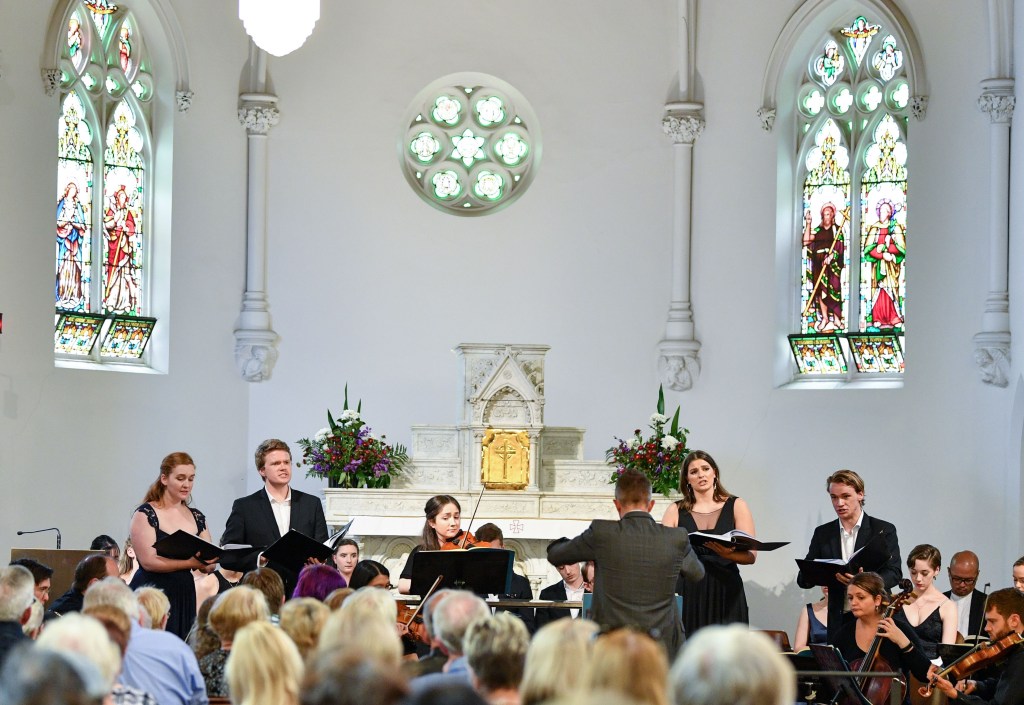
Leah performing in Opera Scholars Australia performance of Handel’s Messiah, 2018.

Meaty question- as someone working in marketing who is also a singer, do you think anything needs to change, for opera in Australia to have a lively future and engage audiences widely?

That’s a massive question! I think there is a lot of merit in collaboration. Collaborating more with ballet or with circus, having big companies and small companies working together… getting that funding spread across different places. Pulling in audiences from those specific areas of interest.

I think there have been some good examples of that recently, with the concerts held by the Melbourne Symphony Orchestra. I think the opera industry could really learn from that. It’s about breaking down all the barriers that people perceive opera to be. Let people take a photo if they want to, within reason! Have more relaxed and accessible performances… Let’s not do the same productions in period costume, with the same directions from fifty years ago, all at the same time.

I think it’s interesting when things are done a bit differently, and that’s what brings in audiences. It also gives marketers, and PR people, a different angle on the same old story! It brings people in, if they hear there’s going to be a Mozart opera performed with a children’s circus company, for example! That will help bring opera to the people.

Leah Phillips

Soprano, arts administrator

Leah Phillips is a soprano who enjoys exploring opera, musical theatre and art song repertoire both new and old. She holds a Bachelor of Music (Honours) from the University of Melbourne and a Bachelor of Music from Monash University. Leah is currently a second year scholar with Opera Scholars Australia and is the recipient of the John Dorrington scholarship. 

This year, she was cast as Sister Bernadette and ensemble in Babirra Musical Theatre’s June production of The Sound of Music. She then went onto play various ensemble roles as a Featured Singer in The Wizard of Oz with Nova Musical Theatre.

As a member of the chorus, Leah has performed in Der Fliegende Holländer (Melbourne Opera), Lohengrin (Melbourne Opera) and Un ballo in maschera (XL Arts). Cover credits include Olive Hargrave in Fly (Lyric Opera of Melbourne), Euridice in Orfeo (MCM) and Yum Yum in The Mikado (Savoy Opera). 

In 2018 Leah was chosen to participate in the AYO National Music Camp’s Orchestral Management program. Shortly after, Leah successfully applied for the AYO Fellowship position at Opera Australia. Leah is currently the Marketing and Communications Officer at the Australian Music Examinations Board.

Thoughts of a Formerly Delusional Musician

By Benjamin Peška

A note from the editor: Ben and I met during the first year of our Bachelor of Music degree. He has written an insightful article for Fever Pitch Magazine on his experiences completely rethinking his approach to music performance. Ben is currently editing the manuscript of his first novel, ‘The Cellist’. If you enjoy Ben’s writing, you can keep up to date with his work through his website, Twitter, and Instagram. – Stella Joseph-Jarecki (Enquiries: stellamusicwriter.wordpress.com)

My name is Ben, and I dropped out of the Melbourne Conservatorium of Music after less than a year. I started in 2013 and it didn’t take me long to realise I was in over my head.

Growing up, my Slavic parents pushed me to practice my cello every day. I had wanted to play in the beginning, but the novelty quickly wore off and by my teenage years I was totally over it. I would occasionally go through periods of intense motivation, usually after a stint in a youth orchestra, but mostly I spent my time mindlessly repeating pieces I already knew.

Around the age of 16, I suddenly decided that I would become a professional musician and no one could stop me. I can’t quite pinpoint what exactly set me off on this path, but it was probably a combination of Jaqueline Du Pre YouTube videos and a general reluctance to apply myself to anything else.

I worked hard to prepare myself for the audition — hours of practice each day, fending off naysayers who reminded me that there was no money in music, and finally, sweating through the audition. I never quite managed to convince my dad that I wouldn’t be out on the streets starving to death.

When I got my acceptance letter, I cried and thought all my dreams had come true. I had no idea what I was getting myself into.

I shouldn’t be so dramatic. My story is really about a naïve, over-ambitious 18 year-old who crumpled when the reality of a music education washed away his idyllic vision of being David Popper’s protégé.

I began studying, enjoying the first few weeks of theory and performance despite the intensity, but again, the novelty wore off. I had come from being the best cellist in my country-town school to the bottom of an exceptional class of first year cellists.

I very quickly realised that most of the other cellists were much better than me, and to say I felt inferior is an understatement. I struggled to come to terms with my newly discovered mediocrity and spent many hours agonising over the fact that I wasn’t good enough, when I should have spent those hours practicing.

My cello teacher questioned basic things like my left hand-position — something so utterly ingrained in a string player’s muscles that redeveloping it is like unlearning how to walk. I failed to get into the university orchestra the first semester and butchered eight-bar compositions in Music Language 1.

I was quickly losing hope in becoming a ‘successful musician’. I told myself I wasn’t a quitter, that becoming a soloist is tantamount to landing on the moon using only a pogo-stick, and that I should get used to hardship if I wanted to achieve my goal.

And I wasn’t wrong. Becoming a soloist is incredibly difficult, even for the best of us. There are plenty of virtuosic musicians out there who struggle to make a living out of nothing but solo performances. In reality, very few musicians do nothing but soloist work. The You-Tube videos we watch of Yo Yo Ma or Joshua Bell playing to sold out concert halls are small snippets of their otherwise (I’m assuming) well rounded careers. Chamber music, collaborations, and teaching are all part of the things they do.

At the time, forging a successful music career was my all-consuming goal. I was determined to become a soloist and didn’t consider any other pathway.

In hindsight, I can see that I was a perfectly capable cellist but had a completely destructive mindset. When I finally pulled the plug, I consoled myself by saying I didn’t want a musician’s lifestyle.

I transferred into a science degree and the $6,000 cello my parents had brought back from Europe gathered dust in the basement.

My fatal flaw was that I had no patience or respect for the long and slow process of development that is required to become a truly great musician. Soloists are formed after years of dedicated practice and a vast array of experience in the music industry. My assumption that I would be handed a soloist’s career on a silver platter when I finished my undergrad was pure, juvenile delusion.

Many of the world’s successful musician’s have never studied music formally because music is the type of discipline where you don’t need a qualification to take part in it. If I had really wanted to be a soloist, I would have been better served by the right cello teacher and enough stamina to practice eight hours a day.

The real value in a formal musical education is the context and breadth it covers. You learn about the history, theory and technique of music so that at the end of it you have a clearer idea of what specifically interests you about music, and where to point your attention from there.

You may simply enjoy having a deeper knowledge of the music you play, and decide to enter a career completely unrelated to music.

But what we shouldn’t do, and something that is all too common among young musicians (exhibit A = Benjamin Peska), is to entertain the idea that music school is all you need to be ‘successful’ musician. Music school is the beginning of a musical career, the bare minimum in a thoughtful approach to music. Even if you stumble to finish line, feeling like you’ve achieved nothing, the knowledge and experience you have acquired is invaluable. Since leaving the Conservatorium, I have uncovered my passion for ethnomusicology, which coincidentally is one of the Majors available at the Con. Had I started my music degree with a healthier mindset, and stuck through the inevitable hardships, I would have most likely discovered my love for ethnomusicology and turned my attentions in that direction. My delusions prevented me from extracting the true value from my musical education.

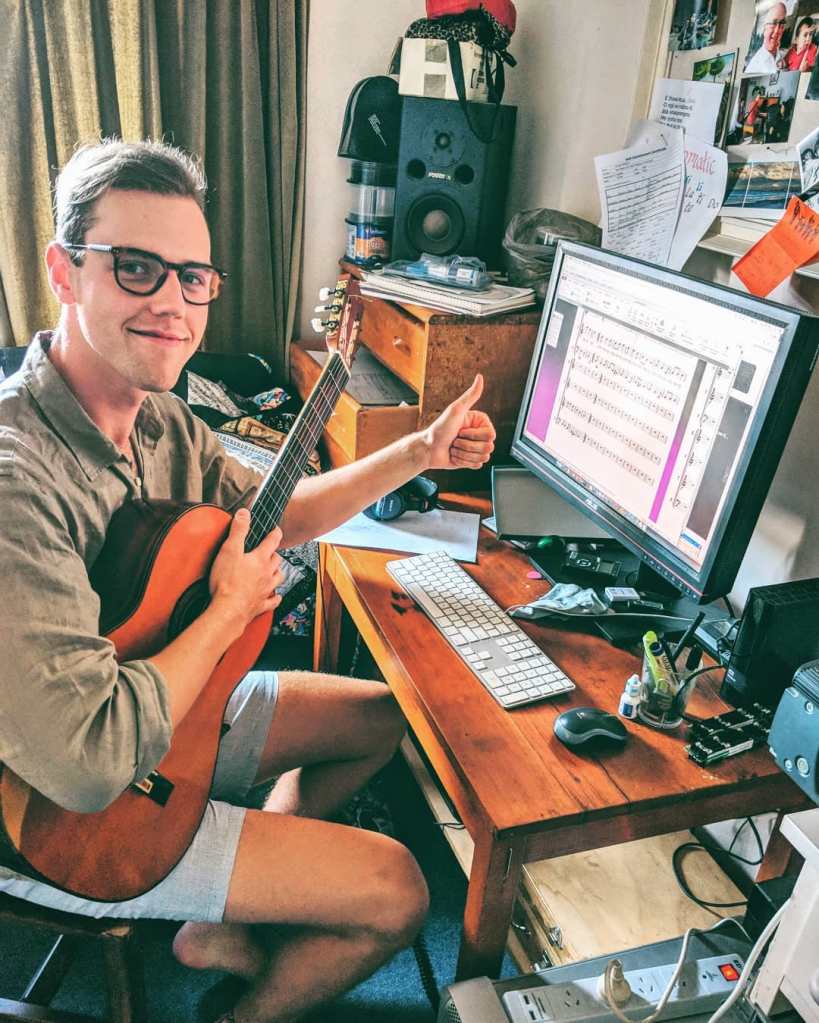
Here’s a pretty cool story from my New Zealand trip: I was staying at an Airbnb in Christchurch with a lady who happened to be a musician and choir leader. We got talking and I told her about the music I do and the Slovak community in Melbourne. The next day she knocked on my door and asked if there are any Slovak songs which would sound nice sung by a 4 part choir. I racked my brain and settled on very well known song called “Na Kráľovej holi” which is perfect for multiple harmonies. She asked if I had the music, which I didn’t, so here’s a picture of me writing it out for her. She promised to send me a video of her choir singing it once they had rehearsed it. The thought of a community choir singing a Slovak song in Christchurch, New Zealand blows my mind!

A few years on from abandoning my music school and I have (mostly) cured myself of my sickness. I rediscovered my love for music, after years of resenting it, and pinpointed exactly what it is about it that excites me: playing with other musicians. With this knowledge, I realise why it was so painful to lock myself in a room to practice for hours on end.

Today, I play more music than I ever have before. I play accordion in a folk band with some friends, teach cello and guitar to a handful of students, and help organise productions and performances at the Slovak Social Club. But one of my all-time favourite things to do is to play Slovak music with my brother at parties. This intimate setting, where people yell out their favourite songs and my brother and I try and catch the key that the tipsy singer has started in, is where I feel music most speaks to me.

I feel connected to my ancestors through the lyrics which hint at what they struggled and triumphed with, and playing without sheet music allows me to immerse myself more deeply in the music and the magic of improvising with another musician. All the while, I get to experience this while in the company of my closest friends and family.

My reasons for playing music have changed vastly over the past five years. Where it used to be a source of intense anxiety and stress, it is now one of my life’s serene pleasures. It took a lot of pain and a major mindset shift, but being clear about why I play music is undoubtedly the most important question I ever answered for myself.