In conversation with… Chris Watson, musical director of Melbourne’s Trinity Choir

By Stella Joseph-Jarecki (Enquiries: stellamusicwriter.wordpress.com)

Recently I had the chance to speak to Chris Watson, musical director of Trinity Choir at Trinity College, Melbourne University. Chris is an accomplished singer originally from England, who has had a long career singing with renowned chamber groups such as Tenebrae and the Tallis Singers. Trinity Choir is a mixed voice college choir modeled on similar ensembles from Cambridge and Oxford. I was particularly interested in asking Chris how choirs steeped in history such as Trinity are bringing their music making into the 21st century.

Trinity’s latest CD Land of Dreams was named Limelight Magazine’s Recording of the Month for October 2019. You can read the review here

In January 2020, the choir will be embarking on an American tour, in collaboration with a number of American college choirs.

If you are intrigued by what you read below, auditions are now open for Trinity’s 2020 season (starting in March). In order to be eligible you must be studying at a university in Melbourne. Choral scholars receive an annual stipend of $4500, and participate in two rehearsals and two services a week. You can find out more about the program here and apply for an audition here

You’ve been musical director for Trinity Choir since 2017, after previously being based in the UK. Do you find that traditional church choirs like Trinity are viewed in a different way in Australia than in the UK?  

One of my biggest challenges is recruiting, and fighting against the perception that singing in choirs isn’t good for you. Trying to encourage people to see it as an important pathway, not necessarily into the musical world, but into any connection with the arts, through the experience you get as a performer. Trinity Choir has some quite illustrious alumni, Siobhan Stagg being the most famous.

One thing that I’ve noticed, I get told off occasionally for sounding critical and I don’t mean to, is that there isn’t a tradition so much here of sight reading. And all the core ensemble skills that are required to do the kind of stuff that we do.

I find people sometimes talk about choirs in the way they wouldn’t talk about string quartet, for example. You wouldn’t find a violinist saying things about small string ensembles that some singing teachers say about choirs. So that’s been a bit of a fight.

It’s interesting to note that in the world which I’ve come from, if you’re an undergraduate at university, singing in the college choir like Trinity, you wouldn’t be studying music. You might be studying music as an academic subject, but you wouldn’t be studying voice at a Conservatorium until postgrad. Whereas here, you’re doing both at the same time at the age of eighteen. So a lot of them get knackered! And that’s one of the differences I’ve started to notice.

What would you say to someone who doesn’t know as much about these college choirs and how they work? What do they offer in terms of a program for young singers?

The reason these choirs exist is to provide the backdrop to worship in a college chapel. They’re modeled on the Oxford and Cambridge model, where the choirs accompany the church services. The more famous ones still have regular services.

A by-product of providing the backdrop for services is that we get through a huge amount of music. We do two services a week, all together that’s about twelve different pieces of music a week, on two rehearsals. So you have to hit the ground running! It means you might not necessarily refine things as well as you would if you were doing a concert.

Our concert programs tend to be sacred music, and when I’m programming the services my primary purpose is to find something that’s liturgically appropriate or features a text from one of the bible readings. But I’ll also have a mind towards the concert program for that year. We tend to do two Masses a year… This year we sang the Vaughan Williams Mass in G Minor.

Next year I’m going to program Hubert Parry’s Songs of Farewell. There are six of them so you can put them down as anthems. When we learned Ross Edwards Mass of Dreaming for the Land of Dreams CD this year, we learned it gradually movement by movement. We performed little bits of it in services and gradually put it all together. We also did the Aro Pärt Passio this year.

We tend to do an international tour every two years. And in the off year, we do a domestic trip and try to do concerts locally as well.

Are the local concerts organised by the college or by you as the leader of the choir?

I organise the additional concerts. We also get invitations occasionally. We were invited to sing at the Peninsula Summer Music Festival this year. But when the directorship of a choir changes, it takes a little while for the reputation to build back up again.

Next year we have a couple of joint concerts planned, one with a choir from Sydney. We also have plans to work together with the Conservatorium and do some performances with the baroque string ensembles. We’re singing with Eric Whitacre when he comes to Monash University, and we’re doing another collaboration with The Song Company. And potentially we have an exciting recording project in the works…

Because of our commitment to singing the church services, and because the students are obviously studying, there’s a limit to how much we can fit into a year’s season.

What are your thoughts on the criticism I’ve often heard from singing teachers, that singing in choirs like Trinity which demand quite a lot of your time, can be harmful to your developing vocal technique as a soloist. (I’ve always taken that with a grain of salt, you obviously don’t want to burn out with too much on your plate, but surely as long as you are singing with your support switched on and not mindlessly draining yourself, choirs can be fantastic)

I would counter, that choirs like Trinity provide an unparalleled music education for eighteen year olds, and as long as they’re being encouraged to sing healthily… I certainly encourage my singers to sing healthily, I know that a lot of organist conductors don’t do that. I’m not one of those, I’m a singer conductor.

After a few years of working on your musicianship skills, you can go on to study voice if you want to be a solo singer. I would put it that way round. And that extends to me, I mean the fact that I am fifty and my voice is still healthy, after singing in the Tallis Scholars for twenty years, proves it’s quite possible to do both. You can sing healthily.

In terms of what I ask the choristers: I try never to use the word blend. I think a choir should be a sum of its parts. I think an engaging sound comes from everyone singing properly. If one person is singing three times as loud as everyone, it’s not going to work! But I ask, particularly the sopranos and altos, to match volume and vowel sound.

I recently heard one of the singers say, ‘I don’t think I can be in Trinity next year as my solo voice is becoming too big.’ And I didn’t say anything at first, but about three weeks later I said, ‘Come on, there’s no such thing as a ‘solo’ voice and an ‘ensemble’ voice’. I mean, that’s not entirely true, but certainly in the context of these young developing voices. I just want them to sing!

I’m not going to force the choir to make a sound that they cannot make. I don’t want them to feel like they have to hold back.

You mentioned that you are recruiting for next year?

Yes we are, for starting in March 2020. We’re particularly interested in hearing from sopranos! And on the topic of auditions, and what I said earlier about sight-singing in Australia- it’s no one’s fault, it’s that students haven’t been taught. It’s to do with how you’ve grown up and the pressures you’re under, and the kind of repertoire you’ve sung.

But I would argue that the benefits to the brain have become quite clear in studies. There are so many reports about the benefits of reading music, particularly about sight reading. I don’t there’s an excuse for not doing it! You wouldn’t teach a language without teaching reading, and music is a language.

In terms of auditions and sight-singing music, I don’t expect people to get it right the first time. I’m looking for someone who can notice where they went wrong, and to get it right by the third time. I supply all the music for auditions in advance, so it’s up to them if they want to spend a bit of time learning it.

The flipside of being a singer who relies totally on their sight-singing skills, is the interpretation of the music is at risk of being more shallow. But it does mean that when you have a tight time-frame in rehearsals, you can jump straight into the music making and not spend time learning the notes.

So how much freedom do you have in choosing repertoire?

I have complete freedom in choosing pieces, but obviously there are certain parameters. Selection is mostly determined by the text. I would actually call myself a bit of a liturgy geek! Some texts can be sung everyday and some are seasonal, like Lent. Once I know what text we need, I also look at difficulty of the pieces. So if there’s a really tricky piece, I also try to program some simpler ones.

Do you enjoy finding repertoire that isn’t as commonly performed?

I like a little bit of everything! I try to commission new works every year. In 2017 we commissioned a piece from David Bednall, who is an English composer in the Howells/ Walton tradition. His piece was as if Kenneth Leighton, Herbert Howells and William Walton came to Australia and had a love child…

Trinity Chapel exterior. Photo credit: Stella Joseph-Jarecki

Last year I commissioned Alice Chance, a young composer based in Sydney. Dan Riley is a member of the choir who also writes a lot of music for us. This year we commissioned Brooke Shelley, she’s also based in Sydney. Next year we’re commissioning an American composer to tie in with the American tour. In 2021 we will be performing a piece by Sarah Thompson. And in the meantime, anyone who wants to send me a piece, we’re always looking to perform new works!

I don’t want to sound evangelical, but as a recent immigrant, I really like being in Australia and I think it’s important that we promote Australian music. Every CD I’ve done with Trinity has featured contemporary Australian music alongside other music. I want to program contemporary Australian music against the best music of other genres.

I hate the word vision, but what would you love to see Trinity choir do in the next few years?

One of the sticking points is the fact that we are a church choir. People don’t want to go to church anymore. It’s trying to persuade people to come to this particular liturgy, which just involves sitting quietly for half an hour with their eyes closed listening to beautiful worlds and music. A kind of meditation, really.  That’s not to downplay the religious side of it, but I think you can get what you want out of it.

A lot of people avoid it because they think they won’t get anything from it. But I think these liturgies have a lot to offer everyone. They’re increasingly popular in the UK, some people describe it as a sort of ‘mind yoga’. I know a lot of atheists who go to Evansong!

Stained glass windows in Trinity College interior. Photo credit: Stella Joseph-Jarecki

Stephen Hough is a pianist who wrote a lovely short article about Evensong, about how it how it affects him… [I have copied Stephen Hough’s paragraph below]

“Evensong hangs on the wall of English life like an old, familiar cloak passed through the generations. Rich with prayer and scripture, it is nevertheless totally non-threatening. It is a service into which all can stumble without censure—a rambling old house where everyone can find some corner to sit and think, to listen with half-attention, trailing a few absent-minded fingers of faith or doubt in its passing stream. Most religious celebrations gather us around a table of some sort. They hand us a book, or a plate, or speak a word of demanding response. They want to ‘touch’ us. Choral Evensong is a liturgical expression of Christ’s Nolle me tangere – ‘Do not touch me. I have not yet ascended to my Father’ (St. John 20:17). It reminds us that thresholds can be powerful places of contemplation; and that leaving someone alone with their thoughts is not always denying them hospitality or welcome.”

One of the things I would love, is for people to see what we do as an approachable thing that anyone can come and access. The chapel’s open. We are there for the community, but we are there for everyone. No one’s going to try and convert you! It can be a friendly place. I mean, you can leave thinking ‘God is doesn’t exist, but that was a nice tune and those words were quite pretty!’

And the other thing I think is just to encourage the idea that high-quality choral singing is a good thing. And idea that sight singing and all the skills required are actually valuable skills, not just for music making but for language skills, mathematics, any of those things…

It would be lovely if there was a bit more rigorous discipline in music learning. Particularly, if people could start taking choirs more seriously, and stop thinking that it’s just something that failed soloists are doing. Not to dismiss them as being damaging to the voice. They can be a fantastic, healthy musical environment for young singers!

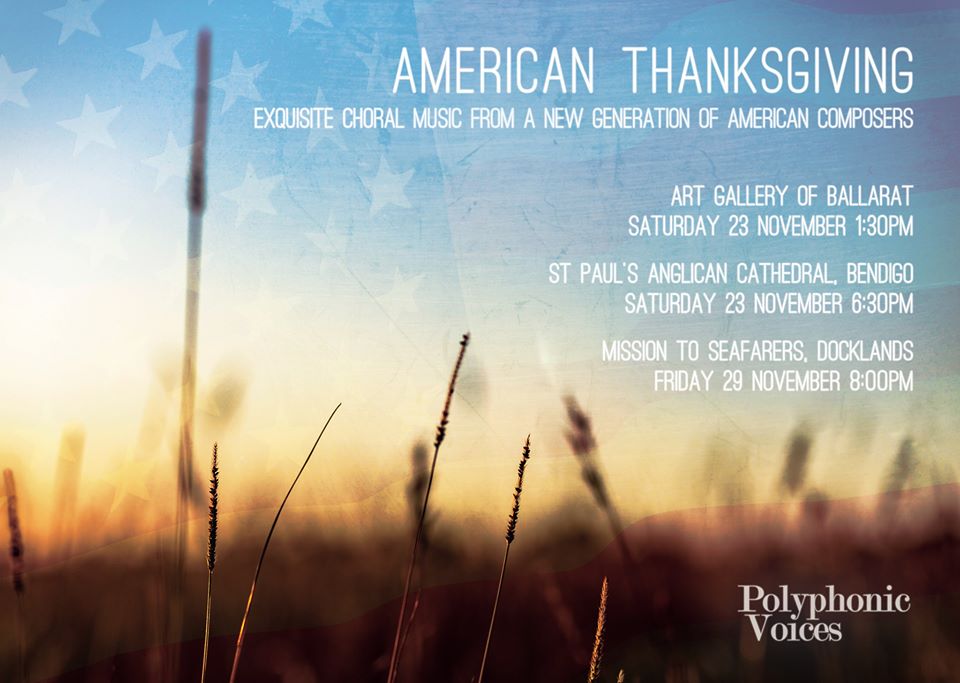
American Thanksgiving: Polyphonic Voices

By Stella Joseph-Jarecki (Enquries: stellamusicwriter.wordpress.com)

Keep up to date with Polyphonic Voices through their website here, their Facebook page here, their Instagram here. Details of their 2020 season will be released early in the new year.

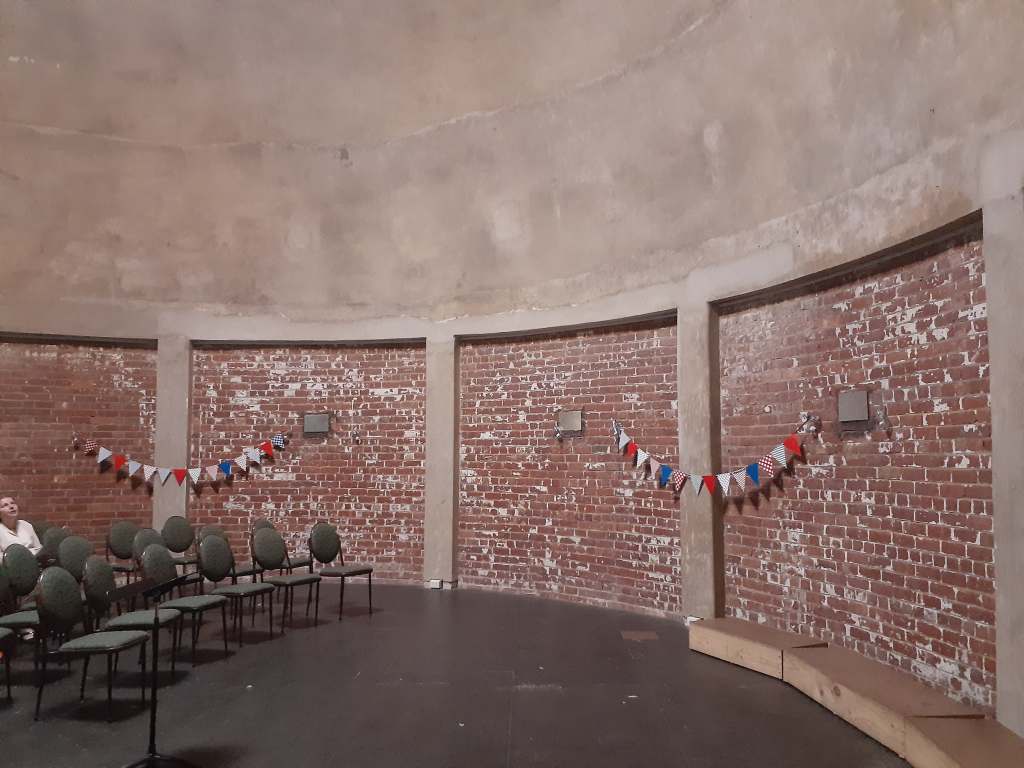
On Friday 29th November, Polyphonic Voices presented a tightly themed program of American choral and gospel music. The venue was the unique and incredibly resonant space ‘the dome’- a domed room which seats about sixty people- inside the Mission to Seafarers in Docklands.

I appreciated the cohesiveness of the programming; the concert was called ‘American Thanksgiving’, there were little touches of red, white and blue decorations around the perimeter of the dome, and miniature pumpkin pies and Reece’s peanut butter cups were served at interval. Throughout the night, the ensemble was led by the steady hand of artistic director Michael Fulcher, who established Polyphonic Voices in 2013.
Of course, it wouldn’t be a concert of American vocal music without the inclusion of some Eric Whitacre compositions. Of the three performed, I thank you God for this most amazing day was a highlight as the shimmering harmonies unfolded over the course of the work.

While I enjoyed the Whitacre, I was particularly drawn to the bold and a crunchy soundscapes of the pieces which followed it. Daniel Knaggs’ setting of Surge, amica mea had a dark and atmospheric quality, the uneasiness contrasting satisfyingly with the words of the joyful love poem. This performance was its Australian premiere. Nico Muhly’s setting of Pater Noster (The Lord’s Prayer) featured a solo soprano line, which was woven in and out of the ensemble’s overlapping short phrases. This line was sung with purity by Megan Nelson, who created a sound which was still reminiscent of haunting wailing, appropriate as the backdrop of the gothic Lord’s Prayer.
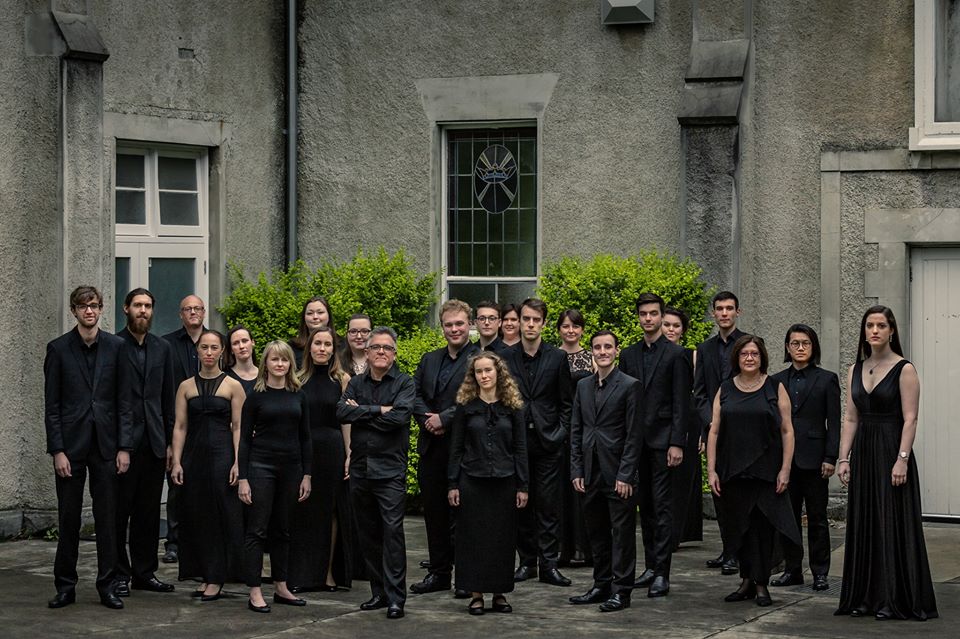
Polyphonic Voices in May 2019. Photo credit: Lucien Fischer

So far I have commented on the character of the pieces in isolation. So let me take a moment to say the power and blend of the Polyphonic Voices ensemble is fantastic. These are clearly some seriously experienced singers, the kind who can instinctively communicate with one another with an almost terrifying exactness. I particularly enjoyed the mass of sound produced by the ensemble, one where the singers still embraced the individual colour of their voices.

I am a big fan of Samuel Barber’s vocal music as a singer myself. I loved the distinctive character of the two Barber pieces programmed. Twelfth Night featured gorgeously crunchy harmonies and created a coldly beautiful atmosphere. To Be Sung On The Water was a dramatically phrased work which harnessed the power of the text.

The second half of the concert delved into another side of the American musical tradition, that of gospel music. It was great to see the ensemble shift their energy from the more austere religious pieces of the first half, to the energetic optimism of gospel music. The first piece presented was the traditional Shenandoah. I felt that the voicing of this particular arrangement dampened the power of the striking tune. This version saw the bulk of the ensemble thickening the texture behind the melody, but it felt like opportunities to showcase the beauty of the line were lost.

Photo credit: Lucien Fischer

The remainder of the gospel section, if it isn’t too tacky to say, certainly took me to church. Down to the River to Pray featured a series of solos sung in a freer more soulful style. These were followed by joyful full-voiced choruses sung by the entire ensemble. A particular highlight was bass-baritone Lachlan McDonald’s assured turns on the solo line, bringing an unforced golden tonal quality to the piece.

Next up was a fabulously fun and frankly, quite bonkers arrangement of Wade In The Water by Jim Clements, originally sung by Voces 8. This was a heightened hyper doo-wop take on the gospel tune and the ensemble did a fantastic job of making multiple key changes and tightly interwoven rhythms sound effortless.

Polyphonic Voices put together an impressive program which showcased the power of chamber vocal music. I’m eager to see what their 2020 season holds.

Polyphonic Voices: ‘American Thanksgiving’ featured artists:

Conductor, artistic director

Michael Fulcher

Sopranos

Kristy Biber

Hannah Hornsby

Megan Nelson

Jane Wiebusch

Altos

Elizabeth Chong

Renée Heron

Juliana Kay

Alex Ritter

Tenors

Andrew Hamilton

William Lennie

Ben Owen

Daniel Riley

Basses

Lachlan McDonald

Joshua McLeod

Bailey Montgomerie

Tim Matthews Staindl

Inventi Plays Mozart Church Sonatas

By Stella Joseph-Jarecki (Enquiries: stellamusicwriter.wordpress.com)

On the evening of Thursday 28th November, Inventi Ensemble presented a compact hour of Mozart Church Sonatas at the Primrose Potter Salon. It was my first time seeing the ensemble perform, after having been invited by the ensemble’s manager Brienne Gawler.

Inventi Ensemble is led by artistic directors Melissa Doecke and Ben Opie, who play flute and oboe respectively. The membership of the ensemble is otherwise fluid, with guest artists coming on board for different concerts and tours. The program described the group as being ‘passionate about music reaching as many people as possible’. As part of this mission, Inventi Ensemble tour widely with chamber arrangements of large-scale orchestral works, perform shows in nursing homes, and mount relaxed shows for audiences of varying ages and sensory needs. This expansive vision for bringing chamber music to Australian audiences made a lot of sense once I saw the ensemble play with vivacious and barely contained energy.

Image credit: Inventi Ensemble Instagram. From left to right: Melissa Doecke, Ben Opie, Campbell Banks, Peter de Jager, Peter Clark, Jessica Oddie.

Mozart’s church sonatas were composed with the aim of showing off the central instrument, the organ, which was played with nimble virtuosity throughout the concert by Peter de Jager. A number of pieces in the concert featured instrument combinations I hadn’t previously seen: flute, oboe, organ, cello and two violins. When the ensemble played together in this formation, the sound was full and well balanced, and featured a lovely mix of tonal colours and textures.

The first piece of the program was one of my favourites, the fabulously sprightly Church Sonata in C, K.329. There was nuanced communication between Doeke on the flute and Opie on the oboe as their parts were woven together, and the performers all displayed a fluidity and lightness of phrasing.

Image credit: Inventi Ensemble Instagram. From left to right: Melissa Doecke, Ben Opie, Peter de Jager, Campbell Banks, Peter Clark, Jessica Oddie.

After the first Church Sonata, Opie announced that Inventi Ensemble had introduced a fresh element to these pieces: each would begin with an improvisatory solo based on a theme from that particular piece, played by a different member of the ensemble. This lent a dynamic and unrestricted character to the program. It also allowed each member of the ensemble a chance to display their style as a soloist, as well as a hardworking group member.

A telling example of this was the featured solo of Church Sonata in F, K.244, played by Campbell Banks on the cello. During the other sections of the program, Banks supplied a warm, solid foundation for the ensemble, smoothly blending into the mass of sound. By contrast, Banks showed his versatility during his solo, coaxing a range of colours and timbres from his instrument.

Image credit: Inventi Ensemble Instagram. From left to right: Melissa Doecke, Ben Opie, Peter de Jager, Campbell Banks, Peter Clark, Jessica Oddie.

The unexpected star of the program was not a Mozart piece at all, but the zany (and I believe rarely programmed) organ Concerto in G, WV.306, by Georg Christoph Wagenseil. The piece featured dazzling melisma from the organ and moved energetically through a range of moods, from darkly dramatic to bouncy and light-hearted. At times there was an oddly contemporary feel to the piece, as the frequent organ solos almost reminded me of the pulsing rhythms of electro dance music, or a frantic keys solo played by Ray Manzarek from The Doors.

The second half of the program returned to Mozart. Church Sonata in C, K.263 featured a comical ‘solo-off’, as Peter Clark on the violin and Peter de Jager on the organ battled for dominance with progressively flashier phrases. Church Sonata in D, K.244 featured an opening solo from Jessica Oddie on the violin, one which showcased a rich tone of golden mahogany. Church Sonata in F, K.224 saw the ensemble stretch and pull the dynamics, creating a landscape of stark contrasts.

In summary, this concert was an exuberant and appealing introduction to Inventi Ensemble. I look forward to seeing where 2020 takes them.

Image credit: Inventi Ensemble Instagram. From left to right: Peter de Jager, Campbell Banks, Melissa Doecke, Ben Opie, Jessica Oddie, Peter Clark.

Inventi Ensemble have recently announced the details of their 2020 season, more information can be found on their website here. Follow their Facebook here, Instagram here

Inventi Ensemble

Melissa Doecke– flute

Ben Opie– oboe

Peter Clark– violin

Jessica Oddie– violin

Campbell Banks– cello

Peter de Jager– organ

An aural shake-up of fabulous proportions: six-four X SPIRAL

six-four ensemble (Facebook here, Instagram here)

Illustration credit: Katherine Smith Illustration

SPIRAL ensemble (Facebook here, Instagram here)

By Stella Joseph-Jarecki (Enquiries: stellamusicwriter.wordpress.com)

Why should we take a chance on new music? More to the point, why is new music something that we feel we need to take a chance on, as if it’s a daunting and potentially spiky experience which might cause our ears to fall off?

I do understand where this reluctance might come from. Anything unfamiliar can be intimating, and for many people, sinking their teeth (ears?) into the classical music canon is daunting enough, let along anything composed recently.  

But I think it would be a great pity to dismiss newly composed contemporary classical/ chamber music. To think of it as somehow less open, less approachable, less fun, or less interesting than new rock, pop, funk, jazz, etc. Genre labels serve a basic purpose, but seeing as composers of broadly classical new works are emerging from hundreds of years of composing traditions, and can be influenced by anything they want to be, why would we ever think of this kind of music as a narrow thing?

On the evening of Thursday 28th November, Melbourne new music ensemble six-four presented a program with special guests, Sydney new music ensemble SPIRAL. As the members of six-four are all alumni of Melbourne Conservatorium of Music, the concert was presented at the Prudence Myer Studio at the new Ian Potter Southbank Centre and was supported by the New Music Studio at the MCM.

As a young musician and person who is incredibly hopeful for the future of classical music of all shapes and sizes in Melbourne, I have to say that this exactly the kind of concert I hope to see more of. A whopping six out of eight pieces were composed in 2018 (!!!) alongside a piece composed in 2017 and a Phillip Glass piece composed in 1995.

The first set was performed by SPIRAL. All seven members of SPIRAL are composers as well as performers, and the group also collaborates with composers outside the ensemble. The instrumentation consisted of Johannes MacDonald on flute and saxophone, Josephine Macken on flute, Oscar Smith and Sarah Elise Thompson on keyboards, Josh Winestock on electric guitar, Rory Knott on electric bass and Will Hansen on double bass.   

SPIRAL ensemble, from left to right: Johannes MacDonald, Will Hansen, Josh Winestock, Oscar Smith, Sarah Elise Thompson, Rory Knott, Josephine Macken.

The first piece was entitled Hey Let’s Go To Woolies (2018) by Joe Lisk, and was in fact inspired by the length of time and direction of the composer’s walk to his local supermarket. Lisk ‘split the piece into three rhythmic cells’ which are then explored through a rubric in a semi-improvisatory form. The beginning of the piece was meditative and Phillip Glass-esque, and the ensemble displayed a fabulous amount of head-bopping energy as they communicated while moving from one section to the next.

The next three pieces in the set were composed by members of SPIRAL. Oscar Smith’s Iron Filings (2018) featured bold juxtapositions in tone and timbre, and was composed in ‘accordion’ form; namely each section became progressively shorter, before this structure was reversed towards the ending. I enjoyed the thumping energy of the percussive sections featuring flute, keys and electric guitars, and the fact the performers were unafraid to push the timbres of their instruments to breaking point and create a bold ‘ugly’ sound. That being said, the piece ended with a tender interaction between double bass and flute, with Will Hansen and Josephine Macken playing with a beautiful straight-toned sound.

SPIRAL ensemble in 2018. From left to right: Will Hansen, Johannes MacDonald, Oscar Smith, Rory Knott, Josh Winestock, Sarah Elise Thompson, Josephine Macken.

Sarah Elise Thompson’s piece Bixler 225 (2018) created a weaving soundscape built on repeated piano motifs. The entire piece had a dreamlike, hypnotic quality, calling to mind images of the gentle motion of waves, or sunlight shifting through water.  The piano motifs were intertwined with atmospheric straight-tone notes sung softly by members of the ensemble and played on flute and double bass. I found this piece to be especially moving as it took me down an aural rabbit hole, one which led to the place described in Sarah’s program notes. Over a summer spent at a US college, Sarah spent many hours in a particular practice room, ‘[playing] the same three chords over and over’ on a keyboard, absorbed in the effect this created while looking out over ‘New England pines trees and greenery’. You can watch SPIRAL perform Bixler 225 here.

SPIRAL’s finished their set with Scesis Onomation (2018) by Rory Knott, a piece inspired by the concept of repeating different words with very similar meanings. This six minute composition was packed with rollicking rhythmical fragments and was highly energetic.

Six-four began their set with No Distant Place (2018) by Lisa Cheney, a composer and compositional lecturer who was in attendance. The piece was inspired by the poem of the same name, first encountered by Lisa on an engraving in a cemetery garden. The two movements of the piece were composed some time apart and possessed starkly different moods. Lisa alluded to this in her address to the audience, saying that when she returned to the text to write the second movement, she responded to it in a dramatically different way. It was fantastic to see the concentrated communication between Chloe Sanger (violin), Tom D’Ath (clarinet) and Alex Clayton (piano), and they moved through moments of the piece which were alternatively peaceful and introspective, and chaotic. You can listen to the piece and read Lisa’s full program notes here.

six-four in 2018. From left to right: Chloe Sanger, Alex Clayton, Oscar Woinarski, Ollie Iacono, Anna Telfer. (Thomas D’Ath seated behind Anna Telfer)

Ingrid Stölzel’s The Voice of the Rain (2018) was performed by the remaining three members of six-four, Anna Telfer on flute, Ollie Iacono on percussion and Oscar Woinarski on cello. Stölzel’s piece was inspired by the Walt Whitman poem of the same name, particularly the idea of ‘the world as an everlasting cyclical process of giving birth to itself and giving back life to its own origin’. Anna Telfer played with an elegance and lightness of phrasing, and the trio interacted skillfully in creating an absorbing and at times eerie sound world. You can watch a performance of the work here

The final two pieces saw six-four play as a full ensemble. The oldest piece in the program was an arrangement of Symphony No. 3 Part III by Phillip Glass, written in 1996. (It’s a lovely novelty to realise the oldest piece in the program is a year younger than yourself). Six-four played with a great amount of dynamic tension, bringing out the ebb and flow in the phrases of Glass’ work.

six-four in 2018. From left to right: Alex Clayton, Chloe Sanger, Oscar Woinarski, Ollie Iacono, Thomas D’Ath, Anna Telfer.

The last of the night was Bear Trap (2017) composed by Ollie Iacono. Ollie introduced the piece as a ‘fever dream’ which contained a bit of everything, including a bit of ‘bossa nova- so perhaps it’s a fever dream in an elevator’. This was a piece which bubbled along happily at times and unleashed screeching crescendos at other times. As far as fever dreams go, it was an interesting and enjoyable ride.

This review has been a long-winded one. I felt that it was important to me to go into detail because these two ensembles represent everything that gets me excited for the future of new music in Australia. These young composers and musicians are brave and dedicated enough to take risks on new rep, rep which is not guaranteed to put bums on seats, rep which challenges assumptions on what chamber music ‘should’ sound like. I am eager to see what six-four and SPIRAL get up to in the future, and I highly recommend seeing them perform if you are looking for a challenging and inspiring night of music.

Turangalîla-Symphonie

Performed by Sydney Symphony Orchestra. November 21st 2019, Sydney Opera House

Conductor: David Robertson

Soloists: Tengku Irfan on piano, Jacob Abela on ondes martenot

By Sean Quinn

A note from the editor- Fever Pitch Magazine guest contributor Sean Quinn recently attended the Sydney Symphony Orchestra performance of Olivier Messiaen’s Turangalîla-Symphonie. The SSO describes the unique work on their website: “Calling for a massive orchestra of almost 100 musicians, solo piano and one of the earliest of electronic instruments, the ondes martenot, Messiaen creates a spellbinding, transcendent world filled with drama and mysticism.

Its first performances in the 1940s were considered nothing short of a revelation from a composer whose musical bombshells seemed to belie his gentle spirituality and humanism. Turangalîla, a word from the ancient Sanskrit, reflects the work’s fascinating dualities: east and west; tonality and lyricism, joy, time, life and death.”

Keep reading to find out Sean’s thoughts! – Stella Joseph-Jarecki (Enquiries: stellamusicwriter.wordpress.com)

My first visit to the Sydney Opera House was one that had me shivering with excitement. After witnessing the sheer glory of Olivier Messiaen’s immense Turangalîla-Symphonie at Melbourne’s Hamer Hall with the Australian World Orchestra (2017) under the baton of Simone Young, who brought powerful contrast to the colourful menagerie of music that lay before her, I was ecstatic to attend my second viewing of the colossal work. This time, the Sydney Symphony Orchestra, led by David Robertson, whose distinct style provided a nice point of difference for me as an audience member. Having not even reached the age of 20 and now seen Turangalîla twice in two of Australia’s finest venues, I had much to contemplate.

I would love to first acknowledge the two soloists; Tengku Irfan on piano and Jacob Abela on the ‘ondes martenot’ – the latter of which I’ve now had the pleasure of seeing perform in this role twice, both times with astonishing conviction and poise around the complexity of the ‘ondes’.

Irfan showed great virtuosity in tackling the fiendish solo piano part, delivering the passion and intensity Messiaen desired in the music as well as the delicate contrasts. At times there was a lack of contrast in certain cadenzas. This is not to say that they were performed with any less technical brilliance, but occasionally seemed a little too hurried, not allowing space for contemplation of the vast palette of colours at hand.

Abela’s performance was incredibly stylish. Adorned in a fitting costume that suited the unique quirk of his instrument and the symphony’s general state, the ‘ondes’ was certainly in the hands of a well formed ‘ondist’. Capturing the mystic, yet somewhat voice-like character of the instrument is no mean feat, and Jacob performed with flying colours, engaging the audience and ensemble with the beauty of the ‘ondes’ varied sound capabilities.

The orchestra under Robertson’s baton, whilst powering through the extremes of Messiaen’s convoluted and occasionally trivial writing with composure and exceptional tenacity, seemed to lack dimensions of dynamic and textural balance, as well as some choices of tempo that lacked variety. Robertson quite fittingly captured in his opening remarks the ‘excessive’ nature of Turangalîla, but I found I was generally underwhelmed with the extent of this ‘excess’ that was explored and exploited throughout the entire performance – I longed to feel the polarising contrast of each section.

The acoustics of the Opera House can be unforgiving, which was exposed with an elaborate entourage of amplification – and this sadly detracted from the orchestra’s presence. I found that certain sections of the orchestra were unsynchronised with both Robertson, the soloists and/or the ensemble itself; on a micro scale. I also come back to the point of hurriedness, where certain points – in particular the ‘Theme of Love’ that is first shown in the fourth movement – was not held in suspense long enough, and felt glossed over.

Particular highlights of the night include the fiery Introduction, which started the evening with a bang. The Piccolo and Bassoon duet at the beginning of the fourth movement; a particular favourite section of mine, showcased a quaint and playful element amid the moodiness of the first half of the work. Though the density of musical colour displayed throughout the first half did occasionally lack depth, from the sixth movement onwards, a sudden warmth and life was breathed back into the orchestra, which allowed for the second half to soar. Robertson’s clear affinity with the Eighth movement rose the mentality of the orchestra – and no matter my conflicting opinion on the movement, it was performed with astonishing character by the entire ensemble. And of course, the fifth and tenth movements shone with the bright lights of American influence as well as representing the divinity and latent eroticism of the symphony.

Overall, this performance was an iridescent display of the meeting-point between the traditional and avant-garde by one of the greats of the 20th Century, performed with great calibre by all. It was worth the trip up from Melbourne, and the experience of seeing the titanic Turangalîla live again. I await its return to Australian concert halls, hopefully in the near future.

Nicole Ng

Photo credit: Jessie Fong

Pianist, accompanist, music teacher

Speech difficulties in her early life meant that Nicole Ng faced challenges in expressing her emotions and feelings through words. Learning the piano at the age of seven helped to develop her confidence and communication skills and she inspires others through her expressive playing and passion for music.

Guiding her aspirations of a creative career as a chamber repetiteur, piano teacher and collaborative pianist, Nicole is currently undertaking a performance teaching degree, studying with Caroline Almonte at the Melbourne Conservatorium of Music (MCM).

Nicole is a busy and in-demand performer, educator, writer and mentor. She has performed with many chamber ensembles, freelanced as a collaborative pianist for music examinations and concerts, performed with orchestras (Melbourne Youth Orchestra, and Victorian Youth Symphony Orchestra), inspired future pianists through her piano teaching, featured as a writer in Rehearsal Magazine and in major blog platforms for the University of Melbourne (UniMelb Adventures, First_Year@UniMelb, and Back for Seconds).

Keep up to date with Nicole’s musical adventures through her Facebook page here, her Instagram page here, and her blog Adventure Time with the Muso here

Seven Tips on… Being a Freelance Collaborative Artist

Photo credit: Jessie Fong

By Nicole Ng

Being a freelance collaborative artist brings new adventures and excitement with every week. Sometimes, it can be hectic juggling my part-time jobs (piano and swim teaching) with university studies, time with family and friends, and most importantly, self-care. However, if you let yourself enjoy the ride, it is heaps of fun and definitely worthwhile.

So, here are seven pieces of advice on being a freelance collaborative artist!

1. Check your availability before accepting collaborative work

Whenever an opportunity is presented to me, I always want to say, “Yes, yes, and yes!” While that is a great attitude to have, you should always check your schedule and availability in your calendar first. That’s the most important thing. You never know, you might double book yourself or have the possibility to over fill your workload. That’s the last thing you want to do. Trust me, I’ve been there! It gets messy and stressful, which brings me to my next point…

2. It’s okay to say no.

This ties in perfectly with my first tip. I consider self-care extremely important, and before accepting work, I always check with myself if this opportunity will be okay for me to handle during a busy period of my studies. Make sure you ask yourself if it’s going to over fill your plate (emotionally, physically and mentally), and remember to question the difficulty of the work itself.

Photo Credit: Nayt Housman

3. Find your niche by saying yes when an opportunity has been presented to you, or by following a new discovery.

Yes, I know. This is totally the opposite from my second point, but that was how I found my specialisation and passion. If I discover some work that interests me, or an opportunity falls in my lap and I’m available, I go for it. Rarely, collaborative work clashes with my part-time job or studies. If so, I always consider and have a good think about it when I believe it would be a once-in-a-lifetime opportunity. There are collaborative positions out there that are in high demand! For instance, working as an associate artist in an orchestra for a dance company, being a dance accompanist, orchestral pianist work, to name a few! You may be surprised on what’s out there when you ask around or search for opportunities.

4. Give it your all and do your best! But most of all, enjoy the ride!

Showing your deep love and passion for collaborating with others will spread like a happy, contagious disease. This can be as simple as having fun while making music with others. As my mum would say to me, “Be humble, and enjoy what you do. It’s a special moment to share with.” By you giving a 100% with fantastic customer service, being a reliable, organised worker, practicing your part well, and obtaining great performance results, there will be a possibility that you’ll get asked to work with them again.

5. Paid job? Try not to undersell yourself, especially when it’s a last-minute job. Trust your worth.

The best example that I would think of is when I’m accompanying a student for their music examination or audition – collaborative work within my own service/self-company. In retrospect, setting up my own associate artist fees wasn’t easy at first. I’m sure others can relate as well. To be honest, I started with $50 an hour for rehearsals and for accompanying on the day of their examination. Then, when I was feeling confident in my collaborative skills, experience and worth, I began to increase my fees. * At the moment, I’m sitting at around $75 an hour for rehearsals and for accompanying day on their examination. I also charge last-minute fees, which is $10 more than what I charge normally. ** However, if there’s a set fee they (a company or parish players) pay artists, then I’d have to roll with it.

*This also includes obtaining my Bachelor of Music degree (university qualifications, or other qualifications).
**I know some collaborative artists may or may not charge last-minute fees. But it’s personally up to you. I have last-minute fees mainly because I juggle with teaching, university studies and personal wellbeing and health.

6. Practice makes perfect. Keep sharpening your artistic skills and knowledge!

I believe it’s always great to keep building and developing your collaborative skills. I work on those skills by practicing sight-reading, improvising and jamming every now and then, or helping a colleague or friend out if they are doing a concert.

Be curious and explore different forms of chamber repertoire and solo repertoire. If there’s some music sheet lying around in a practice room, take it as an opportunity to discover something new. Become practiced at transposing from concert pitch to other keys for orchestral instruments. This is useful when working with younger students for their music examination. For instance, when expressing how they can develop their musical ideas, or correcting their intonation and pitch at a particular bar.

Photo Credit: Melbourne Youth Orchestras

7. Advertise your work by using social media platforms or simply talk about it with others (friends, colleagues, networking events, etc).

We’re now living in a time where we can easily share information with others through social media platforms. It’s accessible and simple to use!  There are various ways you can connect with your intended prospective audience, applications such as Instagram, Facebook, and LinkedIn.

Here’s how I show my work with others through social media and other platforms through with its intentions:

Instagram – Casual insight into my career, studies and life. It’s my all-time favourite social media platform to use!

Facebook Page – Formal and professional insight into my career and performances

LinkedIn – Formal insight of my career and forming connections with colleagues in a professional way.

Blog – Written outlook into my career, studies and life

Website – I’m currently working on it and planning to use it as a professional outlook into my career, studies, performances and life, connecting with my social media platforms in one.

There are other social media platforms such as TikTok, if you’d like to engage with younger audience with dank musician memes. TwoSet Violin are definitely hitting their stride with this method!

Another way you can engage with people about your work is by talking about it. It doesn’t have to be all fancy, but rather a casual, interesting outlook into what you do. Take it as short snapshot of your profession. For instance, I was having a small conversation with a lady at a gym I go to, and she was interested in my work and wanted to keep in touch.

You can keep up with Nicole’s musical adventures through her Facebook, Instagram, or blog.

Fever Pitch Magazine enquiries can be sent to Stella Joseph-Jarecki through stellamusicwriter.wordpress.com

Six questions with… Emilia Bertolini, soprano

By Stella Joseph-Jarecki (Enquiries: stellamusicwriter.wordpress.com)

I had the chance to fire a few questions at Emilia Bertolini, a passionate soprano who is currently participating in numerous young artist programs, such as Opera Scholars Australia and Young Songmakers Australia. You can keep up to date with Emilia’s singing adventures on her Facebook page here, her Instagram here, and her official website here

On Tuesday 4th of February 2020, Emilia will perform a program of 17th and 18th Century music as part of her chamber group Ensemble Ancien. This concert will be presented as part of the Local Heroes series at the Melbourne Recital Centre. Find out more here

Tell us about your experience taking part in the opera camp program at Lyric Opera Studio Weimar, preparing the role of Susanna for a performance of Mozart’s Le Nozze di Figaro.

Where to start! I probably spent about five months working on the role among other projects. Susanna is one of the longest roles in the repertoire so it was quite an ambitious undertaking but I approached it methodically. I divided my score up with colourful tags separating the recits, arias, duets and larger ensembles. I did lots of non-singing practice, speaking through the recits and going through the Castel translations to make sure that I understood every bit of text, not just for my own character but for everyone else in the scene too. When I arrived in Weimar I was a bit apprehensive that I hadn’t sung through any of the ensembles with other singers, but it was so satisfying when I finally got to!

I had a wonderful time in Weimar. The singers were so friendly and talented, just a joy to work with! The schedule was very busy, we worked seven days a week usually from 10am until 10pm. And since Susanna is on stage for most of the opera, I was usually required in the rehearsal room. The program really confirmed that this is what I want to do with my life. I was constantly inspired and engaged, I truly enjoyed every second of it.

What do you love so much about Mozart’s operas?

Oh wow… so many things! I think it’s hard to go past the ensembles. Mozart’s ensemble writing is just magical, and when you get to sing with people who really pay attention to those subtle details and colours in the ensembles, there’s really nothing better.

What do you think are the essential qualities needed to be a successful and resilient singer?

Ahh, I’m not sure if I’m the right person to be answering that! I certainly don’t have the definitive answer but personally, I just try to be the best colleague that I can be. I think that if singers turn up to every rehearsal prepared, and are kind and helpful to everyone involved, that’s the most important thing.  I also think it’s important to be really clear on your personal values surrounding why you sing. I sing because making music brings me endless joy and fulfillment. It’s really easy to get caught up in the negative aspects of this path so I always just bring myself back to my values and why I love singing.

How do you approach time management, as a singer who has to maintain vocal practise and stamina, but also work on foreign languages, acting, researching repertoire, etc?

This is a very individual thing, and I’m really aware of the fact that many singers don’t have the luxury of being able to dedicate a lot of time to some of those aspects due to work commitments or their financial situation.  In my case, I really just enjoy practicing, learning, being in rehearsal and learning languages. As soon as things become chores I don’t want to do them, so I just try to remain constantly inspired and excited to be learning new things!

In terms of time management, I’m pretty addicted to my phone, I’m always making lists, spreadsheets, sending emails and making appointments in my calendar to make sure that I have very clear deadlines. I often feel like I’m juggling a lot of things so the more I write things down and set my deadlines, the better I feel.

How do you cope with the prospect of entering an over-saturated job field, in the sense that there are hundreds of sopranos out there auditioning for every role… how do you distinguish yourself and work out what makes your voice unique and what you can bring to roles?

This is the aspect of the career that I find most daunting, and I often wish that I was literally any other voice type! However, I try to come back to my personal values and the fact that I don’t care if it’s at the Metropolitan Opera or in my shower, I’m always going to sing and I will find opportunities to sing because there really isn’t anything else that I’d rather do!

Who are some of your favourite vocal composers and what would be a dream role for you in the future?

At the moment my favourite operatic composers would be Mozart, Handel and maybe Donizetti… but it really depends on the singer or the recording. I will never sing Wagner or big Puccini arias but I love listening to recordings of early twentieth century singers performing that repertoire. My current dream role would be Mélisande from Debussy’s Pélleas et Mélisande which is completely different!

I am obsessed with art song so it is hard to go past Schubert, Schumann, Debussy and Britten, to name a few. I’m also a bit of an early music nerd so Purcell, Rameau and Strozzi are also up there with my favourites. There is so much interesting repertoire out there and I just want to explore as much of it as I can.

Emilia Bertolini

Soprano

Emilia Bertolini is a versatile musician with a love of an eclectic range of music. 2019 has held a range of exciting opportunities for Emilia including being selected to take part in the Young Songmaker Development Program with Songmakers Australia, performing at the Melbourne Recital Centre Salon with Ensemble Ancien, and going to Germany to perform the role of Susanna in Le Nozze di Figaro with the Lyric Opera Studio Weimar.

In 2018, Emilia played the journalist in Lyric Opera Melbourne’s production of Poulenc’s Les Mamelles de Tirésias and understudied the role of Yniold in Victorian Opera’s Pelleas and Melisande.  During her time at University, Emilia played Despina in scenes from Così fan tutte, and explored a variety of chamber music from Baroque composers Couperin and Lully, to Romantics Schubert and Schumann, and even dappled in Schoenberg’s haunting Pierrot Lunaire. Emilia’s solo concert repertoire includes Fauré’s Requiem, Vivaldi’s Gloria and Beatus vir and Pergolesi’s Stabat Mater.  Emilia has received several awards and scholarships including the AEH Nickson Travelling Scholarship, the Hedy Holt and Roger Prochazka Memorial Award at the 38th National Liederfest, the Murray Ormond Vagg Scholarship and the Voshege Scholarship through Opera Scholars Australia.

Emilia holds a Bachelor of Music with first-class Honours from the Melbourne Conservatorium of Music, and being an avid linguist, holds Diplomas in both French and Italian. In 2020, Emilia is most looking forward to competing as a finalist in the Opera Scholars Australia Aria competition which will be held as a part of Opera in the Market in February.

You can keep up to date with Emilia’s singing adventures on her Facebook page here, her Instagram here, and her official website here