Come From Away

Photo credit: Stella Joseph-Jarecki

Comedy Theatre. Playing now, until 19th January 2020

Book, Music & Lyrics: Irene Sankoff, David Hein

Director: Christopher Ashley

Musical staging: Kelly Devine

By Stella Joseph-Jarecki (Enquiries: stellamusicwriter.wordpress.com)

Come From Away is simply a remarkable ninety minutes of theatre. It proves a show can pick an absolute punch without an absolute spectacle, going without large-scale sets, lavish costumes, or complex special effects.

The show does not feature the traditional music theatre divide of a handful main roles and a crowd of chorus members. Instead, it is energised by twelve fantastic performers who are on stage for almost the entire show, with each performer in charge of portraying multiple characters.

Come From Away tells the stranger-than-fiction story of the small town of Gander, Newfoundland, population 10,000, that suddenly had to host 7,000 stranded passengers in the wake of 9/11. In the immediate aftermath of the terrorist attack, all air traffic in or bound for the USA was grounded. As the airport in Gander is one of the largest in the world (and was frequently used back when US aeroplanes still needed to re-fuel before crossing the Atlantic), a whopping 38 planes were forced to land there.

The townspeople of Gander and the stranded passengers use the forces of music and alcohol to lift their spirits after a long few days. Photo credit: Jeff Busby

While the events which spark the plotline are obviously tragic, the mood of the show never veers into sappy sentimentality. Instead it focuses on the human stories of resilience and making do in seemingly impossible circumstances. The patchwork of anecdotes from the townspeople and travelers are woven into vibrant songs. The actors would change roles with fluidity, sometimes with the simple technique of taking off/ putting on a certain jacket or hat.

The small but mighty band of eight musicians played with incredible skill and vitality, and kept me and my parents bopping our heads throughout the entire production. The musical energy was brought from the first seconds of the opening scene, the thumping percussive chorus Welcome to The Rock. Several numbers in the show, such as Heave Away and Screech In, channeled the traditional music of Newfoundland, a kind of fiddle-heavy folk music reminiscent of pirate sea shanties. (The traditional music of Newfoundland has its roots in Celtic music, I found an informative and concise article on this musical heritage here)

Englishman Nick (Nathan Carter) and American Diane (Katrina Retallick) form a bond over the course of the events in Gander. Photo credit: Jeff Busby

Being a non-traditional musical, the production didn’t feature formal dance choreography so much as stylized movement and theatrical blocking of the actors. Many of these techniques would be very familiar to anyone who has taken a basic acting course, such as having two rows of wooden chairs set up to represent the interior of the plane, and a near constant flow of performers weaving around each other as they shifted from scene to scene, maintaining the energised dynamic of the show without any sagging between the developments of the story.

Gander citizen Beulah (Emma Powell) comforts passenger Hannah (Sharriese Hamilton), who is yet to hear news of her firefighter son in the wake of 9/11. Photo credit: Jeff Busby

One of the rare solo musical number was sung by Beverley Bass, a female air captain of one of the flights grounded in Gander (played by Zoe Gertz). The mood of Me and the Sky was reflective and triumphant, as Beverley told her story of persevering in a profession where only a tiny portion of flight captains are female. The song hits its peak with a killer belting section, very musically appropriate as she sings of soaring through the sky and finding her wings.

With only a bare-bones set of wooden chairs and tables on a revolving stage, the cast and crew of Come From Away created an immersive and wonderfully entertaining musical experience. Despite the sobering plot device, the musical was uproariously funny, with just the right amount of inspirational sprinkled in.  

I encourage absolutely everyone to see it. Even if you are someone who doesn’t normally enjoy big-budget musicals, the unorthodox character of Come From Away is sure to appeal.

Gander mayor Claude (Richard Piper) holds a ceremony in the pub to make some of the stranded passengers honorary Newfoundlanders. Photo credit: Jeff Busby

Cast:                                                                                                   

Nicholas Brown: Kevin J & Others                                                                 

Nathan Carter: Nick & Others

Zoe Gertz: Beverley & Others

Sharriese Hamilton: Hannah & Others

Doug Hansell: Kevin T & Others

Kolby Kindle: Bob & Others

Simon Maiden: Oz & Others

Sarah Morrison: Janice & Others

Richard Piper: Claude & Others

Emma Powell: Beulah & Others

Katrina Retallick: Diane & Others

Kellie Rode: Bonnie & Others

Band:

Luke Hunter: Musical Director, keyboard, harmonium, accordion

Vicky Jacobs: Assistant Musical Director

Dave Beck: Drums, percussion

Caleb Garfinkel: Mandolin, acoustic guitar, bouzouki

Tim Hartwig: Electric, acoustic and nylon guitars

Matthew Horsley: Whistles, Irish flute, uilleann pipes

James Kempster: Electric and acoustic bass

Xani Kolac: Fiddle

Ben Smart: Bodhrán and percussion

Creatives:

Irene Sankoff, David Hein: Book, Music & Lyrics:

Christopher Ashley: Director

Kelly Devine: Musical staging

Ian Eisendrath: Musical supervisor, musical arrangements

Beowulf Boritt: Scenic designer

Toni-Leslie James: Costume designer

Howell Binkley: Lighting designer

Luke Hunter: Musical director

Gareth Owen: Sound design

August Eriksmoen: Orchestrations

Joel Goldes: Dialect coach

Richard J. Hinds: Associate choreographer

Lynne Ruthven: Casting director

Gender Euphoria

Presented as part of the Melbourne International Arts Festival. The Famous Spiegeltent, 15th-20th October 2019.

Co-Creator/Director: Maude Davey. Co-Creator/Performer: Mama Alto. Music Director: Ned Dixon

By Stella Joseph-Jarecki (Enquiries: stellamusicwriter.wordpress.com)

As I settled in to watch Gender Euphoria at the famous Spiegeltent, I noticed a sense of jovial expectation in the air. As the audience were excitedly chatting away, and I took in the colourful flashing lights and disco balls strung up around the perimeter of the tent, I felt more like I was participating in a rowdy party than getting ready to watch a performance.

Gender Euphoria assembles together the largest transgender and gender-diverse cast ever featured on a main stage in Australia. It is a true variety show, with a range of short and sweet performances featuring everything from dramatic monologues and aerial gymnastics, to lip-synching and sung ballads.

The capable ringmaster for the night was cabaret singer Mama Alto, who took to the stage in many stylish and sequinned gowns throughout the evening with her signature flowery headpiece. She addressed with the audience with delightfully pun-ny alternatives to ‘Ladies and Gentlemen’: ‘Lollies and jellybeans’ and ‘They-dies and gentle-them’. As she reiterated in her opening and closing monologue, only machines think in binary, and after all, we are ‘delightfully, dizzyingly, deliciously human’.
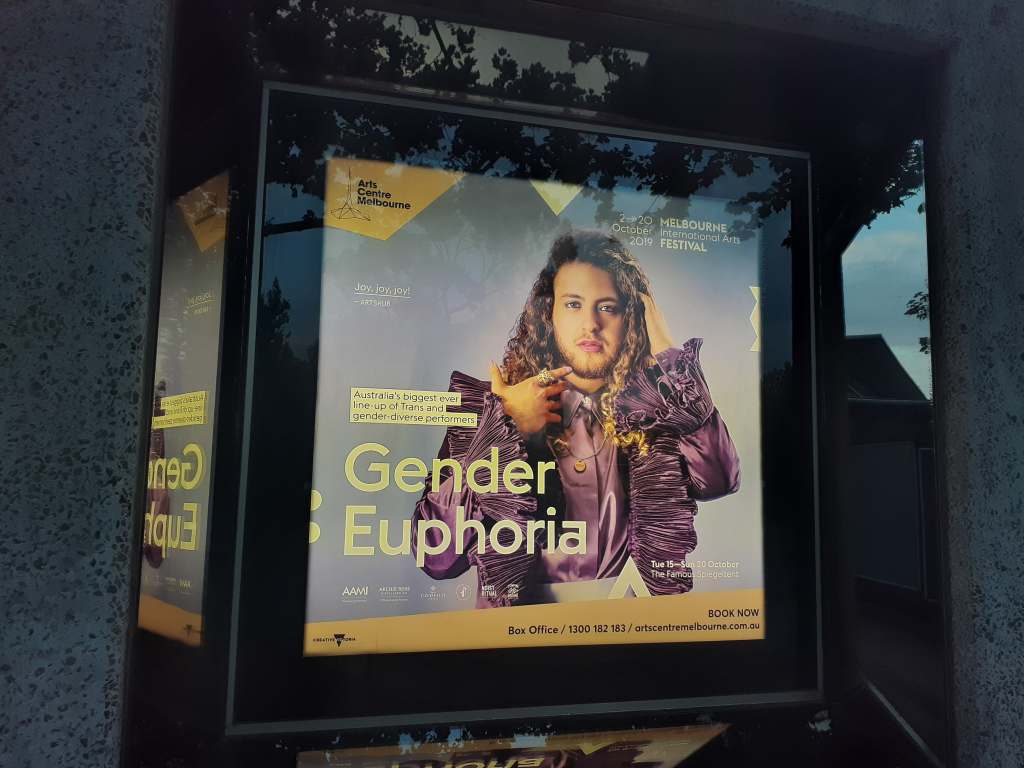
Nevo Zisin featured on the poster outside the Arts Centre.

While I was expecting bold and brassy song and dance, which was certainly featured in the show, I was happily surprised by the eloquent and sharply realised spoken word performances. Performers Harvey Zielinski, Fury, Nevo Zisin, and Melbourne special guest Nikki Viveca all delivered powerful and insightful monologues on their experiences as transgender and gender diverse people. A memorable vignette from Zielinski’s speech was a time he was waiting for his food outside a fish and chip shop, in the midst of his female to male transition. He was then approached by a male customer who called him ‘mate’ and began earnestly talking at him on the topic on finance, prompting Zielinski to wonder: ‘At what point did I become his audience and not his enemy?’

Fury spoke in a charismatic fashion on the nature of transgender stories, and the fact that they are at their core, human stories of growth, revelation and change. They spoke powerfully on the strangeness of the belief we commonly hear in society, that we won’t be real until someone loves us enough.

Nevo Zisin delivered a sharply intelligent and wryly humorous address, describing themselves as a Gender Whisperer who will ‘manipulate your voices into empowerment and self-confidence, and crawl over the skin of straight white old men and infect them with empathy’. The ancient history nerd in me was very happy to hear Nevo reference ancient Mesopotamian goddess Inanna/ Ishtar, who was purported to have androgynous powers such ‘changing man into woman and woman into man’. Nevo addressed the transgender audience members, earnestly stating ‘I want you to not need to be brave anymore, for our existence to no longer be radical.’

Nikki Viveca brought a delightfully batty energy to her monologue, which appropriately enough explored how she channelled her confusion about her gender as a child, into an interest in witchcraft and magic.

Mama Alto sang throughout the night, and showcased her powerful upper register and nuanced artistic interpretation of ballads. Mx Munro presented a sultry jazz club take on Christina Aguilera’s Beautiful with lovely communication with the musicians in the pit, music director Ned Dixon and bassist Cerise Howard.

Later we were presented with a genuinely moving lip-synch to Beyoncé’s I Was Here and Whitney Houston’s rendition of Higher Love by Crystal Love, an Aboriginal trans woman from the Tiwi Islands. She talked briefly about the Tiwi islands and the rates of suicide being so high, especially within the LGBTQI community. Amao Leota Lu, a Samoan fa’afafine and transgender woman of colour, treated us to a dance performance to thumping party anthem Chameleon by PNAU, with a fabulous UV light glow-in-the-dark costume, accompanied by a fabulously enthusiastic Auslan interpreter.

The interior of The Famous Spiegeltent

The line-up of performers was rounded out by Quinn Eades, Mahla Bird, dancer Bailee Rose and Krishna Istha. Istha is a stand-up comedian who came to comedy from a performance art background, and delivered the zinger: ‘The aim for stand-up comedy is for the audience to laugh. The aim for performance art is for the audience to never laugh again.’ When Quinn Eades and aerialist Mahla Bird took to the stage, Eades delivered a monologue while physically supporting Bird, who ascended a rope and performed aerial stunts (with no harness!).

The finale of the night saw the entire ensemble sing The Pretenders’ Hymn to Her as an anthem of resilience. Gender Euphoria was a vibrant, disco-infused testament to the fierceness and tenacity of the human spirit. As a supporter from the outside looking in to the trans community, I sincerely hope it tours Australia, and hopefully cabaret festivals around the world.
Swan Song- Schubertiade

Songmakers Australia, featuring artists from the Young Songmakers Development program

Concert 4 in Schubertiade Festival. Hawthorn Arts Centre, 6th October 2019.

By Stella Joseph-Jarecki (Enquiries: stellamusicwriter.wordpress.com)

Over the course of an October weekend, Songmakers Australia presented a series of concerts as part of a festival dedicated to the music of Franz Schubert. I attended the fourth and final concert, Swan Song. The concert was so titled as it focused predominantly on music composed by Schubert during the final year of his life, including a song cycle of the same name.

Tragically, Schubert died at the age of 31 after contracting syphilis. Schubert is a composer who is very close to my heart, as he was the first composer of classical vocal music who captured my imagination as a teenage voice student. His exquisitely melodic lieder were the first pieces of music which made me want to pursue classical singing more seriously. (A big thank you to my first serious singing teacher Angus Grant for introducing me to his work!)

Chamber group Songmakers Australia regularly hold concerts of art song and have presented a yearly subscription series at Melbourne Recital Centre since their foundation in 2011. Current core members of the group, led by pianist and repetiteur Andrea Katz, are Merlyn Quaife, Nicholas Dinopoulos, Christina Wilson and Brenton Spiteri, and the ensemble’s artistic patron is Graham Johnson. Over the course of the Schubertiade festival, these singers were also joined by emerging artists taking part in the Young Songmakers Development program: Emilia Bertoili, Alastair Cooper-Golec, Stephen Coutts and Hamish Gould. 

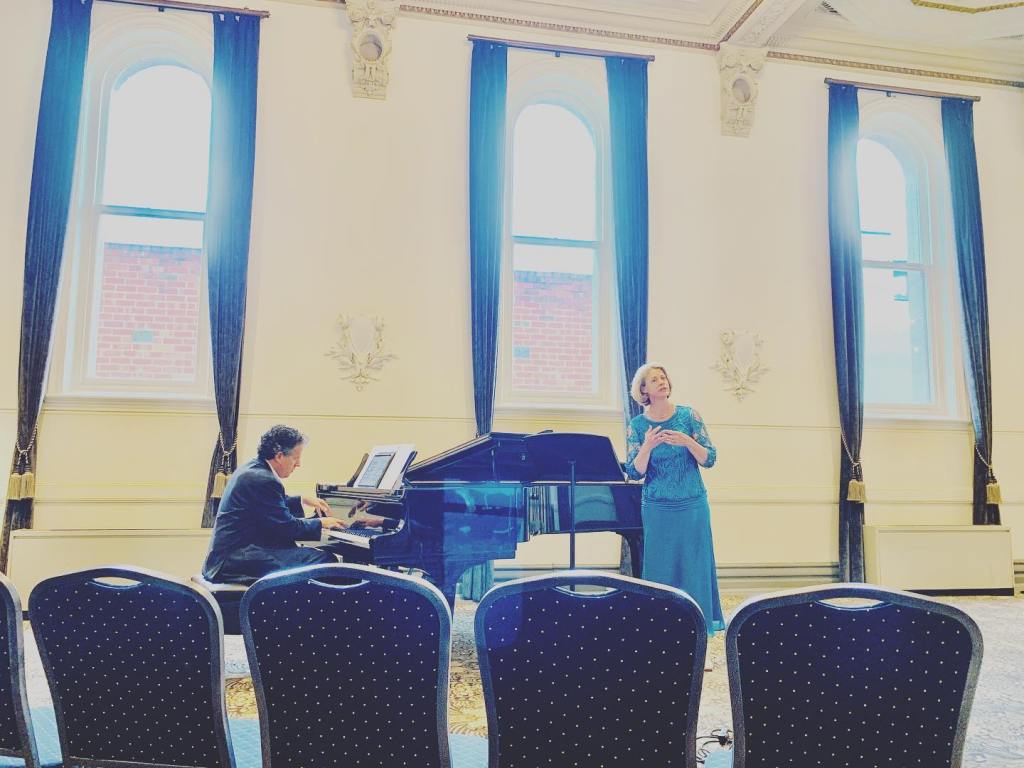
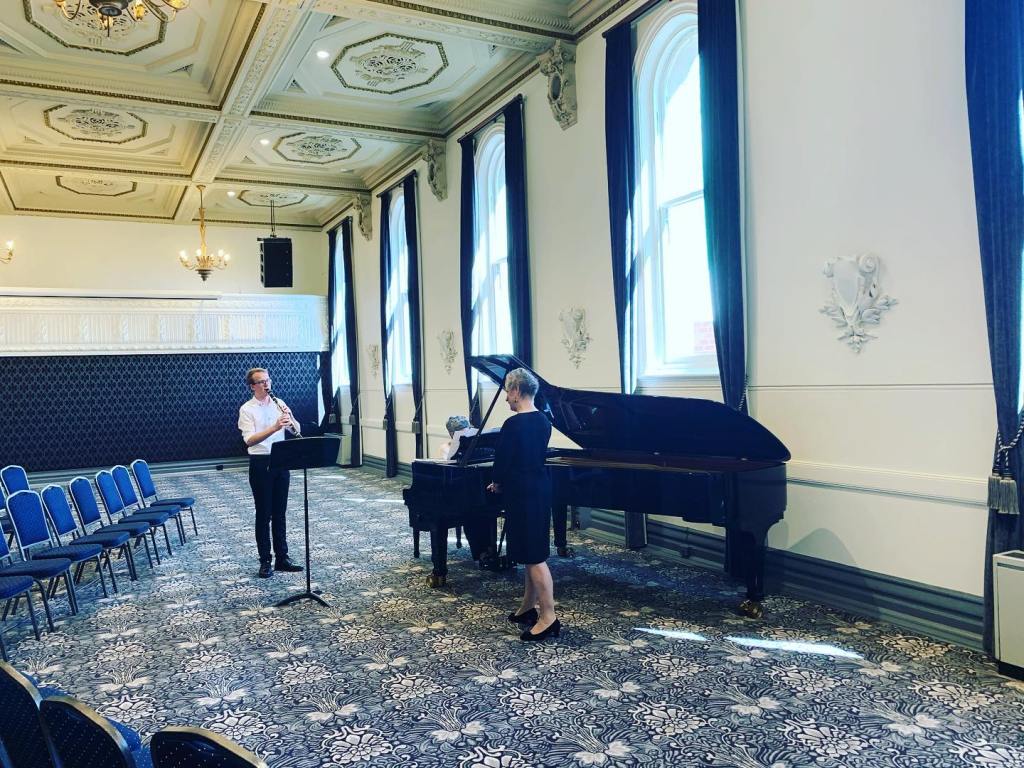
From left: Blake Cutler, Andrea Katz and Merlyn Quaife rehearse Der Hirt auf dem Fels at the Hawthorn Arts Centre. Image supplied.

The program of Swan Song was well-balanced, and included solo lieder, duets, a trio consisting of voice and clarinet accompanied by piano, and a quartet and sextet for the finale. The vocal performances were universally strong, with the developing artists holding their own alongside the more seasoned performers. An absolute highlight was Der Hirt auf dem Fels (The Shepard on the Rock) which saw Merlin Quaife perform beside clarinettist Blake Cutler. There was lovely communication between the two performers, as they took turns carrying the dominant melodic line, and each had a chance to shine as a solo performers. As a vocal student and all-round singing nerd, listening to Merlyn Quaife was like witnessing a master at work. Her command of her bright and agile soprano voice was astounding. Her use of dynamics, ranging from a fierce fortissimo to a delicate pianissimo, was enormously exciting to witness. The Heine songs from the song cycle Schwanengesang (Swan song) were also dramatically and musically exciting, with Nick Dinopoulos showcasing an impressive depth to his bass-baritone voice.

There were no weak links in the line-up of performers. Mezzo soprano Christina Wilson displayed a rich caramel vocal tone during her solo lieder An die Musik. Baritone Stephen Coutts had a brief but meaningful appearance, lending a warm golden vocal quality to the pieces he was a part of. Soprano Emilia Bertoili and tenor Alastair Cooper-Golec both showcased a sophisticated level of musicality and agility in their phrasing. Unfortunately I did not get to hear counter-tenor Hamish Gould, as he was featured in the other concerts of the festival.

From left: guest pianist Alan Hicks rehearses with Christina Wilson for day 1 of the festival, Saturday 5th October. Image supplied.

During my time as a voice student at the Melbourne Conservatorium of Music, I was lucky enough to take part in Andrea Katz’s vocal ensemble subject for several semesters. It is lovely to see her put her impressive programming and musical interpretation skills to use in Melbourne, by mounting regular events with Songmakers Australia. It was telling to me that the quartet and sextet were very well balanced vocally, with a range of tone colour and dynamics emerging with the canny communication between the performers. I know first-hand how challenging it can be to achieve a good blend with a chamber group of classically trained vocalists, each with unique and powerful voices, (while still letting each soloist take their moment to shine), and Andrea’s skill in guiding ensembles in this way was on full display.

If you want to experience the magic of music composed by Franz Schubert, Robert Schumann, and many of the other composers of art song, the concerts held by Songmakers Australia are a fantastic place to start.    

The repertoire of the concert is listed below:

Accompanied by Andrea Katz throughout

Die Taubenpost (Bass-baritone Nick Dinopoulos)

Licht und Liebe (Soprano Emilia Bertoili, tenor Alastair Cooper-Golec)

The Heine songs from song cycle Schwanengesang (Nick Dinopoulos and soprano Merlyn Quaife)

Der Hirt auf dem Felsen (Merlyn Quaife and clarinettist Blake Cutler)

And die Musik (Mezzo soprano Christina Wilson)

Des Tages Weihe (Baritone Stephen Coutts, Emilia Bertoili, Alastair Cooper-Golec, Christina Wilson)

Gebet (Young Songmakers, Christina Wilson, Merlyn Quaife, Nick Dinopoulos)

Jonny Spielt Auf

IOpera in collaboration with The Orchestra Project. A concert performance of Ernst Krenek’s 1926 opera Jonny Strikes Up. Athenaeum Theatre, 4th October 2019.

By Stella Joseph-Jarecki (Enquiries: stellamusicwriter.wordpress.com)

The news that IOpera was presenting a performance of Ernst Krenek’s Johnny Strikes Up! (Jonny spielt auf) struck me as exciting and very unexpected. During my time as a voice student, I had never come across Ernst Krenek or his music. I was only introduced to Jonny spielt auf during the course of my research for my Honours Musicology thesis. In fact, this concert performance constituted the Australian debut of the opera written in 1926.

Jonny spielt auf marked an intriguing moment in opera history. It was a smash hit when it first premiered, with opera houses across Europe scrambling to program the new work into their upcoming seasons. One of the opera’s main characters is Jonny, an African-American jazz musician, who was originally performed by white opera singers in blackface. Krenek was very interested in jazz music and the culture associated with it, and while having performers in blackface is certainly not an accepted practice today, the opera itself was a manifestation of Krenek’s genuine respect for the music and culture. Jonny is not treated with tokenism or strangeness in the plot of the opera, as he simply takes part in the somewhat chaotic events taking place on stage, and has a love interest in the character of hotel maid Yvonne. Jonny spielt auf was banned by the Nazis when they came to power in 1933, as they saw it as being sympathetic towards a “degenerate” culture.

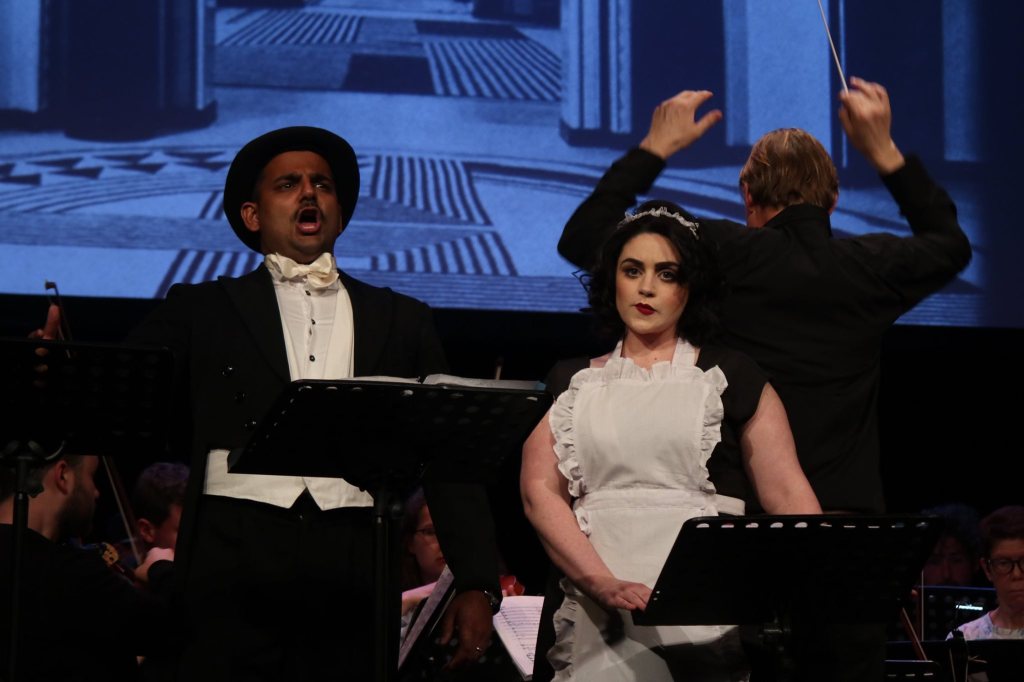
Shoumendu Schornikow as Jonny (left) and Rebecca Rashleigh as Yvonne (right). Image supplied.

IOpera is a not-for-profit chamber opera society founded by Peter Tregear and Gert Reifarth. On their website, they describe their central ambition as mounting chamber operatic works which are on the fringes of the repertoire. I commend IOpera on this gutsy manifesto. I believe it is supremely valuable to stage works which are rarely performed. There is really no downside to the experience as an audience member, because in the best case scenario, you discover a hidden gem. In the worst case scenario, you have an uncomfortable two hours but will walk out of the theatre with an enhanced knowledge of rare operatic repertoire (which you can put to good use at dinner parties). In either case you’ll at least have avoided sitting through Madame Butterfly for the four-hundredth time. (No disrespect intended towards Giacomo Puccini …)

The cast of this performance were supported by an orchestra of roughly twenty instruments (including a keyboard and banjo). Peter Tregear conducted the musicians with assurance, and they rose to the challenge of the music with great skill. During the opera, a series of slides were projected onto a screen behind the orchestra in style of the silent films of the 1920s. 

The mood of the opera was bewildering at times, as it was certainly didn’t qualify as a sombre melodrama but wasn’t quite a slapstick comedy either. The plot sees uptight composer Max strike up a relationship with the beautiful opera singer Anita. She is slightly more relaxed in her attitude towards life, and has a night of passion with violin player Daniello while on tour. Various escapades ensue, with Jonny attempting to steal Daniello’s violin by placing it in Anita’s banjo case, Yvonne being accused of the crime, and a madcap police chase across Paris.

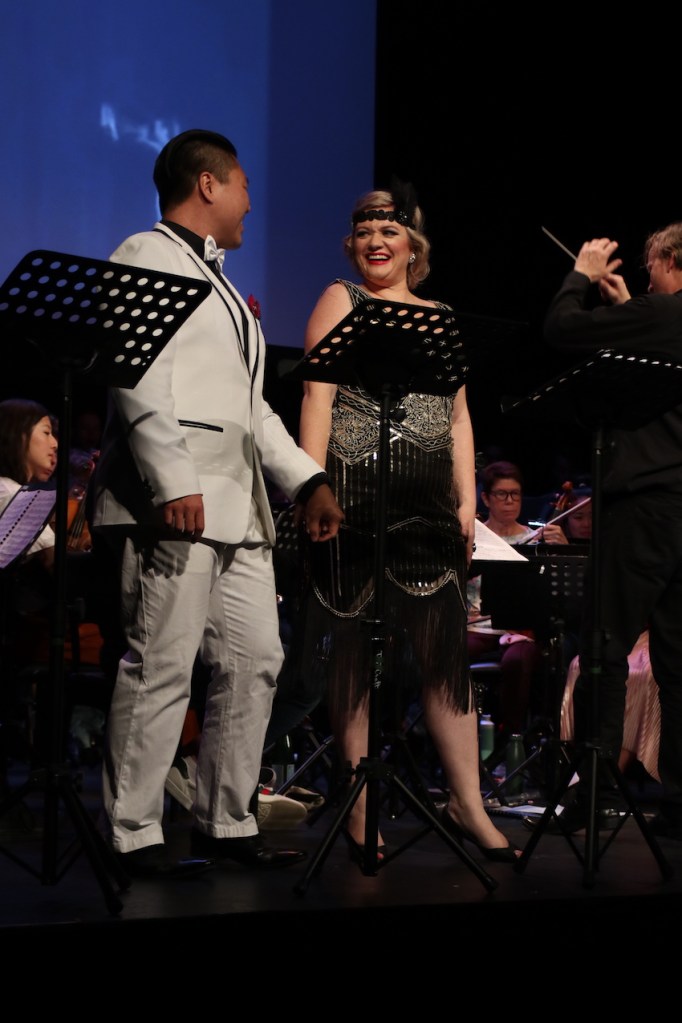
Raphael Wong as Daniello (left) and Lee Abrahmsen as Anita (right). Image supplied.

The cast were universally strong, with Fraser Findlay stepping in to the role of Max a week before the performance. Lee Abrahmsen was splendid in the role of Anita, showcasing her vocal agility and fabulously bright and powerful upper register. Raphael Wong lent a charismatic energy to the role of handsome violinist Daniello. Shoumendu Schornikow gave a balanced performance as the mischievous Jonny, playing off Rebecca Rashleigh’s sprightly energy and sparkling clarity of voice as Yvonne. The opera was sung in English, with a libretto by Jeremy Sams.

The cast did a great job of enunciating the English words, always a challenge with an operatic voice, however it should be mentioned that I was sitting in the front row and cannot speak for those seated at the back of the Athenaeum (a venue with a particular acoustic not always suited to opera). The chorus of fifteen or so singers produced a warm and expansive sound in their featured scenes. A musical highlight was the scene in which the female chorus members supplied the serene voice of the Swiss Alps, as Max desperately (and a little illogically) consulted the mountains for wisdom.

In staging Jonny spielt auf, IOpera provided a rich and interesting musical night at the theatre. I look forward to hearing of their future efforts in bringing rarely performed operas to the audiences of Melbourne.

Willkommen, Bienvenue, Welcome

Hello there! Welcome to Fever Pitch Magazine. Thank you for taking the time to read my review of IOpera’s presentation of Jonny Strikes Up.

The website is looking a pretty empty at the moment, because Fever Pitch Magazine will be officially launching on the 1st of November. From this date, I will be regularly posting articles, interviews, reviews of musical events in Melbourne and more…

This online publication is for, and predominantly written by, young musicians, music therapists, music educators, composers and arts administrators. My goal is to promote lively discussions on the many meaningful pathways open to those with a music degree or musical training of some kind.

Please return after November 1st if this piques your interest!

With thanks,

Stella Joseph-Jarecki