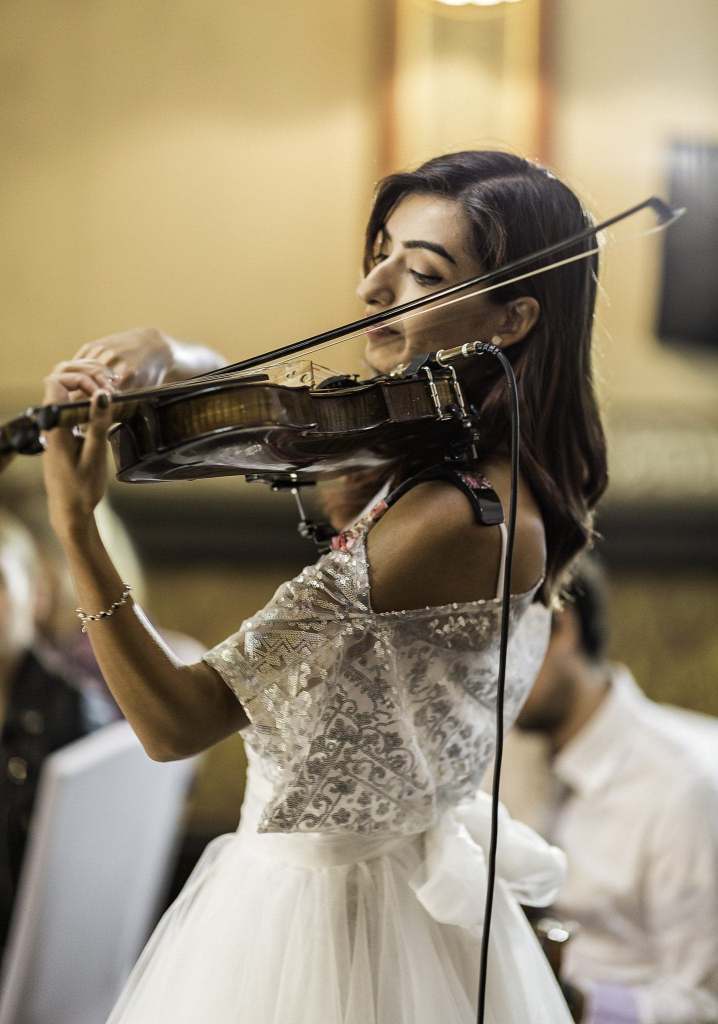
Bridgitte grew up loving everything creative, especially in music and art. Her passion for playing the violin lead her to study a Bachelor of Music and Masters of Music (Performance Teaching) with Primary Suzuki Violin Accreditation at The University of Melbourne.
Her fascination with music’s ability to inspire and bring joy to others as it did to her has influenced her career as a violin teacher and freelance performer today. She most enjoys teaching her students and developing their skills in music, knowing these skills also help in many other aspects of their lives.
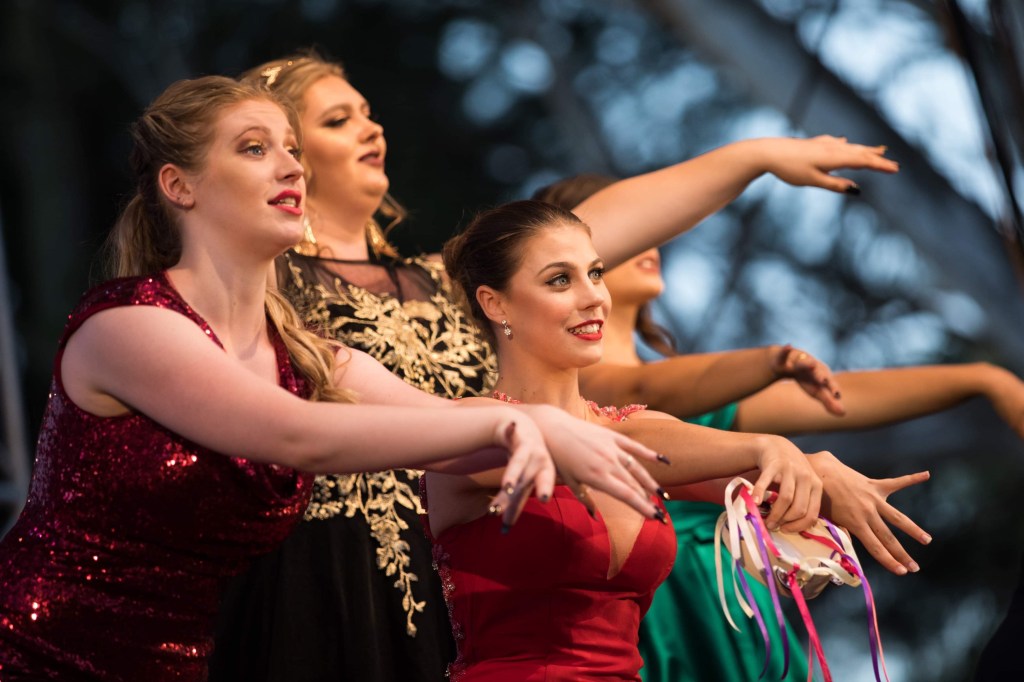
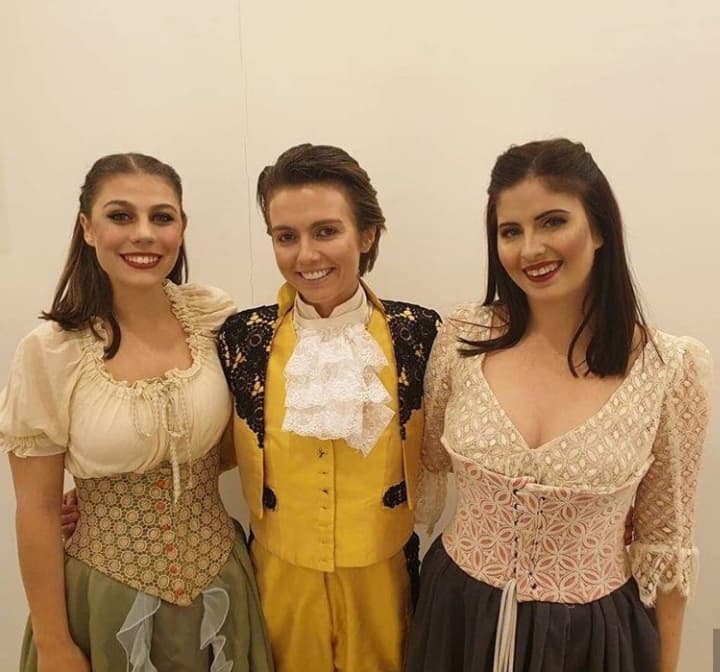
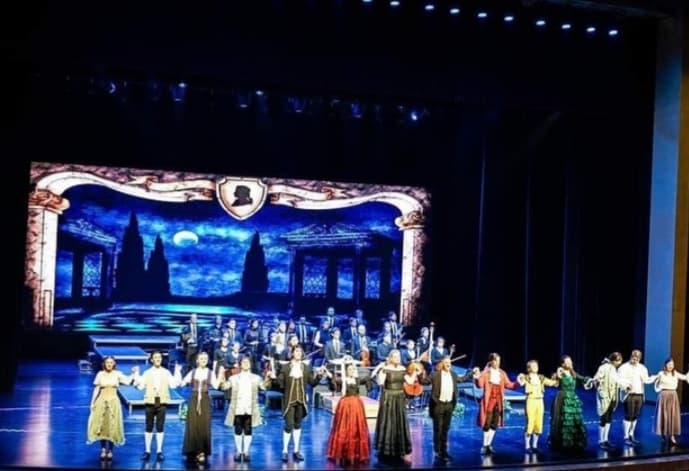
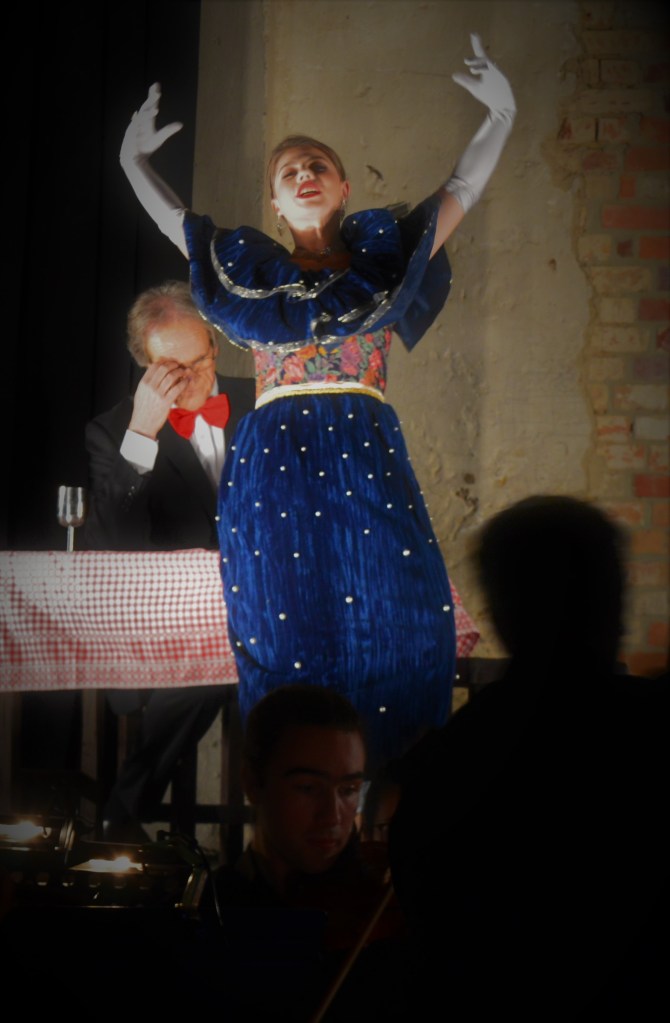
I had the chance to speak to soprano Jordan Auld, whose first year out of her music degree saw her tour China as part of the ensemble of Australian International Opera Company’s production of The Marriage of Figaro. During this tour she also covered the role of Susanna. Later in the year, Jordan performed the role of Musetta in BK Opera’s season of La Boheme.
Jordan will next be seen on stage during Opera Scholars Australia’s Opera in the Market event at Victoria Market on February 17th. She will be one of the three finalists competing in the Scholar of the Year Aria competition. More information and tickets can be found here You can follow Jordan’s projects through her Instagram and Facebook.
When did you realise you wanted to pursue classical singing more seriously than a hobby?
It’s quite a funny topic, because when I think about going into music performance seriously, there was never really a definitive decision of ‘right, this is going to happen’. I was performing a lot as I grew up, after my mum put me into a little toddler class of dance, drama and music.
So I went to that class, I loved it, and I mellowed out a bit. I kept it up almost all the way through my schooling. So when it got towards the end of year twelve with talk of career paths, it was pretty inevitable… I was slightly leaning towards pursuing medicine, but really that was because I wanted to be on Grey’s Anatomy, as an actor!
With classical music in particular, I came to classical singing really late. I got told at thirteen that I had a classical sounding voice, but I was pretty adamant that I would be the next Beyoncé because of my dancing! My teacher at the time really thought I should look into classical, but me being a thirteen year old and feeling like I knew better, I danced around it and didn’t come back to it until year eleven. For my IB (International Baccalaureate) music subject, I had to present a wide range of genres. My teacher said to me if I wanted to do well, I was going to have to engage with classical voice. So I finally did.
But I feel like the more that you open yourself up to the world of classical music and opera, the more you fall in love with it. And it has gotten to the point that there’s nothing I would rather do.
What excites you about opera?
Everything about it! It’s the culmination of so many different art forms and the grandest form of storytelling.
While opera is carried by the voice, I feel like as performers, we are actors first. I feel like I have failed my job if I haven’t portrayed the events convincingly. You can sing through an opera, but if you don’t show the emotional side and the intentions of the characters, you’ve lost what opera is about. While you need to be convincing, you need to be vulnerable as well.
When it all comes together, as an audience member I almost feel fireworks in my chest.
So you’re currently working full time alongside performing with Opera Scholars Australia, how do you approach time management and self-care?
During year eleven and twelve I completed IB, the International Baccalaureate. IB is probably the biggest mammoth of a multi-task you can possibly endure at the one time. You’re juggling a lot of stuff for a really small outcome, which feels like the be-all and end-all at the time.
So in year eleven my parents sat me down and instilled in me importance of time management. Prioritising things that were due the next day over things that were due in a week. At the time I didn’t warm to it, because I was one of those people who thought I could do everything, all the time.
In regards to juggling performing and working, I got my first job at fourteen and have never not had a job. So the over time, balancing musical commitments with study and work has become a normal thing for me.
In regards to self-care… being a dancer, I’m able to listen very closely to my body and work out when I really need rest. I find small things like going for a walk or having a bath are helpful. Baths really help, that feeling of lying down and shutting your mind off.
Could you talk to us about the tour of China, which you undertook in March of 2019 with the Australian International Opera Company?
So we toured a version of The Marriage of Figaro, cut down from four hours to ninety minutes. We took the show across China on a schedule similar to what you would see for a typical musical theatre season. For opera singers, that’s quite uncommon, as seasons normally have rest days between shows. And rest days are so important!
So it was a matter of trying to build up the stamina to be performing either once a day and having the following day off, or doing a double show… That was definitely a learning experience. And when you put the travel on top of that too! You really learn that you have to pace yourself, because you really can’t sprint in a situation like that.
It got to a point where we surrounded by so many people all the time, and I’m such an extravert, but there were times where I just wanted a little time to myself… so I’d get up and go to the gym really early in the morning. Listening to what I needed was important. Because we were travelling together, performing together, going out together, exploring the cities together… I did need a bit of extra time reading, having a bath, working out at the gym, going to breakfast early.
Looking back at it, during the tour you’re so in the thick of it, everything’s happening. But when a couple of months have passed and you’re looking back, it’s like, oh my god, I can’t believe we got through that and we were all sane at the end!
The beauty of opera and live performance is, depending on how everyone is feeling, each show is different. When you are on a tour, you have a bit of freedom with things changing and adapting. Coming straight out of university, it was such an exciting time to have that as my first big professional engagement.
It was an insanely packed six months… I basically had about a month and a half to learn Marriage of Figaro, which we then performed for about a month, while I was simultaneously learning Musetta from La Bohéme.
What were some of the most challenging moments of your Bachelor of Music and Honours year?
The transition from high school to university can be quite challenging. You get to the end of year twelve and you feel like a big fish in a small pond. Then you get to university and you realise that your pond has expanded… it’s a bit of a cultural shock, but it’s a healthy thing too. So navigating that and allowing myself to step back was challenging. Especially as I moved down from Sydney, I knew it was going to be hard in some ways.
I remember in second year, I was becoming so emotionally attached to my music, that it was hindering my progress because I was becoming so possessive of what I was producing. And it was becoming quite detrimental and unhealthy. So I realised I had to reach out, and I had a chat to Dr. Margaret Osbourne, who runs the subject Peak Performance Under Pressure. And that was when I noticed I had to step back and realise who I was, outside of a singer.
Because when you are at school, you try so many subjects and you also have extra-curricular stuff. And from that, you pick your favourites, and your favourites become your career, and it’s almost as if you’ve lost that extra-curricular element because it’s now your life. Sometimes you need to take a break and do something else.
And what were some of the most rewarding moments of your degree?
I did the Chamber Ensemble performance subject during my Honours year, and I absolutely cherished being able to work intensely with instrumentalists. When you’re making music with a small group, the sensory experience is so heighted. For me that was really rewarding.
In semester one I got to work with a cellist. I remember there was a time the group was rehearsing and there was something I wasn’t communicating musically. And Andrea said, put your hand on the back of the cello, sing and then listen to Josh while he’s playing. And it completely changed how I was looking at the piece.
A bit of a mean question, but could you tell me some of your favourite composers for the voice?
I’ve been listening to a lot of bel canto opera lately, which I’ve been loving. It can be a little daunting and scary to listen to because there’s typically a lot of coloratura! (Fast-paced virtuosic vocalisations). I’ve really warmed to Rossini in particular. I love Il Viaggioa Reims, which I saw in Melbourne. I felt like it really changed me. His style is florid and virtuosic, which I see as a bit of a challenge.
I am a sucker for Puccini. I think every soprano is! He writes such beautiful music. And all of his operas somehow connected in a way, so listening to La Boheme and going back and listening to parts of Suor Angelica, there are elements that are really similar. I really love how connected they are. Those are the sort of things you only find out when you get to perform a lot of his works.
Another composer I really love, but haven’t had the opportunity to perform much of his work, is Fromental Halévy. I saw his opera La Juive in Munich and it was life-changing.
Do you have a handful of dream roles?
It’s funny thing, actually thinking about dream roles. During uni I went through a period of having to find out who I was apart from a performer. So you start to detach yourself a little and come to peace with the idea that some things may not happen for you.
I think a dream role would be Rachel in La Juive, that would be amazing. I would love to do Violetta from La Traviata. She’s such a multi-dimensional character and to bring her to life requires so much… I really see that as brilliance.
Soprano Jordan Auld, is a vivacious, dynamic and versatile performer. Trained in Classical Voice and Opera at the Melbourne Conservatorium of Music, University of Melbourne, Jordan graduated with a Bachelor of Music (Honours) in 2018 and continues her performance, engaging in opera, chamber music, recital and concert work.
For the 2019 season, Jordan experienced an array of exciting opportunities including; travelling to China in March, covering the role of Susanna in the Australian International Opera Company’s production of Le Nozze di Figaro whilst also performing in the ensemble. Upon returning to Australia, Jordan workshopped excerpts and scenes from Le Nozze di Figaro where she performed Susanna for the Lyric Opera of Melbourne’s, Director workshop. Straight after, Jordan made her role debut as Musetta in Opera Van Diemensland’s production of La Boheme, receiving praise for her “vivacious Musetta” (Stage Whispers). Jordan reprised this role again with BK Opera towards the end of the year in their intimate opera in a pub adaptation to great acclaim.
Recently, Jordan travelled to Brisbane performing in Pucinni’s three one act operas in a rare staging of, Il Trittico. Jordan performed in all three operas as lovers in Il Tabarro, Suor Dolcina in Suor Angelica whilst also covering Suor Genevieve, and was the Lauretta cover in Gianni Schicci.
A pianist, accompanist and vocal coach of extraordinary versatility, Argentine born Andrea Katz is equally at home with Chamber Music, German Lieder and Grand Opera.
She studied piano with Vlado Perlemuter in Paris, Alexander Tamir in Jerusalem and specialised in the interpretation of German Lieder with Graham Johnson in London.
Since becoming an Australian resident in 1990, she has worked with all major musical organisations in the country: Opera Australia, Victorian Opera, Sydney Symphony, Sydney, Perth and Brisbane Festivals, Sydney Music Conservatorium and Melbourne Symphony Orchestra.
A prolific recital pianist, she performs regularly with prominent Australian and international singers and ensembles, including a yearly season at the Art Gallery of New South Wales Resonate Series. Highlights of the last 11 seasons are recitals with Yvonne Kenny, Peter Coleman-Wright, Emma Matthews, The Sydney Omega Ensemble, The Sydney Soloists, cellist David Pereira, and violinists Pekka Kuusisto and Gil Shaham.
She is the founder and Artistic Director of Songmakers Australia, Australia’s foremost vocal chamber music ensembles.
Since 2006 she is the Director of the Vocal Ensemble at the University of Melbourne Conservatorium of Music. She is currently a Lecturer in Music-Répétiteur and Convenor of the MCM Art Song Festival.
She has released 2 CDs with soprano Merlyn Quaife, Lest we Forget (TP185) and Fortune my Foe for Move Records.
I had the chance to speak to Andrea Katz, a busy pianist, repetiteur, vocal coach and true jack-of-all-trades. Andrea is the founder of Songmakers Australia, a vocal ensemble dedicated to the performance of art song and lieder. Songmakers Australia is the Australian branch of the Songmakers Almanac established in the UK by Graham Johnson. Andrea also teaches and accompanies voice students at Melbourne and Monash University, and runs the young artist development program the Young Songmakers.
Alongside Andrea, the current core lineup of Songmakers Australia is: soprano Merlyn Quaife AM, tenor Brenton Spiteri, bass-baritone Nicholas Dinopoulos and mezzo-soprano Christina Wilson. Songmakers Australia will soon be presenting a concert at Tempo Rubato, Crossing the Bar in collaboration with vocal ensemble The Gesualdo Six. Among the pieces performed will be Calvin Bowman’s piece Crossing the Bar. The full program and tickets can be found here.
The Young Songmakers can be followed on their Facebook page. Their next engagement will be taking part in the Beethoven marathon held by community radio station 3MBS on February 23rd.
You started your studies as a concert pianist. So I was wondering how you ended up as a repetiteur working intensely with singers and opera companies, was it a gradual transition or were the two paths intertwined from the beginning?
My life has been a serious of turns. Mostly dictated by the universe! I was always attracted to vocal music. There were many records of great singers in my house. I come from a family of musicians so there was always music around, of all kinds. My mum played in an orchestra until a few years before she died. One of my first memories is of me sitting on the floor in the middle of her chamber orchestra rehearsal, just looking up at it all going on!
The idea of being a concert pianist was always there… and then you face reality. Looking back, I’ve realised that in order to be a concert pianist, I was probably about two or three years late every single turn. And the expectation is getting earlier and earlier. By the age of sixteen, if you’re not at the top of your game, that’s it, you’re late.
So I was about three or four years older than that. And by being later and saying to myself, okay, so I will go to a new place and I will start trying again, what happened was… it turned out that I had been collecting all of the information that I needed in order to be a repetiteur and a collaborative pianist.
When I look back, the career that I have is the result of everything I have done my whole life. I don’t have any regrets over not being a solo pianist. I say solo pianist, not concert pianist… If I need to play a solo I’m able to play a solo, if I need to play with the orchestra, I’m able to play with an orchestra. In general my life is so much more fulfilling because I have so many other things going on. And that includes teaching!
On the topic of education, you’ve run the Vocal Ensemble subject at Melbourne Conservatorium of Music since 2006. Being in that class was a highlight of my degree because we actually got to get out there and sing a whole range of stuff! The first time I ever learnt passages of coloratura (virtuosic fast paced vocalisations) was for a piece for Vocal Ensemble.
Does it get easier over time to find repertoire for young singers? Some singers come to you when they’re eighteen and they’re very fresh, and some singers come to you when they’re twenty-two and you can throw them in the deep end a bit.
During the first two or three semesters of Vocal Ensemble it was a little difficult to select repertoire. But then this magic thing started happening, where people kept coming back.
In theory you only need to do Vocal Ensemble once. But you have the students who return. The ones that do it for credit, the ones that do it not for credit, the ones that have finished university like in the case of opera singer Daniel Todd… Daniel was in the middle of a law degree after completing his music degree, and actually came back to watch and participate in the class for a semester, as a kind of musical escape!
The class has evolved into this fluent thing, where you always have people coming back who take the new students under their wing. There is much more of an integration of the voices. And even if the repertoire sometimes is slightly out of the reach of the person assigned to it, by working with a group, it elevates them.
A similar thing has been happening with the Young Songmakers singing alongside the senior Songmakers. They have been working with me for a year and they have been developing and they are all very, very talented. But the moment you combine them with the senior Songmakers, suddenly it’s like, whoa. They start breathing in a different way, they start projecting in a different way… and it’s not forced, it’s just this osmosis of musical skills.
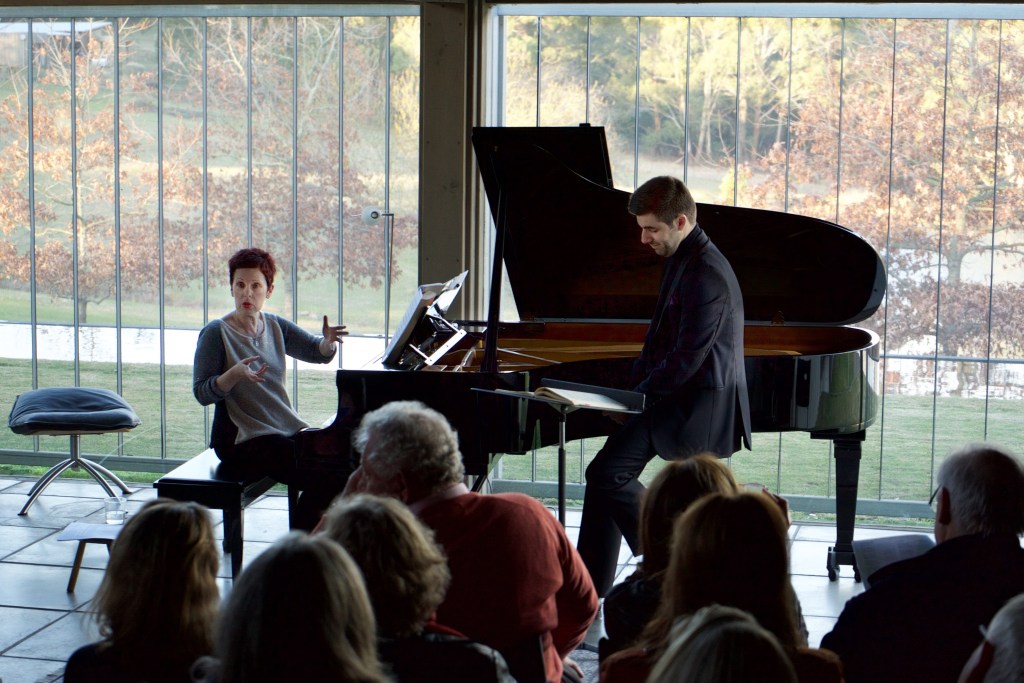
Andrea Katz (left) and Nicholas Dinopoulos (right)
Is the Young Songmakers program something that developed naturally through doing Songmakers Australia with Merlin Quaife and Nick Dinopoulous, who both work in music education alongside having active performance careers?
It was the natural progression, first of all because our model which has been the Songmakers Almanac with Graham Johnson. They also have a Young Songmakers program.
One beautiful, serendipitous occasion was when Sally-Anne Russell, our original mezzo-soprano, decided after six years that she wanted to move on and do different things… So I got in touch with Christina Wilson, initially to ask her to take part in a concert which was coming up in three or four weeks. And she was absolutely magnificent and we just thought, she’s the right replacement. So I talked to her about it and she joined us. And the funny thing is, Christina studied in Manchester where she met her husband Alan Hicks, who is also a singer. And after moving to London together, they were actually Young Songmakers with Songmakers Almanac, under Graham Johnson!
Can you name a handful of composers who persistently inspire you? For someone who’s been in the game for as long as you have, it really means something when a composer’s work is still inspiring you decades and decades later…
Well you’ve touched on one of my favourite subjects. I’ve said this many times, I’m very honest about this… I love Schubert, I love Chopin, I love Beethoven and I have a very, very great affinity for Schumann.
But the only way that I can describe my relationship with Brahms is… Music for me very spiritual, very emotional, blah blah blah, whatever. And you can describe music as sensual or sexy, but that doesn’t mean you have that sort of relationship with a composer. But the only composer, andI mean the only composer, whose music makes me realize immediately that am a woman, is Brahms. And I have no idea why. I hear two notes, three phrases in Brahms pieces and I just go… okay, I’m a female!
Andrea with the 2019 Young Songmakers. From left to right: Alastair Cooper-Golec, Hamish Gould, Andrea Katz, Stephen Coutts, Emilia Bertolini.
In March 2019, you performed in the play 33 Variations, named after the 33 variations Beethoven wrote on a waltz by Anton Diabelli. You were on stage playing the variations throughout the play. What was your role in the production and how did you find the theatrical elements interacted with your performance?
The main character of 33 Variations is musicologist. She discovers that she is suffering from motor-neuron disease, after she has been given a very important grant to research the 33 Variations. She wants to find why Beethoven was so obsessed with something so trite as the waltz by Diabelli. (That’s her opinion, not mine!) So there are parallels between what’s happening in her life, and what happened to Beethoven.
The play is very clever. It’s in 33 scenes. It doesn’t touch on all of the variations, but it touches on all the influential ones.
The main character travels to Bonn, to the archives of Beethoven’s work and correspondence… And I cannot tell you how much fun we had searching through the materials, because you can actually access them online! In Bonn she meets a music librarian who becomes a very close friend. And while they start talking about Beethoven and his secretary Schindler, and Diabelli, there are flashbacks to scenes between Beethoven and Schindler. So you have scenes in the 18th century and the scenes in the 20th century. The one connection is the piano.
I learned the variations separately from the play, abstractly. In the same way you would approach any solo piano music. I did my analysis, finding the pulse of the music, etc, etc.
When we actually started rehearsing, none of those fundamental things changed for me in playing the pieces. I never changed the tempo of any of the variations to fit the action. Also, the choice of the variations are absolutely perfect. The author of the play actually worked with a very famous Beethoven scholar, so the choice of the variations was not left to chance.
What did change for me though, was the emotional attachment to the music. It proved to me that even abstract music does have a plot. I knew that before, but it became much clearer to me after working with actors at such a close proximity. During rehearsals we were talking about the situations, talking about the text, getting the dynamics. So some of the timing was changed.
It did become such an integral part of the performance. To the point that it was up to me to start the transition to the next scene. I would finish a variation in a way that would cue a lighting change, or the opening of a door. The variations very much became another character in the play.
Andrea Katz (left) and actor Ellen Burstyn (right) during the 2019 production of 33 Variations.
Do you think there is operatic repertoire that is often overlooked? Operas that you would like to see performed more frequently?
I think there is a lot of repertoire that is overlooked. For instance, there are some early Mozart operas which are really extraordinary. I remember working on Mitridate, re di Ponto with the Australian Chamber Orchestra. And Mozart wrote that when he was fourteen. There is something for everybody, there are three sopranos, two countertenors, tenors, baritones, basses, everyone! And it is extraordinary music and absolutely entertaining.
Cendrillon by Massenet is an absolutely magnificent opera that should be done much more. Pieces like Ravel’s L’enfant et les sortilèges should be done more, it’s beautiful and would attract a lot of young children to the opera.
So basically if you follow some of the really interesting new, boutique opera companies in Australia, that’s the sort of repertoire that bigger companies should be doing too.
As a very busy teacher, repetiteur, performer, coach…how do you tackle time management?
I’m a very disorganized person, but I’ve learned my lesson! So I rely more and more on planning and having a really clear calendar.
Sometimes the only way that you’re going to survive is by blocking two hours here and two hours there. You erase them from every booking calendar available for students or coachings. And that way you have those blocks in your personal calendar and you know you have that time.
I recommend to my students that they make a list of what they need to do the following day, and to actually cross the things they’ve achieved off their list. It’s very important to recognise all the achievements you’ve done in that day. It’s very foreign to my nature, but sometimes you have to learn to be organised!
And in more extreme cases, sometimes the only way that you’re going to survive is if you completely cancel one day. Because you’re overstretched and you really cannot do anymore. You apologized profusely, you lock the door and then you catch up with the world.
What have been some rewarding moments for you in running the Vocal Ensemble subject?
We did the Mozart Requiem in D Minor about six or seven years ago with the Melbourne University Orchestra. They approached me about doing it. And I said, yes I’ll do it, but all of the soloists have to come from the class.
So I had the four quartets, and one soprano at the beginning and the end. And the choir was made up of the biggest vocal ensemble class I ever had, we had 41 people. The entire semester was devoted to learning the Mozart requiem, and everyone sang everything except for the four quartets and solos. So that was a big one!
We did a Salon concert at the end of 2018 with Linda Barcan which was really gorgeous. We’ve done Vaugh Williams’ Serenade to Music with sixteen solos, we’ve done Brahms Zigeunerlieder. And in the oratorio concert we had at the end of 2019, we had large groups singing without a conductor leading any of the ensembles. A central philosophy of the class is to give singers the tools to be as independent as possible.
Joel Walmsley is a Melbourne based trumpet player who is currently studying a Master’s degree in Orchestral Performance at the University of Melbourne. Joel is a casual trumpeter with both the Melbourne Symphony Orchestra and Orchestra Victoria and works as a freelance musician in Melbourne.
Joel has participated in Australia’s top programs for young musicians including the Australian Youth Orchestra’s National Music Camp, Australian Youth Orchestra’s Momentum Ensemble and the Australian International Symphony Orchestra Institute. Internationally, Joel has attended the prestigious Aspen Music Festival in Colorado where he studied with Raymond Mase, and also the International Music Masterclass and Festival in Sicily, studying with Reinhold Friedrich and Kristian Steenstrup.
Joel is currently under the tutelage of Shane Hooten and has studied with Rosie Turner, Joel Brennan, Fabian Russel and Mark Fitzpatrick. Joel is also passionate about education and teaches in multiple Melbourne schools.
I recently had the chance to speak to Joel Walmsley, a young trumpet player currently completing his Masters of Music (Orchestral Performance) at Melbourne Conservatorium of Music. We talked about his experience playing with the Melbourne Symphony Orchestra during his second year of uni, his strategies for tackling self-doubt, and why he really loves Bach.
At what point did you realise that you wanted to pursue playing trumpet more seriously?
That’s a good question, and I feel like everyone’s answer to that is pretty different! One day when I was in year eight, my trumpet teacher said something like, ‘So next year you’re going to do this AMEB grade, and then you’re going to do your AMusA in year eleven, and then you’ll apply for this course…’and so on, and I had not even considered studying trumpet seriously at that point. It was a lot to hear and it kind of scared me. But the funny thing was, it turned out exactly how she predicted.
I never really had a magic moment where something clicked. For me it was a gradual thing. I think playing trumpet started to feel like a big part of what me, ‘me’. It was somehow tied in with my identity, and that made pursuing it a natural step.
It’s funny you mention that it was a gradual process. I’ve talked to many musicians who went through a similar mental process. And it’s not simply embracing the love you have for your instrument and performing, but accepting the fact that a creative portfolio career is always going to be unstable, unpredictable… the complete opposite of a reliable routine.
I’m trying to teach myself that I’m lucky to be in that position. The element of the unknown, things are dynamic and not locked in… the world is your oyster! So I try to remind myself that it’s a privilege and a beautiful thing, not a hindrance or big scary obstacle.
How did you find the experience of playing with the Melbourne Symphony Orchestra very early on in your undergraduate performance degree?
I auditioned for a casual position with the MSO during the break between first and second year of my undergrad… So early 2015. It was really exciting and really, really terrifying!
My first gig was playing Edgard Verese’s Deserts, as part of MSO’s Metropolis series. To this day, it remains one of the strangest and hardest works I’ve ever had to play! I freaked out about it, I listened to every recording, I got the score, I looked at all these different books which broke down the piece… it was a surreal experience, and such a weird piece. I remember the trumpeter Bill Evans jokingly saying ‘We’re going to ruin music for this poor kid forever!’
But it was a wonderful first experience with the MSO. What surprised me was how natural it felt. Playing with the MSO was something that had been a far-away dream for so long, and when you’re actually sitting in the first rehearsal, you’re chatting to people like you’re in a Melbourne Youth Orchestra rehearsal… if anything it’s more relaxed! To these people, this is their everyday, it’s like rocking up to the office for them.
I think back to those times and I think, ‘Wow, I was practically a child!’… not that I did anything embarrassing, but I think I was so overwhelmed by the experience that I didn’t quite take it all in. But I was extremely lucky to have that experience early on.
How do you conquer/ minimise nerves and self-doubt?
For me, self-doubt and nerves are two very different things, although of course they are intertwined. They affect me in very different ways. Self-doubt is a thing that affects me in the practice room rather than the stage.
I didn’t have too many issues with nerves until early on in my undergrad. I ran into a few speed bumps in terms of trumpet playing and they became the source of some anxiety. Over time though, I’ve learnt what I need to do to deal with nerves.
If I prepare properly, and I know exactly what would be the best-case or worst-case scenario, and I’m ready to accept either outcome, then I find myself in this mental space where nothing is going to surprise me. There are things that I know will be really good, there’s things that might be good, there’s things that probably won’t be good unless I’m having a really good day… if I am mentally prepared for all of those things to happen, then when I miss that big note, it doesn’t give me anxiety, it’s just like, ‘Ah well, that didn’t happen.’ And if I perform regularly, my nerves almost completely disappear.
Now self-doubt is a much bigger thing. Self-doubt in a much broader sense. I definitely find myself using less than constructive self-talk during periods where I feel more down. Wondering whether I’m going to ‘figure it out’ or ‘make it’ whatever the hell that means, and what that means for my relationships and future.
As part of my Masters of Music (Orchestral Performance), I’ve been taking a subject run by Dr. Margaret Osborne, Optimal Performance Under Pressure. During that subject we’ve talked a lot about changing the tone of our self-talk. It sounds cheesy, but practicing positive self-talk makes an enormous difference and can fundamentally change how you view yourself in the world.
I think people can feel as though performance nerves and self-doubt are an inevitability and they are at the mercy of these emotions. But it’s completely possible to harness those crippling nerves into energy that actually enhances a performance.
The whole mental health issue is something I wish institutions focused on much more heavily, and from earlier on. In music, everyone’s egos are on the line all the time and we’re constantly practicing to improve ourselves. It’s this inward dialogue of me, me, me.
Part of the issue is, many performer’s sense of self-worth comes from how good they think they are, compared to others on their instrument. Or how good they are on their instrument, full stop. And I’ve struggled with that. It’s a matter of separating who I am, from my ability on the trumpet.
How do you target breath control as a brass player?
Breath control as a trumpet player is different to tuba playing or trombone playing- lung capacity doesn’t matter as much. I’m a taller person with above-average lung capacity, but there are tiny trumpet players who would have half my lung capacity, who are absolutely incredible, far better than I am… it’s more to do with the coordination, using your air in a free and efficient way. And having a good understanding of the anatomy of breathing.
I was lucky enough to do some study with Kristian Steenstrup when I was at a trumpet festival in Sicily a few years ago. Kristian is one of the leading authorities on brass pedagogy, with an air-heavy approach. Some teachers don’t talk about air at all!
He taught me a handful of great breathing exercises which I do before I start playing each day. Basically, I strive to play in the most efficient way I can, relying on my air as much as possible and my lips as little as possible.
I’ve had to really work on my stamina and power in my practice over the years. For me, improvement comes from efficient playing with proper use of the air, and also just forcing myself to get used to playing high and loud by allocating part of my daily practice to that area specifically.
Favourite composer for trumpet/brass instruments in general?
Mahler is a composer who lets us have fun. For orchestral writing, Mahler, Strauss, Wagner, Bruckner, Shostakovich come to mind. They do tend to stick to fairly ‘traditional’ use of the brass section – fanfares, loud stuff, punctuation, and chorales. We do love playing that stuff, however I really enjoy the challenge of composers that blur the lines between the brass, wind and string sections in terms of their function – as though the music was written with a certain colour or texture in mind, rather than a certain instrument. Some of the great French composers do this really well.
Composers like Bach were writing incredibly decorative and brilliant trumpet parts during the Baroque era. These pieces are some of the most difficult pieces in the repertoire, played really high up in the register on natural trumpets. And for a period of about 200 years, the ability to do that was completely lost.
But after the invention of the valve, orchestral composers such as Berlioz embraced writing for trumpet for more than just arpeggios. I think any composer who uses the brass section for more than just the typical function is special. The use of trumpet as a wind instrument.
What is your favourite aspect of playing in a full-scale orchestra with around one hundred other musicians?
A teacher of mine once compared it to being on a sports team, or in a rock band. The feeling of playing amazing music in a huge orchestra is indescribable. You’re a part of something greater than yourself, something that makes people smile or cry or laugh or think. Those moments remind me why I’m pursuing orchestral playing as a career.
I go back to the example of the end of the Rite of Spring. It’s this really cool moment. If one person in the orchestra comes in at the wrong spot, the whole thing can fall apart. So about a hundred people are depending on each other for absolute perfection.
What do you think makes the trumpet unique?
I love instruments which produce a very pure sound, or a tonal quality similar to the human voice. The trumpet can produce a really expressive sound, almost like a singer without words. We can also produce an enormous range of dynamics. If we want to flatten an orchestra we can, but if we want to sound like an oboe, we can. A very popular piece for trumpet is the Alessandro Marcello oboe concerto, played on piccolo trumpet.
I love how versatile it is as an instrument. It sounds equally at home in a jazz group, rock band, big band, orchestra, chamber ensemble, a solo instrument…
Someone once said to me that brass instruments are the closest instruments to the human voice. Vocalists have the voice-box, brass players have their lips. Other instruments use strings or a reed to produce a vibration… with singing, the vocal chords produce the vibration and the head is the resonating cavity. Similarly, with trumpet, our lips produce the vibration, and the entire body of the trumpet is the resonator, amplifying the sound. That’s why trumpet players love listening to singers, chatting to singers about breathing… I sing in my practise all the time! I don’t feel like I’m a great singer, but it’s connecting to that feeling of resonance, of your body feeling free to resonate as much as it wants.
So what does an ideal musical career look like for you?
At the moment I am doing an orchestral master’s degree. I would love to play in an orchestra. Getting there is the hard part but I’m going to do everything I can! But I’m excited by how any different things you can do with music.
What is an aspirational piece of music you’d like to play one day?
Bach’s Brandenburg Concerto No. 2 in F major. If you know, you know.
Being completely honest, I haven’t felt up to writing motivational or optimistic opinion pieces recently lately. While I want Fever Pitch Magazine to be a place where tired and disillusioned creatives can come to feel a sense of solidarity in struggle, sometimes pessimism is the only emotion I feel.
And it seems hypocritical of me to preach transparency and a warts-and-all approach to this strange industry, without admitting to my own frequent periods of non-existent motivation. I’ve been mulling over this lately, looking for a catchy phrase to turn tiredness and disappointment into a motivational quote. But the truth is, a pithy quote doesn’t always exist. Sometimes pessimism is all you’ll feel. The music industry is a hard place to thrive for so many reasons: unstable budgets, frequent cuts, the challenge of believing in yourself as an artist, the limited number of jobs… Admitting that is not weakness. It is realism.
The concept of the versatile portfolio musician is a well-known one, and one born from necessity. Most people simply aren’t able to make music performance their full-time career path. We must accept that frequent compromises are needed to survive, unless we have the luxury of a trust fund. But we can take a leaf out of Bear Grylls’ book: adapt, improvise, overcome.
And there are many positives which can come from abandoning the rose-coloured glasses: in looking for work outside of your original blueprint, you might discover a new passion. Many people stumble into the world of arts administration, having had no pre-conceived ideas of entering the field. It is a fascinating world in of itself, and certainly not some sort of consolation prize for failed performers. But sometimes fantastic opportunities will look nothing like you imagined.
So how can you conquer these period of feeling flat, restless, unmotivated, angry? If you have to wait for it to pass, that’s what you do. You take things day by day. Speaking from my own experience, it is so easy to get bogged down in that state, and to feel too tired to try new things. My advice is to find an activity that gets you out of the house, something that forces you to concentrate relatively intensely, but something that most importantly you find enjoyable. It’s a great thing to get your brain firing in an area that is unrelated to your career or main creative pursuits. I’m going to try some adult ballet classes, and rejoice in having absolutely no ambitions in ballet except improving my posture and strength. Other ideas could be taking up hiking, martial arts, painting, sculpture…
During frustrating times it has helped me to remember that ‘the only way out is through’. No matter how much it may feel like it, you have to remember that you are not stuck. You are in motion. It may not be pretty, but you can use your uncomfortable, disconcerting, murky periods of self-doubt to figure out why you feel that way.
Singer, musical director of Trinity Choir at Trinity College, Melbourne University
Christopher Watson has been Director of Music at Trinity College, Melbourne, since January 2017. Before moving to Australia he spent 20 years working as a freelance singer and conductor, based in the UK. He has given many performances of the Evangelist role in Bach’s Passions including in the Cathedral of the Madeleine Salt Lake City, Merton College Oxford, Christ Church Oxford, Canterbury Cathedral and the Philharmonie in Berlin and has worked as soloist for Paul Hillier, Paul McCreesh, Philippe Herreweghe, Trevor Pinnock and with the CBSO, Le Concert Lorrain and The Lautten Compagney.
He made his debut with The Tallis Scholars in 1998 and went on to make over 500 appearances with them. In 2007 he made his debut at Carnegie Hall with Theatre of Voices, giving the world premiere of David Lang’s Pulitzer Prize-winning Little Match Girl Passion, their recording of which won a Grammy Award in 2009. He returned to Carnegie Hall with Theatre of Voices in February 2015 to perform Stockhausen’s Stimmung. He also sang regularly with Tenebrae, the Gabrieli Consort, Collegium Vocale Gent, Alamire and Gallicantus and has made over 100 recordings of repertoire by, among others, Dufay, Josquin, Tallis, Byrd, Lassus, Bach, Berio and Pärt. The latest disc by the Choir of Trinity College, featuring a Mass by Ross Edwards, was released in 2019.
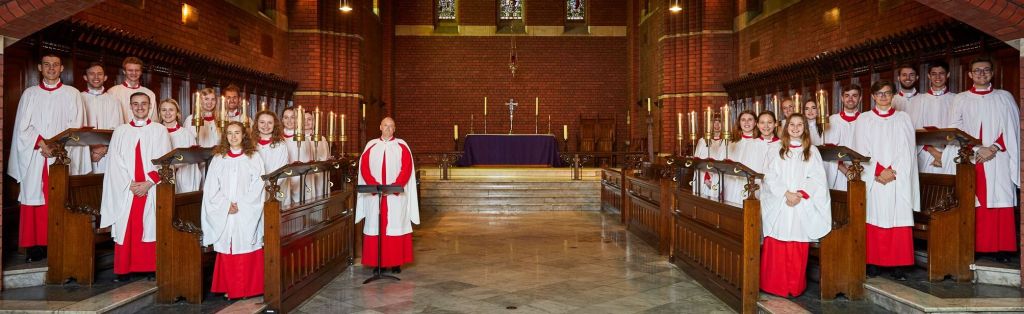
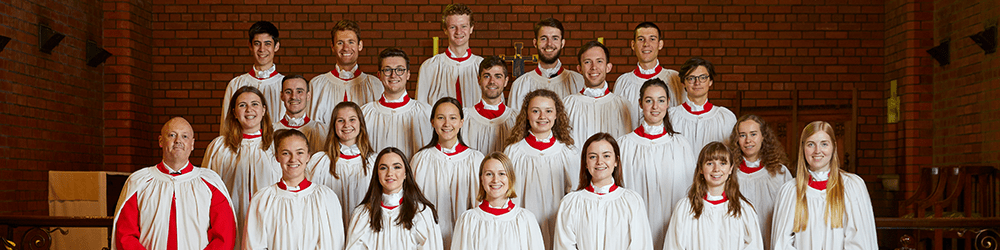
Recently I had the chance to speak to Chris Watson, musical director of Trinity Choir at Trinity College, Melbourne University. Chris is an accomplished singer originally from England, who has had a long career singing with renowned chamber groups such as Tenebrae and the Tallis Singers. Trinity Choir is a mixed voice college choir modeled on similar ensembles from Cambridge and Oxford. I was particularly interested in asking Chris how choirs steeped in history such as Trinity are bringing their music making into the 21st century.
Trinity’s latest CD Land of Dreams was named Limelight Magazine’s Recording of the Month for October 2019. You can read the review here
In January 2020, the choir will be embarking on an American tour, in collaboration with a number of American college choirs.
If you are intrigued by what you read below, auditions are now open for Trinity’s 2020 season (starting in March). In order to be eligible you must be studying at a university in Melbourne. Choral scholars receive an annual stipend of $4500, and participate in two rehearsals and two services a week. You can find out more about the program here and apply for an audition here
You’ve been musical director for Trinity Choir since 2017, after previously being based in the UK. Do you find that traditional church choirs like Trinity are viewed in a different way in Australia than in the UK?
One of my biggest challenges is recruiting, and fighting against the perception that singing in choirs isn’t good for you. Trying to encourage people to see it as an important pathway, not necessarily into the musical world, but into any connection with the arts, through the experience you get as a performer. Trinity Choir has some quite illustrious alumni, Siobhan Stagg being the most famous.
One thing that I’ve noticed, I get told off occasionally for sounding critical and I don’t mean to, is that there isn’t a tradition so much here of sight reading. And all the core ensemble skills that are required to do the kind of stuff that we do.
I find people sometimes talk about choirs in the way they wouldn’t talk about string quartet, for example. You wouldn’t find a violinist saying things about small string ensembles that some singing teachers say about choirs. So that’s been a bit of a fight.
It’s interesting to note that in the world which I’ve come from, if you’re an undergraduate at university, singing in the college choir like Trinity, you wouldn’t be studying music. You might be studying music as an academic subject, but you wouldn’t be studying voice at a Conservatorium until postgrad. Whereas here, you’re doing both at the same time at the age of eighteen. So a lot of them get knackered! And that’s one of the differences I’ve started to notice.
What would you say to someone who doesn’t know as much about these college choirs and how they work? What do they offer in terms of a program for young singers?
The reason these choirs exist is to provide the backdrop to worship in a college chapel. They’re modeled on the Oxford and Cambridge model, where the choirs accompany the church services. The more famous ones still have regular services.
A by-product of providing the backdrop for services is that we get through a huge amount of music. We do two services a week, all together that’s about twelve different pieces of music a week, on two rehearsals. So you have to hit the ground running! It means you might not necessarily refine things as well as you would if you were doing a concert.
Our concert programs tend to be sacred music, and when I’m programming the services my primary purpose is to find something that’s liturgically appropriate or features a text from one of the bible readings. But I’ll also have a mind towards the concert program for that year. We tend to do two Masses a year… This year we sang the Vaughan Williams Mass in G Minor.
Next year I’m going to program Hubert Parry’s Songs of Farewell. There are six of them so you can put them down as anthems. When we learned Ross Edwards Massof Dreaming for the Land of Dreams CD this year, we learned it gradually movement by movement. We performed little bits of it in services and gradually put it all together. We also did the Aro Pärt Passio this year.
We tend to do an international tour every two years. And in the off year, we do a domestic trip and try to do concerts locally as well.
Are the local concerts organised by the college or by you as the leader of the choir?
I organise the additional concerts. We also get invitations occasionally. We were invited to sing at the Peninsula Summer Music Festival this year. But when the directorship of a choir changes, it takes a little while for the reputation to build back up again.
Next year we have a couple of joint concerts planned, one with a choir from Sydney. We also have plans to work together with the Conservatorium and do some performances with the baroque string ensembles. We’re singing with Eric Whitacre when he comes to Monash University, and we’re doing another collaboration with The Song Company. And potentially we have an exciting recording project in the works…
Because of our commitment to singing the church services, and because the students are obviously studying, there’s a limit to how much we can fit into a year’s season.
What are your thoughts on the criticism I’ve often heard from singing teachers, that singing in choirs like Trinity which demand quite a lot of your time, can be harmful to your developing vocal technique as a soloist. (I’ve always taken that with a grain of salt, you obviously don’t want to burn out with too much on your plate, but surely as long as you are singing with your support switched on and not mindlessly draining yourself, choirs can be fantastic)
I would counter, that choirs like Trinity provide an unparalleled music education for eighteen year olds, and as long as they’re being encouraged to sing healthily… I certainly encourage my singers to sing healthily, I know that a lot of organist conductors don’t do that. I’m not one of those, I’m a singer conductor.
After a few years of working on your musicianship skills, you can go on to study voice if you want to be a solo singer. I would put it that way round. And that extends to me, I mean the fact that I am fifty and my voice is still healthy, after singing in the Tallis Scholars for twenty years, proves it’s quite possible to do both. You can sing healthily.
In terms of what I ask the choristers: I try never to use the word blend. I think a choir should be a sum of its parts. I think an engaging sound comes from everyone singing properly. If one person is singing three times as loud as everyone, it’s not going to work! But I ask, particularly the sopranos and altos, to match volume and vowel sound.
I recently heard one of the singers say, ‘I don’t think I can be in Trinity next year as my solo voice is becoming too big.’ And I didn’t say anything at first, but about three weeks later I said, ‘Come on, there’s no such thing as a ‘solo’ voice and an ‘ensemble’ voice’. I mean, that’s not entirely true, but certainly in the context of these young developing voices. I just want them to sing!
I’m not going to force the choir to make a sound that they cannot make. I don’t want them to feel like they have to hold back.
You mentioned that you are recruiting for next year?
Yes we are, for starting in March 2020. We’re particularly interested in hearing from sopranos! And on the topic of auditions, and what I said earlier about sight-singing in Australia- it’s no one’s fault, it’s that students haven’t been taught. It’s to do with how you’ve grown up and the pressures you’re under, and the kind of repertoire you’ve sung.
But I would argue that the benefits to the brain have become quite clear in studies. There are so many reports about the benefits of reading music, particularly about sight reading. I don’t there’s an excuse for not doing it! You wouldn’t teach a language without teaching reading, and music is a language.
In terms of auditions and sight-singing music, I don’t expect people to get it right the first time. I’m looking for someone who can notice where they went wrong, and to get it right by the third time. I supply all the music for auditions in advance, so it’s up to them if they want to spend a bit of time learning it.
The flipside of being a singer who relies totally on their sight-singing skills, is the interpretation of the music is at risk of being more shallow. But it does mean that when you have a tight time-frame in rehearsals, you can jump straight into the music making and not spend time learning the notes.
So how much freedom do you have in choosing repertoire?
I have complete freedom in choosing pieces, but obviously there are certain parameters. Selection is mostly determined by the text. I would actually call myself a bit of a liturgy geek! Some texts can be sung everyday and some are seasonal, like Lent. Once I know what text we need, I also look at difficulty of the pieces. So if there’s a really tricky piece, I also try to program some simpler ones.
Do you enjoy finding repertoire that isn’t as commonly performed?
I like a little bit of everything! I try to commission new works every year. In 2017 we commissioned a piece from David Bednall, who is an English composer in the Howells/ Walton tradition. His piece was as if Kenneth Leighton, Herbert Howells and William Walton came to Australia and had a love child…
Last year I commissioned Alice Chance, a young composer based in Sydney. Dan Riley is a member of the choir who also writes a lot of music for us. This year we commissioned Brooke Shelley, she’s also based in Sydney. Next year we’re commissioning an American composer to tie in with the American tour. In 2021 we will be performing a piece by Sarah Thompson. And in the meantime, anyone who wants to send me a piece, we’re always looking to perform new works!
I don’t want to sound evangelical, but as a recent immigrant, I really like being in Australia and I think it’s important that we promote Australian music. Every CD I’ve done with Trinity has featured contemporary Australian music alongside other music. I want to program contemporary Australian music against the best music of other genres.
I hate the word vision, but what would you love to see Trinity choir do in the next few years?
One of the sticking points is the fact that we are a church choir. People don’t want to go to church anymore. It’s trying to persuade people to come to this particular liturgy, which just involves sitting quietly for half an hour with their eyes closed listening to beautiful worlds and music. A kind of meditation, really. That’s not to downplay the religious side of it, but I think you can get what you want out of it.
A lot of people avoid it because they think they won’t get anything from it. But I think these liturgies have a lot to offer everyone. They’re increasingly popular in the UK, some people describe it as a sort of ‘mind yoga’. I know a lot of atheists who go to Evansong!
Stained glass windows in Trinity College interior. Photo credit: Stella Joseph-Jarecki
Stephen Hough is a pianist who wrote a lovely short article about Evensong, about how it how it affects him… [I have copied Stephen Hough’s paragraph below]
“Evensong hangs on the wall of English life like an old, familiar cloak passed through the generations. Rich with prayer and scripture, it is nevertheless totally non-threatening. It is a service into which all can stumble without censure—a rambling old house where everyone can find some corner to sit and think, to listen with half-attention, trailing a few absent-minded fingers of faith or doubt in its passing stream. Most religious celebrations gather us around a table of some sort. They hand us a book, or a plate, or speak a word of demanding response. They want to ‘touch’ us. Choral Evensong is a liturgical expression of Christ’s Nolle me tangere – ‘Do not touch me. I have not yet ascended to my Father’ (St. John 20:17). It reminds us that thresholds can be powerful places of contemplation; and that leaving someone alone with their thoughts is not always denying them hospitality or welcome.”
One of the things I would love, is for people to see what we do as an approachable thing that anyone can come and access. The chapel’s open. We are there for the community, but we are there for everyone. No one’s going to try and convert you! It can be a friendly place. I mean, you can leave thinking ‘God is doesn’t exist, but that was a nice tune and those words were quite pretty!’
And the other thing I think is just to encourage the idea that high-quality choral singing is a good thing. And idea that sight singing and all the skills required are actually valuable skills, not just for music making but for language skills, mathematics, any of those things…
It would be lovely if there was a bit more rigorous discipline in music learning. Particularly, if people could start taking choirs more seriously, and stop thinking that it’s just something that failed soloists are doing. Not to dismiss them as being damaging to the voice. They can be a fantastic, healthy musical environment for young singers!















 Fever Pitch Magazine