Selfish, self-centred, self-absorbed, self-serving. All of these terms skew negative; selfish implies a person who is happy to put themselves first to the detriment of others, even when they have other options. The other three call to mind a person who would think about every event in relation to themselves, or who may not even consider that other people and their problems exist.
What are the words that exist at the other end of the spectrum? I’ve always found the phrase ‘self-care’ a bit grating, but the definition is rather lovely: “The practice of taking an active role in protecting and maintaining one’s own well-being and happiness, in particular during periods of stress.”
I’m trying to become more conscious about putting myself first, or more accurately, in the centre of my own plans for my own life. (Which is pretty logical when you think about it.) It doesn’t sit naturally with me but I’ve found a good way of framing it: you either develop an ego, or you learn to act like you do.
I used to be reluctant to take on new opportunities because I vaguely thought I needed to be ‘ready’ first, and perfect my skills in theory. A few years ago I would never have started up a blog! Although that wasn’t entirely due to lack of confidence- I didn’t want to start a blog unless I knew I could structure it well and tackle particular topics I was passionate about. After a year of studying musicology, I realised I could treat a blog as means to an end, the end being practical journalism and writing experience.
The following two quotes helped me completely flip my mindset on being ready/ taking random opportunities life throws you:
It’s aterrible thing, I think, in life to wait until you’re ready. I have this feeling now that actually no one is ever ready to do anything. There is almost no such thing as ready. There is only now. And you may as well do it now. Generally speaking, now is as good a time as any.
Hugh Laurie- Actor, writer, musician
If someone offers you an amazing opportunity but you are not sure that you can do it, say yes, and work out how to do it later.
Richard Branson- Serial entrepreneur, founder of Virgin Airlines, general out-of-the-box thinker
The way these two men describe it (and it’s worth noting that both have had sustained and successful portfolio careers), the willingness to take chances and try new things can be learnt. And it’s true! You can become better at putting your hand up, without being stopped by the thought ‘Am I worthy of this opportunity?’. You’ll probably never stop asking yourself that question, but you can learn to ignore it.
To be honest and quite rude, the world is full of people who may not deserve the opportunities they have been given (look at the president of the United States, and the person who wrote a few chapters of Twilight fan fiction and got a book deal and a multi-million dollar film adaptation in exchange). They aren’t apologising, so why should you?
Now for some music-orientated thoughts on the topic… After years of being an avid music student, soaking up everything said to me by teachers and coaches, I’ve realised the best thing I ever did for myself as a performer was concentrate my energy on the skills that had nothing to do with singing.
Being a capable singer is a matter of discipline, technique and healthy sound production. I’m not downplaying the skill of being able to accurately replicate pitch and rhythm, read music, and be heard across a concert hall. But those things alone don’t make you an artist. Interpretation, acting, nuance of phrasing, being generous with your colleagues, telling a story, having charisma on stage… These are the qualities that make you a performer. And they require you to form your own opinions.
Photo credit: Stella J.J.
More than becoming technically faultless, my ultimate goal is to become an independent artist who is capable of maturely receiving constructive critique, but is still strongly guided by my own internal compass and creative ideas. Finding some midway point between trusting myself, but still being able to listen to others.
Listening to mentors and experts is essential but it can be hard. Especially if you’ve thrown years of your life and thousands of dollars at a dream of singing opera in Europe, for example.
Over the course of many conversations during my degree, I learnt that while there are hundreds of opera houses in Europe (Germany has one in almost every town), there must be thousands of singers. The general standard of talent and technique that a top or mid-tier opera house would see during their auditions would be staggering. I have no doubt there would be hundreds of working singers in Europe who could become star soloists overnight. They might spend their entire careers singing in the chorus without progressing past an audition.
So the odds are intimidating and kind of ridiculous. Why would anyone bother? I guess the better question to ask is, why not?
Nothing is certain. In many sad and scary ways, COVID-19 has proven that. So if chasing a difficult dream is what you want to do, I absolutely respect that. Go for it. But go for it with your eyes wide open. Know that things aren’t necessarily ‘fair’. No matter how talented or determined you are, there is no absolute guarantee of success. You will always be at the mercy of certain forces outside your control: the random alignment of being in the right room on the right day, the people around you auditioning, the people on the audition panel…
But no matter the outcome, pursuing a goal you are passionate about will bring its own rewards. You might end up having an exciting and fulfilling life in the process!
I recently put out the call to my immediate musical network, to see who would be happy to share with Fever Pitch Magazine how they have adapted during this period of social distancing. The last few months have been disorientating and frequently exhausting, and stage three lockdown has recently been re-implemented in Victoria. Prioritising your mental and physical wellbeing is more important than ever.
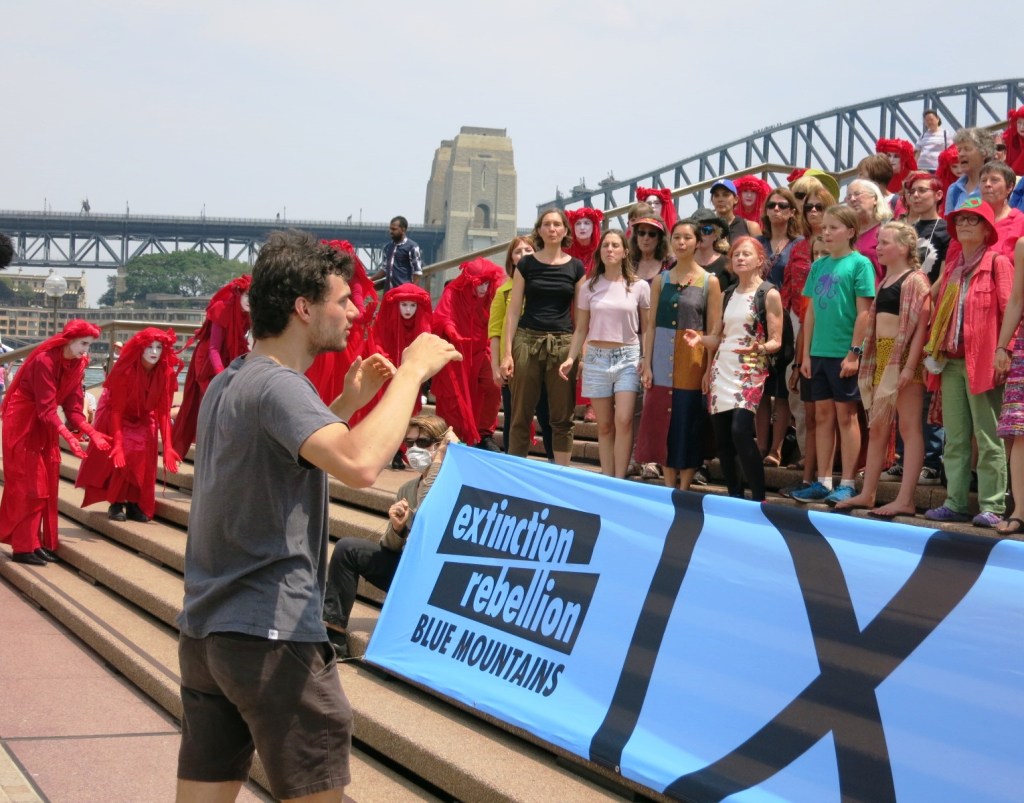
This prompted me to start an ongoing series called Creativity Amongst Crisis. Today we will be hearing from emerging composer Josh Winestock. Josh is currently based in Sydney and works within a variety of ensembles, including new music ensemble SPIRAL and protest choir The Black-Throated Finches, part of environmental advocacy group Extinction Rebellion (XR).
Can you tell us a few sentences about yourself, what your musical practice is, and how you’re currently working on it.
I’m a Sydney-based composer and improvisor interested in experimental, independent and community music making. Before the pandemic I was involved in a collaboration with dancers, running an activist choir, playing with and writing for my amplified ensemble Spiral, and writing a bit of acoustic instrumental music here and there as well. I try to exist in many musical worlds, but I think my music takes a lot from minimalism, impressionism, folk and modern jazz fusion.
Josh conducting a flash mob choir as part of a protest by Extinction Rebellion Sydney (XR), December 2019. Photo credit: Rigmor Helene Berg
What have you found to be most challenging aspects of this time of COVID-19, as a performing artist and more generally day to day?
Like many people I went into lockdown with many projects that I thought I would be able to get through, and of course it wasn’t that simple. The uncertainty of the situation, the many questions of ‘how much can I get done’, ‘how much am I supposed to get done during this time’, ‘what is even possible at the moment’, ‘how long will we be locked down’, were part of why it was difficult to stay focused. I started the lockdown by practicing guitar a lot, but as months went on I found it difficult to motivate myself with no rehearsals or performances to work towards.
Josh conducting protest choir The Black-Throated Finches as part of Extinction Rebellion Sydney (XR). December 2019. Photo credit: Rigmor Helene Berg
Anything particular you’d like to reflect on in this strange and disorientating socially-distanced period?
I think musicians have a really strong awareness of time, since we have to divide and manipulate it pretty carefully when we’re writing or playing music. Being on online calls I became really aware of how relative time is on this platform. Anyone who’s tried to make music over web conferencing knows about the staggering time delay that makes it impossible to play any conventional music together without comical results.
Experimenting with it made me realise how time is relative in that online space; two people clapping might be perceived as in sync from your perspective but out of sync from mine, just based on the speed at which each person’s video stream reaches our computers. Maybe one person’s internet connection is getting worse, so they might slow down from our perspective, but for them it’s the rest of us who are getting slower. It’s a bit like the way the universe works, where we “see” distant stars thousands of years into the past, where time and space are literally distorted according to the speed of light. In this environment we may think we’re playing “out of time”, but there’s actually no such thing as playing “in time”, there’s no objective perspective on the flow of time; how can you play in time in a space where the word “simultaneous” is meaningless? That’s pretty cool I reckon, and I think there’s a good piece in there somewhere…
Do you have any projects in the works you’d like to share?
I’ve been involved in pretty diverse bunch of web-based musical projects during lockdown: a few socially distanced orchestras, an isolated choir video project I’m still editing, and some specially commissioned pieces for Zoom with Ensemble Onsombl. So I’m feeling like a bit of an expert on isolation internet music! One project has stood out to me, something I think produced genuine and worthwhile art that embraced the circumstances rather than trying to recreate the music we would otherwise be making.
For a while I’ve been playing with a longstanding free-improv collective in Sydney, the Splinter Orchestra, and we were invited to play at the Avant Whatever festival in Melbourne, which was sabotaged by the pandemic. The organiser decided to take the festival online, which isn’t self-explanatory at all; “taking the festival online” isn’t itself a course of action, it’s the start of a complex and unfamiliar discussion.
The Splinter Orchestra, as a group, has a really strong connection to “place”; they’ve gone into the bush multiple times to play, walking around and engaging with the sounds of nature. During lockdown we took our regular weekly plays onto Zoom, chatting and catching up before trying to improvise with each other through our microphones, recording our sound locally at high quality to sync up later.
Fortunately we don’t generally play music with a central rhythmic pulse, so the time delay that sabotages most attempts at music making over the web didn’t destroy us, but of course there were a lot of other issues. We could only ever hear a few of the fifteen-odd people on the call, and even those not very well, with Zoom struggling to distinguish between intentional sound and background noise, mangling our playing in the process. We got some decent recordings out of those early sessions when we combined our recorded audio in post, but while we were playing it was unsettling and frustrating, and the online environment was obviously totally at odds with Splinter’s usual engagement with place.
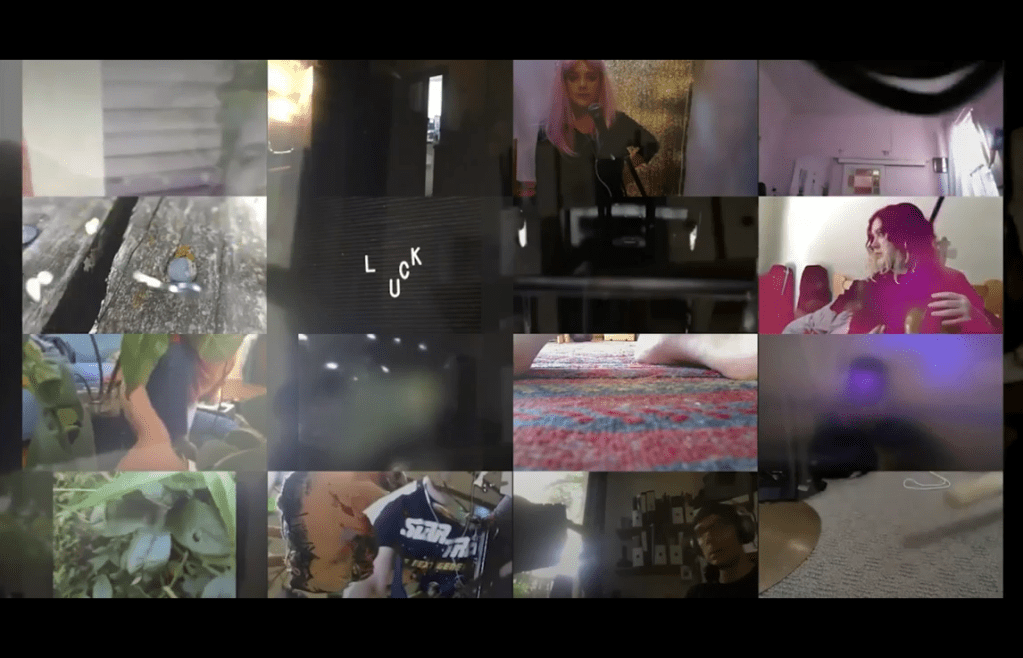
Over time though we found different ways of working with the medium. A couple of people had been messing around with virtual backgrounds (as you do on a friendly Zoom call), or typing stupid comments in the chat box during a play. One of us put a doll in front of the camera to replace his own face.
We gradually realised that these were the kinds of things that Zoom was good at conveying, and we learned to focus on them; we had people using coloured lights and knitted hats to create kaleidoscopic patterns in their window, or people putting coloured film over the camera and distorting their own faces, people dressing up in costumes and face paint, people tricking their virtual backgrounds into painting their faces digitally, or combining themselves with swarms of monochrome pigeons or cartoon characters.
I enjoyed using brights lights to create abstract patterns over video I had lying around on my computer. We captured both the gallery view and several different speaker views to edit together and overlay in post, and we could embrace the subjectivity of each person’s perceived experience of the improv, influenced by their connection speed and the mysteries of the algorithm.
We ended up presenting a 73-minute video piece at the festival, and I’m really proud of it. I think we moved past trying to cling on to what we had lost, and we found something really new. It felt distinctive to this era of isolation, but not hopeless or a pale imitation of something that would have been better in person. It was different; not better, but under the circumstances kinda “right”.
How do you sustain hope for the future, or overcome periods where you feel less motivated?
I think I got pretty weighed down by all my plans when the lockdown first started. Things felt a lot more positive when I moved on from the projects I had originally planned that I was obviously not going to get around to. I’ve ended up being pretty busy recently just by embracing things as they come up, doing this as they interest me, and I think there’s something to learn from that. As for hope for the future though, that’s a hard one…
Josh Winestock is an Australian composer, improviser and multi-instrumentalist based in Sydney. He recently completed a Bachelor of Music in Composition with first class honours, from the Sydney Conservatorium of Music. As a composer he has worked with ensembles including the Conservatorium Symphony Orchestra, Conservatorium Saxophone Orchestra and the Australian Youth Orchestra, and has written a variety of chamber music, vocal music and large ensemble music, including a concertino for saxophone and wind orchestra.
He is part of various improvising groups and collectives, including a project he helped to found, Ensemble Onsombl, and has more recently started exploring collaboration with physical theatre artists. He has also been involved in acapella and wind band playing and continues to be invested in community music making. He is the guitarist and a founding member of young amplified chamber group Spiral. His practice is oriented around extending his musical limits across his different musical worlds, and he is passionate about organising grassroots contemporary concerts to bring communities together.
It’s 8.24pm on a Sunday night and I’m feeling miserable, sitting in an empty apartment. A friend has just flaked out on calling me for the third time this week. Over the past few days, I’ve been brushed off by other friends and have even attempted to find some good conversation on Tinder, before remembering the kind of conversationalists who use Tinder.
The hissy fit I am throwing is the culmination of a particularly stressful month. For obvious reasons the first half of 2020 has been unusual, tiring and stressful for everyone. I have been particularly lucky to have had stable employment throughout this pandemic, and the kind of office job which was relatively simple to convert online. The things that made it challenging were the things that would have existed for anyone sharing a flat: I have a very small bedroom and live with two housemates who are also working from home.
The main reason I’m feeling so sad and aggravated is that my handful of fabulous, amazing, independent best friends are scattered across Melbourne. As much as I passionately love these people, they are pretty flaky when it comes to returning my messages. I’m all the more conscious of this because I am currently single (have been for a while, to be honest), I don’t live with close friends, and I don’t have a family relation close to my age I can confide in.
I’ve seen some optimistic stuff on the internet that makes maintaining friendships sound so easy: “Check in with your mates and incorporate Zoom trivia into your routine!”. But the truth is, if your friend has a partner or siblings they are particularly close to, you probably haven’t heard from them lately. After all, the natural human response during times of stress is to limit extraneous effort and concentrate your energy on the day-to-day matter of survival. You maintain the relationships that are the most immediate and nourishing: those with your family members, your partner, the people you see every day. Anything beyond that is an activity.
Photo credit: Stella J.J.
I don’t blame anyone for that. I understand very well that not everyone is as socially motivated as I am. Introverted people actually need time alone to recharge and maintain their mental health.
By the same token, I am learning to stop feeling annoyed at myself for the way my personality functions. I hate sounding so whiny and affected by others! I hate that other people have the power to make me so sad. Or more precisely, I hate that long periods of not seeing my friends has such a massive effect on my mood and energy levels. I may be an extroverted person, but I am not particularly pushy. Calling or texting my friends more than two days in a row feels obscene.
It’s a common anecdote from research studies that seeing a loved one’s face or hearing their voice can instantly produce endorphins. Hugs are scientifically proven to lower your blood pressure and level of stress hormone norepinephrine, and encourage the production of happy hormone oxytocin.
This pandemic is a lonely time. It’s so important that we keep tabs on our loved ones right now, as the last few months have been filled with persistent, inescapable stress and existential confusion. I keep thinking of those who are trapped in difficult or abusive relationships and are unable to leave, and those who were going through a tough time mentally before all of this pandemic stuff happened.
I’ll leave you with my parting thoughts. You can have an independent personality without necessarily having an introverted one. You can look after your own health and your own problems, while still craving human contact. It’s not only normal, but something that can help you build your own happiness.
I’ve just accepted it. I’m hard-wired to be part of a pack, not a lone wolf.
I recently put out the call to my immediate musical network, to see who would be happy to share with Fever Pitch Magazine how they have adapted during this period of social distancing. The last few months have been disorientating and frequently exhausting, and stage three lockdown has recently been re-implemented in Victoria. Prioritising your mental and physical wellbeing is more important than ever.
This prompted me to start an ongoing series called Creativity Amongst Crisis. Today we will be hearing from educator and bass-baritone Nick Dinopoulos. Nick originally contacted me to have a chat about the work he has done as musical director of Australian Boys Choir, a veteran giant in the Australian choir world. I was surprised and heartened to see that the choir’s education team is predominantly made up of tutors in their early twenties. I imagine this would be hugely beneficial on both sides: it would provide fantastic teaching experience for those starting out on their ~musical career journey~, and a meaningful level of understanding between the tutors and the students due to the closeness in age. You can follow Nick’s work through his Facebook page and website, and learn more about the Australian Boys Choir here.
Can you give the readers a bit of background of your work as a performer and educator? Has it been a slow progression into education-based work with schools and universities, or were you teaching alongside performing from early in your career?
The words ‘portfolio career’ and ‘scheduling freak’ would definitely sum up my life! As a freelance opera singer and recitalist, singing teacher and university lecturer, all in addition to my work as artistic director of the Australian Boys Choir, no two days during the work week are ever alike. My diary is insane, but I love the variety.
I never thought I would become a singing teacher or a choral conductor, and never envisaged working at university. Honing my knowledge of music and understanding of the voice were key, but equally significant has been the desire to pass it on. Especially with my university voice students, I frequently say “Did that work for you? Great! That’s yours now.”
All of these various aspects have developed simultaneously and organically over time – I just wanted to be the best I could be. Being asked to be a founding core member of Songmakers Australia at age 23 was something that helped take my career as a singer to the next level. I’ve had to turn down some seriously great opera contracts over the past few years, which is always sad, but you can’t make everything fit.
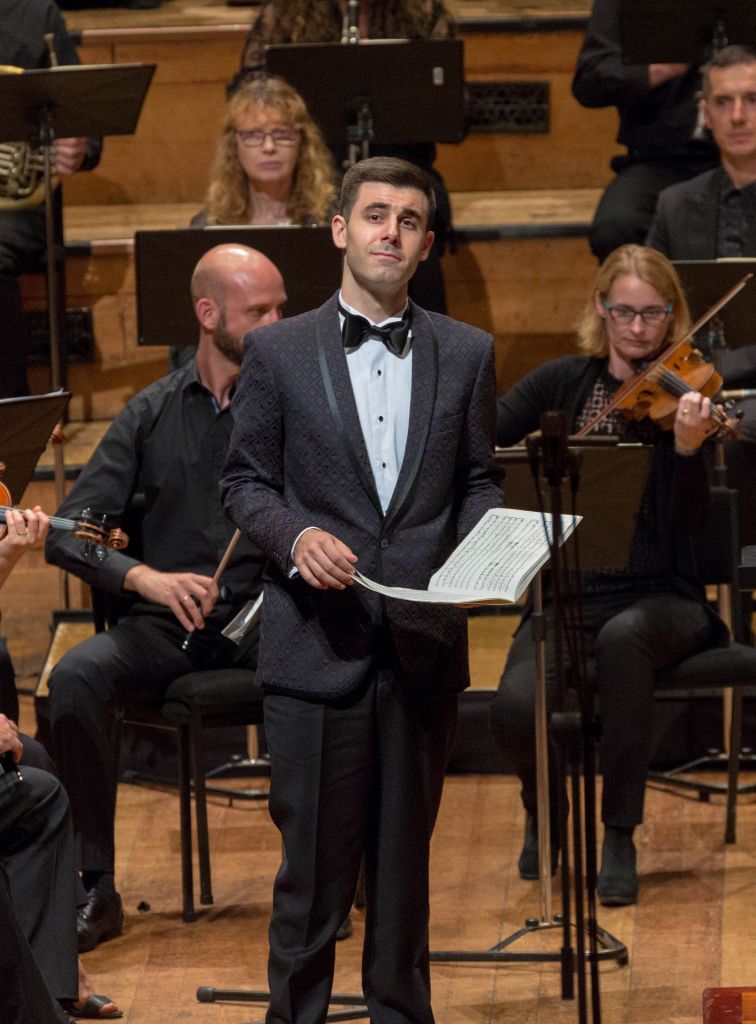
Onstage as Ercole in Cavalli’s Giasone, City Recital Hall Sydney, Pinchgut Opera. Photo by Keith Saunders
Do you have any pointers for singers and musicians reading who would like to enter the field of choir directing, musical directing in schools, etc?
No matter how badly you do it, play the piano. Even if you can’t play the full accompaniment, come to understand the harmonic structure of the piece from the inside out. Always practice your repertoire at the keyboard – slowly and carefully – and know your limitations.
Work out how your voice functions and cultivate the strongest possible technique/best possible vocal habits. Gently build your stamina, take vocal rest, and try giving non-verbal instructions/feedback. Also, systematically warm-up and cool-down on a daily basis.
Lastly, no one really needs you to look like Toscanini. Having success as a leader of musicians comes as a result of listening. Singers and instrumentalists always do better as individuals when they perceive their conductor/mentor is actually hearing what they are doing.
What have you found to be some of the most rewarding moments in working intensively with choirs? Particularly as your time as Artistic Director as Australian Boys Choir.
Working with singers of any age and experience is incredibly rewarding, no matter the level at which it takes place. If you can help them be just that little bit better at something by the end of the rehearsal than they were at the start, you’ve done your job. If you can involve an element of rigour, share humour, and imbue a sense that the music is living and means something, even better!
My work with two great university choirs over the past few years, the 150-voice Monash University Singers and the 30-voice Melbourne Conservatorium Chamber Choir, has been incredibly edifying.
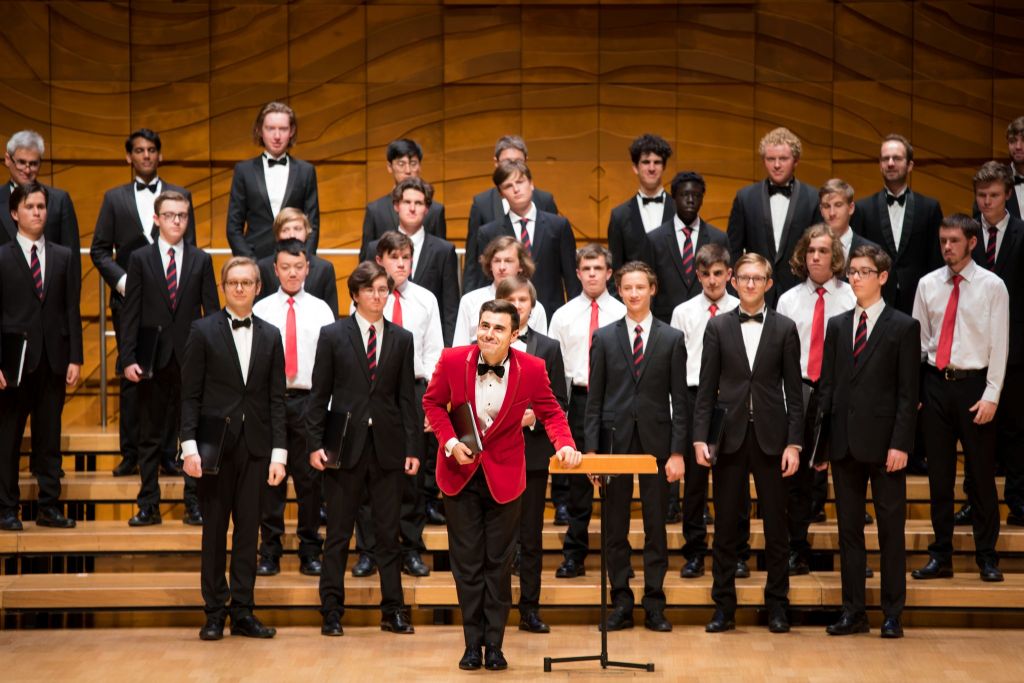
Onstage at Melbourne Recital Centre with The Vocal Consort and singers of the Australian Boys Choral Institute. Photo by Jane Kupsch.
Preparing some of the largest choral-symphonic repertoire for orchestral performance has been a real thrill – watching the singers up on stage be committed to being in the moment (even when some of them might have resisted the process in rehearsal) is terrific to see. Also, working with outstanding voices with soloistic potential to help them take their musicianship and level of ensemble skill to the next level is wonderful. Seeing them rise up to what you know they can be is tremendously gratifying.
On the Australian Boys Choir, I should say that it is quite a particular organisation in the musical landscape of our country. It combines high-level musical literacy and aural skills with vocal training and performance experience. The choir tours internationally, records often, and seeks to collaborate broadly. The top singers are very dedicated to what they do, and spend years honing their craft.
Positive role-modelling is incredibly important, and our group of teenaged voices (called the Kelly Gang, after the Choir’s founder, Vincent. J. Kelly) and our very top changed male-voice ensemble The Vocal Consort provide a tremendous example for the younger singers. These groups also provide an important pathway for young men to continue singing on the other side of the voice-change.
Australian Boys Choir 2018 European Tour, entry to the Thomaskirche Leipzig, where J.S. Bach was Music Director from 1723-1750. Photo supplied.
I have many great memories of my time working at the Boys Choir, but a true “wow” moment was touring to Europe in 2018 and getting to conduct the boys in a performance of the great Bach motet Jesu, meine Freude in Bach’s own church of St. Thomas’ Leipzig. If you love Bach as much as I do, walking into that building is simply overwhelming, let alone seeing your name on the door! It wasn’t just the jetlag we were feeling, and I’m positive that the significance was not lost on the singers.
Among other staff, at Australian Boys Choir you employ an accomplished group of eight musical tutors in their twenties. Many of them grew up singing in the choir themselves. I started Fever Pitch last year at the age of 23, partially because I felt daunted at the prospect of forging a musical career after my degree. Many of the people following the blog are in a similar life stage and position, do you have anything you would like to reflect on for that audience?
Our staff are amazing. I don’t know how else to describe them. They are passionate. They are serious and funny in equal measure. Alongside their work for us, they are emerging as some of the brightest music educators, conductors, composers, pianists, organists, singers, speech pathologists (and even lawyers!) in the country. In many cases, they are also living their very best ‘portfolio career’ life but also do very much care about the organisation and what it means. They want to see the children and young people we work with garner the utmost from their time in training.
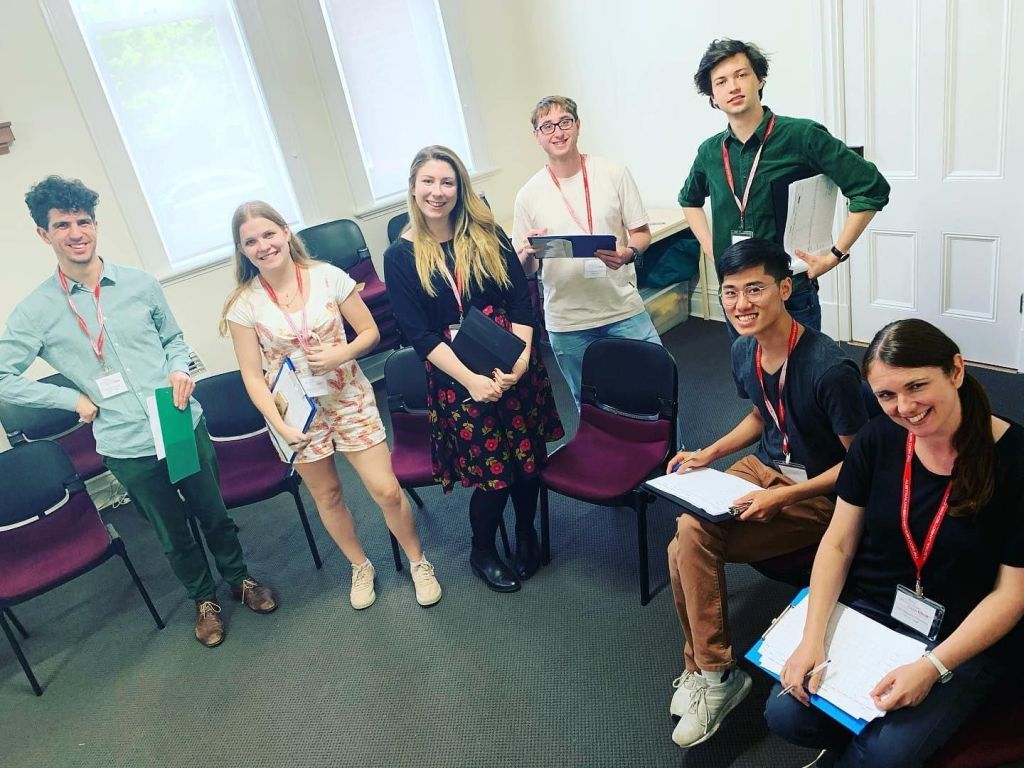
Music Staff of the Australian Boys Choir on a break between auditions. Photo supplied.
I actually had a Zoom meeting with a colleague of mine the other day, and she took the time to remark just how many talented people had gone through and maybe then even been on the staff of the Australian Boys Choir. The reality is that a musician is a musician. The only thing separating emerging musicians and more established professionals is the time spent on the journey honing one’s craft.
The Boys Choir auditions for new members several times a year, and we’re about to do that again soon – if you know anyone who might be interested, they can find the details at www.australianboyschoir.com.au/join. But even if you’re not a boy aged seven- nine years of age, there are so many benefits to getting involved with community/corporate/chamber music-making – and even better if it involves singing!
What have been the particular challenges in continuing to have rehearsals over this COVID-19 affected period? Have you learnt anything specific that you may not have been forced to learn, were it not for the restrictions and the flow-on effects?
I have had to tell the boys that their concert engagements with Victorian Opera and the Melbourne Symphony Orchestra scheduled for August and October have had to be cancelled! That was devastating. The really had earned those opportunities, both as individuals and as a group. The Australian Boys Choir has 80 years’ worth of culture and tradition to preserve, and I’m absolutely committed to getting through this.
But in terms of the physical delivery of rehearsals, the boys have weekly online rehearsals, community singalongs and tutorials, and mostly sing on mute in their own homes when they’re not demonstrating things individually. We’ve had to suspend our expectations and do things in smaller doses. Focus on the little things. Read the Zoom room and go with the flow. Does that sound Zen? I’m not sure, but that’s all there is to it!
How do you sustain hope for the future, or overcome periods where you feel less motivated?
I think the best way to stay motivated is the thought that we must all simply strive to use our skills, whatever they may be, in the most beneficial way possible for others. None of what I do in my working life is actually about me. It’s about providing benefit to humanity in some small way. Do what you do and do it well. Don’t fight, just exist. Oh, and schedule things!
Schedule practice. Schedule chats. Know where your time goes. Know what takes up more time than it should, or than it needs to. The industry has been steadily changing over the past decade or so, but that change is now accelerating. As musicians, as artists, as creatives, what we do has worth. It is so very important. The arts make the world a place worth living in.
He is frequently heard in live-to-air broadcasts on ABC Classic FM and 3MBS FM, and is a core member of Songmakers Australia under the artistic patronage of Graham Johnson.
For IHOS Opera / MONA FOMA 2012 he created the role of The Poet in the world premiere performances of Constantine Koukias’ The Barbarians (Helpmann Award nomination, Best Opera category). The 2013 season saw critically acclaimed debuts for both Victorian Opera (Melbourne) and Pinchgut Opera (Sydney).
I recently put out the call to my immediate musical network, to see who would be happy to share with Fever Pitch Magazine how they have adapted during this period of social distancing. The last few months have been disorientating and frequently exhausting, and stage three lockdown has recently been re-implemented in Victoria. Prioritising your mental and physical wellbeing is more important than ever.
To this end, I’d like to present a series entitled Creativity Amongst Crisis. I hope it can supply you with some tips, optimism, and most importantly, the knowledge that are you not alone in this crappy time. First up is emerging lyric baritone Daniel Felton, who lends his dulcet tones to operatic choruses and a capella groups alike. You can follow Daniel’s work through his Facebook and Instagram pages.
Can you tell us a bit about the repertoire you have been working on recently?
Recently I finished filming a digital version of Gian Carlo Menotti’s The Telephone with Gertrude Opera and have taken part in some virtual projects with Burgundy Blue, Exaudi and Choral Edge and a collaborative project led by Nic Cester from the band Jet.
I am currently learning Gugliemo for Cosi Fan Tutte, the role of Don in Don Giovanni and preparing a handful of roles with Gertrude Opera for the Yarra Valley Opera festival in October (I can’t mention specifically just yet!). I’m also looking at the Dichterliebe song cycle by Schumann. Other than that, just general practice of piano and violin stuff (nothing specific).
What have you found to be most challenging aspects of this time of COVID-19, as a performing artist and more generally day to day?
The most challenging part I have found about the COVID-19 isolation is not having people around me to make music with. For me, music is something that I enjoy to an even greater extent when sharing it with friends and colleagues. Not having that direct contact with other musicians was initially quite hard. I often found myself longing for something as simple as just hearing instruments or voices producing chords or counter melodies. Granted, there have been manageable ways of making music with others through the internet, but it is never the same.
Virtual choir performance by Choral Edge. ‘We Will Go No More’, composed by Juliana Kay, set to text by Lord Byron.
Anything particular you’d like to reflect on as we slowly come out of this strange and disorientating socially-distanced period?
I certainly have had time to reflect on how one keeps a positive mind set whilst also keeping the mind active. Classical musicians in our day-and-age will inevitably face times where we are less busy or occupied; and by extension less happy. This period in time has been a test to see if I have the stamina to pull through the isolation and loneliness, and keep the music alive in myself. If I can get through this hard time, I know have the skills required to do so in the future.
Do you have any projects in the works you’d like to share?
With Gertrude Opera, I have been working on a virtual production of The Telephone by Menotti. Soprano Bethany Hill and I were both able to record and film our separate parts from our home states, and they were edited together by our Director Linda Thompson and Musical Director Matthew Toogood. It is a modern take on a classic, and a fantastic idea for how to keep opera going in a time when opera houses and theatres are closed.
Have you learnt anything specific that you may not have been forced to learn, were it not for COVID-19 restrictions and the flow-on effects?
I have learned two main skills in my time during isolation. The first is my reliance on technology. I found myself really depending on technology for communication, but eventually branched out further using internet resources, computer software and recording equipment to use both for practice and performance. It did take some getting used to, but I was able to acquire everything I needed to keep things going.
The second was keeping fit and focused. Before isolation, I had designated times I would practice fit in between work, rest and rehearsals. As I had far more time on my hands, and was trapped at home, I found my overall energy levels to be far lower; this was made all the more difficult with Ramadan fasting.
In response to this, I put a lot of effort into scheduling physical exercise and going for walks as frequently as I could. I would do the same for music practice. I would force myself to get motivated, and once I had started to sing or study, it all became easier from there. All of this was possible due a tight schedule and rigid day to day plan which I would adhere to as adamantly as I could.
How do you sustain hope for the future, or overcome periods where you feel less motivated?
One of the major benefits of living in this day-and-age is access to social media and technology. This allowed me to stay in close touch with family and close friends. I consider myself a people person in the sense that it is the people in my life that bring me joy. Despite not being in their physical presence, it was assuring to know we could still be there to support one another from a distance.
We all had obstacles to overcome in these hard times, but we were never alone, and we would always support each other when the times became very tiring and difficult. I made a personal motto of mine to remind myself “even in isolation, we stand and sing together”.
25 year old lyric baritone Daniel Felton has 20 years of experience; from multiple accolades in dance, training in various musical instruments, and professional operatic performance. Daniel has been working with numerous opera companies in Australia since 2013, such as Melbourne Opera, BK Opera, Lyric Opera, Opera Australia, and Australian International Productions. Some major roles and covers to his name are Schaunard from La Boheme, Figaro from Le Nozze di Figaro, Hannah Before in the Australian Premiere of As One, and Dwarf 7 in the world premiere of Grimm’s Fairy Tales. Daniel is a working professional with a drive to perform in Australia and Internationally.
I feel a strange internal pressure sometimes when I remember I am turning twenty-five this year. This is tied up in expectations I’ve placed upon myself, and a common mindset among creative people: an urgent desire to reach your goals before you ‘run out of time’ or ‘miss your chances’. (This is not helped by the true scarcity of funding and opportunities in the performing arts industry)
I’m know that twenty-five is hardly the onset of old age. But sometimes I feel afraid that I won’t be given opportunities to do my best work, or feel the dizzying high of achieving something I worked long and hard to do.
This is a very human fear because no one can know exactly what their future will hold. Your twenties can be a particularly disorientating and lonely time, because your life probably does not look like how you expected it to when you were an optimistic (and uninformed) teenager.
Another recurring thought is that I ought to have unlocked some mysterious, revelatory insight into the formula of success by now. The kind you see advertised in click-bait articles on the internet: 10 habits of SUCCESSFUL BILLIONAIRES you should start doing right now!
Over the last few years I have come to realise there is no mystical secret to success. Time and time again, I’ve found it’s the boring and straightforward stuff that helps in a crisis. Going to bed at a regular hour and eating fruits and vegetables doesn’t stop bad things from happening, but it does boost your body’s natural inclination to manufacture endorphins.
When I was a kid, there were a couple of small freedoms I thought of as the epitome of adult independence: staying up past midnight and eating chocolate cake any day of the week. Then I started buying my own groceries and I realised that I’d get a stomach ache if I ate more than two slices of chocolate cake in one sitting. And I’m usually sleepy by 10pm.
So what are the other underwhelming, common-sense bits of wisdom have I gained at the age of almost twenty-five?
Photo credit: Stella J.J.
Make yourself uncomfortable/ short term pain, long term gain/ blah blah blah
After graduating from my studies at the end of 2018, I knew exactly how I would feel in a few months: cagey and desperate to return to uni. I’ve always been the kind of person who enjoys being busy. And for all it’s flaws, my Bachelor of Music gave me an opportunity to research topics I was really passionate about, access one of the most comprehensive libraries in Australia, and comfortably maintain a glorious circle of musical friends. It was a pretty good deal.
It was scary to look beyond the horizon of years of structured study. Uni had supplied me with eighty percent of my social circle and had taken up eighty percent of my day-to-day life. I hadn’t taken a gap year, apart from six months off between finishing my undergrad and starting Honours.
And that’s exactly why I forced myself to pause, before ploughing straight into a Masters or a PhD. I knew it would feel odd and initially kind of wrong to not have any external structure to follow. But I also knew that those feelings of pessimism, of being lost, of being overwhelmed by the savagery of the job market for twenty-somethings, were going to happen at some point. Whether I confronted them now, or in another three years after finishing a second degree, I wasn’t going to be able to skip to the part where I ended up with a perfect career.
I do intend to undertake a postgraduate degree eventually, but probably only after a couple more years in the full-time workforce and a three-month sabbatical trekking across Europe.
So what did I learn by deliberately ignoring the urge to return to the comforting cocoon of university assignments and delaying life decisions? That there is more than one kind of discomfort. Sometimes situations feel ‘wrong’ because they’re new. Other times a situation will feel ‘wrong’ because it is distressing or unsafe. It can be hard to distinguish them at the time, but if you think your feelings of discomfort are primarily the result of nerves and your lack of experience, I strongly recommend forging ahead. You’d be surprised to learn how often people become experts ‘on the job’.
And to round out my Oprah-isms, here’s a metaphor. Growth is like training for a marathon: there will be pain, you might throw up on your shoes, but if you keep going you’ll eventually see results.
Photo credit: Stella J.J.
Throw mud at the wall and see what sticks
Another major ~life experience~ I went through that year was the Great Housing Disaster of ’19. The crazy stuff that went down during those five months will certainly be mined for creative projects in the future. If you want the statistics, I would have to say I attended twenty or thirty sharehouse interviews over four active months of looking. An additional month was completely eaten up by the ludicrous experience of finding a place, being asked to move in, struggling to get the real estate agents to answer my phone calls, shifting my stuff in, sleeping there for four nights… and receiving an email from the agents on a Tuesday night informing me that my application had been rejected. I wish I was exaggerating.
The whole experience was exhausting, demoralizing, and often made me wonder if I had been cast as the lead in a melodrama without my knowing. At least I got the chance to learn certain hard truths about the housing market, and became much more comfortable with the idea of speed dating in the process (because sharehouse speed dating is scarier!)
Fast forward to January/ February this year, and I found myself in the midst of a similar kind of search: looking for a permanent job after two months of casual and contract work. I applied for around thirty jobs on Seek, and had phone interviews for maybe two or three of them.
A particularly senseless and ugly side of the job market is the unreasonably high expectation of experience. I mostly applied for entry-level administration jobs as I had a few months of experience doing admin work for arts organisations. For these basic positions, companies would usually expect two-three years experience in a similar position. But surely if you had already suffered through two-three years of answering emails and making appointments, you would be trying to promote yourself instead of applying for positions that would earn you the same income or less, and wouldn’t present any kind of a challenge… And in the meantime, hordes of capable candidates in their twenties who only have part-time work experience as they were studying, are arbitrarily held back from jobs they could do in their sleep.
Photo credit: Stella J.J.
I can’t emphasise enough the tiring but wonderful quality of tenacity. You lose nothing by putting your name forward, and the more you do this, the greater your chances. It really is a case of throwing mud at the wall and seeing what sticks.
You can’t fight your emotionsand win
I suspect some people equate emotional maturity with a kind of impenetrable, zen-like emotional state where nothing can bother you. But that’s impossible! You’re not weak or undisciplined if something make you angry, upset, even jealous or insecure; in small amounts those are valuable human emotions which can teach you something. You can’t constantly police your emotions and thoughts, and neither should you. However you can control how you respond to them.
So really, I think the secret to sustained success is to remind yourself every day that you are human. I’ll leave you with the mental refrain I have been returning to over the last few crazy months: we do our best, with what we have.
I am a classically trained singer, who would love to earn part of my income singing opera in the future. I also have ambitions to write the libretto for a new opera (or several).
I am also a lover of pop music, which you will know if you have followed my writing on this blog over the past few months. Some of my all-time favourite artists were the pop megastars of their era: ABBA, The Mamas and The Papas, Dusty Springfield, Elvis Presley…
I also worship at the altar of the pop divas of today: Lady Gaga, Beyoncé, Ariana Grande, Kylie Minogue (not currently reigning but no less legendary) and in my opinion, Britney Spears’ entire back catalogue, even her heavily synthesised electro-pop period, has aged very well.
I think pop more than deserves its place of merit alongside other musical genres. It’s the only kind of music which has never, ever failed to cheer me up on a terrible day, even if it was only a tiny increase in mood. But I have never felt worse for turning on a catchy pop song during a period of anxiety or pessimism. So today I will be attempting to unpack exactly why pop music shaming is a flawed, and frankly, illogical way of thinking. Please be warned, I’ve almost written a full-length essay on the subject.
Battle-lines are commonly drawn between the two opposing pillars of classical music and pop music. It’s not enough to simply enjoy classical music on its own merits, you have to hold it up as some sort of untouchable ideal, while trashing pop music as simplistic and mindless. Those on the opposite side of the argument call that comparison hypocritical and snobby; after all, classical was the popular music of its time.
I agree with certain parts of this statement. A good point of comparison is the song form of lieder. Lieder is commonly described as a collaboration between voice and piano, with a sophisticated piano part and words taken from German poetry. (The term ‘art-song’ refers to similar forms written in countries outside Germany like Italy and France).
The most famous examples of lieder became enormously popular in Europe from the 1820s to the turn of the twentieth century. There are a number of similarities between lieder and modern-day pop songs: both typically go for three to five minutes, are concerned with love and relationships, and are catchy and melodic (and often repetitive). Some lieder even follow a verse-chorus-bridge structure. Because lieder is short and sweet, it’s likely to be enjoyed even by those who have no prior knowledge of classical music.
During the nineteenth century, lieder was consumed in a remarkably similar way to being downloaded on iTunes or streamed on Spotify: the average Joe or Josephine would eagerly await the latest releases, buy the sheet music, and perform them for their friends at soirees held in their living rooms. A star composer of this period was Franz Schubert. During his short lifetime, Schubert experienced a kind of fame and popularity similar to that of a chart-topping singer-songwriter.
Pictured: Gustav Klimt’s painting ‘Schubert at the Piano’, 1899
On the opposite end of the spectrum, larger compositional forms such as symphonies or string quartets contain so many moving parts, and the way they are layered together is an element in itself. The structural complexity and technical difficulty of these forms is what distinguishes them from a short song. I don’t make that distinction to minimise the skill in producing an excellent pop song; the simplicity is where the impact and genius of pop lies.
Therein lies my point: the two are like apples and oranges. Some people will prefer one over the other, but both are delicious and nutritious. They’re consumed in different ways- you would probably be shocked and slightly afraid if you saw someone biting into a whole orange, skin and all…
ASSUMPTION TWO: If it’s popular, it must be overrated
Laying aside distinctions of structure, what is pop music? The ‘pop’ in the name is obviously short for ‘popular’. Like fashion, pop music is in a constant state of flux, morphing with the times.
It’s not necessarily true that any musical act that experiences success, has to be classified as part of a pop music movement. Punk rock bands such as The Ramones emerged out of the rebellion against the dominant style of rock at the time.
My stance on popularity is that it’s just as silly to automatically assume an album will be crap because it has been produced by a mainstream record label, as it is to assume an album will be crap because it has been produced by a tiny indie label. Maybe stop assuming and let yourself enjoy the kind of music you enjoy. (That’s aimed at the people who say they hate Coldplay when in fact they hate admitting they don’t actually hate Coldplay).
Everyone listens to music through their own aural filter: I’m a singer and I love melodies. I love melodies of all kinds: ones that are pretty and consonant, and ones that are dissonant, crunchy and eerie… if something is fun to sing, I’m interested.
When I hear a well crafted melody, it feels like a dopamine shot straight to the brain. In the words of Alex Fletcher, the former 80s pop star played by Hugh Grant in Music and Lyrics: “You can take all the novels in the world, and none of them will make you feel as good, as fast, as: I got sunshine on a cloudy day/ when it’s cold outside, I’ve got the month of May.”
ASSUMPTION THREE: Accessibility must be a bad thing
There’s one valid real reason for not liking pop music: it doesn’t make your brain chemicals do the ~happy things~ when you listen to it. It’s a genre like any other, offering its own quirks and charms.
No one laughs at rock music like they do pop music. Critics and consumers don’t trash-talk folk, blues, funk, or jazz anywhere near as enthusiastically (well, maybe in the case of jazz). I’d say that people don’t trash-talk rap, but certain conservative demographics definitely do (and that’s an article for a whole other day, to be written by someone with a far more comprehensive knowledge of rap than I… Seriously, contact me if you’d like to write that article).
If you’re making sweeping statements about how an entire genre has no value because it features catchy hooks or because the songs are enjoyed by stadiums full of people, you’re just a wanker. You’re not intellectually superior because you don’t sing along to Britney Spears.
A case in point which brings me great satisfaction is the case of The Beatles. The Beatles are described by music critics and consumers alike as one of the most significant rock bands of the twentieth century (and their influence continues into the twenty-first century as well…) They arguably changed the course of musical history, and speaking as someone who was born in 1995, I have consumed their music almost purely incidentally. The way the creative output of four guys from Liverpool has seeped into almost every aspect of Western pop culture (advertisements, movies, even linguistic shorthand), is kind of staggering.
And yet The Beatles started out as one of the first ‘boy bands’ in history. Teenage girls screamed and fainted at the mere sight of them exiting an airplane (they even made up a word for it, ‘Beatlemania’). Many adults at the time turned their nose up at the band: in an essay published in the New Statesman, Paul Johnson wrote: “Those who flock round the Beatles, who scream themselves into hysteria, whose vacant faces flicker over the TV screen, are the least fortunate of their generation, the dull, the idle, the failures.” It just goes to show…
Problematic aspects of the industry and the relentless quest for profit
If I hadn’t rabbited on enough, I wanted to add the postscript that while I love pop music, I don’t love every aspect of the industry.
There’s often an inverse relationship between the size of a record label and the amount of creative freedom given to its artists. Independent labels can keep their costs down and their management tight-knit, without being beholden to stakeholders, investors or executive studio heads.
Since the nineties, pop music has slowly moved away from bands who wrote their own hit songs with one or two collaborators, to a production line of slickly marketed pop acts. Even though the first lab-created boy band was The Monkees in 1960s, we can see this become an established method in the late eighties- nineties with the management-assembled groups The New Kids on The Block, the Backstreet Boys, NSYNC, Take That, S Club 7 and of course, The Spice Girls. These acts were specifically designed to appeal to teenagers, with a different member to cater to each demographic. The ‘bad boy’, the ‘sweet boy’, the one who could rap/ dance, etc, etc… and One Direction really proved that this tactic still works wonders.
Because of this corporate approach, pop history is littered with acts who struggled to actually perform live. They weren’t seasoned musicians who managed to become famous, they were young people with the ‘right look’ and bare minimum musical talent, who were chosen to become the ‘next big thing’.
I’m not trying to be cruel, because these artists have released some great hits, but singers like Katy Perry, Jennifer Lopez and Selena Gomez have managed to carve out hugely successful music careers despite, not because of, their mediocre voices. All three have sold-out arenas thanks to the power of savvy production, charismatic stage presence and aesthetic, sex appeal and a fantastic team of writers. On the other hand, artists like Lady Gaga, Ed Sheeran, Adele and Eminem were busking, hustling and honing their craft years before they got signed to a record label.
So I see where people are coming from when they criticise commercially successful artists who can’t get through a single set-list without gratuitous lip-syncing. It can be quite infuriating when the ‘industry’ in ‘music industry’ seems to be more important than the music itself.
And lastly, there is the matter of how womanhood is presented and sold in the pop music industry. There have been debates raging for decades over whether highly sexualised pop stars are helping or hindering the feminist cause.
I think it depends on the specific artists and the power they have over their own releases. It doesn’t make you a prude if you are slightly uncomfortable with the way female artists have to be ‘packaged’ to sell music records. A case in point is the evolution of the group Fifth Harmony, assembled by Simon Cowell (the brain behind One Direction) during a season of The X Factor in the US. During the competition the ages of the members ranged from fifteen to nineteen.
Stills captured from Fifth Harmony’s music video for ‘BO$$’. From left to right, bottom frame: Camila Cabello, Dinah Jane, Normani Hamilton, Lauren Jauregui, Ally Brooke.
When Fifth Harmony released the first singles off their debut alum, the music videos were decidedly seductive, with almost ludicrously aggressive thrusting dance moves. The thing that makes me uncomfortable about this, is the fact that four out of five group members were seventeen or eighteen when the videos were filmed, and had been contracted to massive commercial studios off the back of a reality TV show. What’s the likelihood any of the girls would have felt comfortable speaking up or objecting to the creative direction of the videos?
There’s absolutely nothing wrong with women feeling confident and in control of how they flaunt their bodies. (Key words being: in control). But there’s a discomforting marketing edge to the way a group of girls went from singing on TV as sixteen-year-olds, to being thrust in front of a camera grinding on a chair the second they were ‘legal’.
Perhaps the most powerful observation I can make is that One Direction were not treated the same way. Despite being assembled through the same TV franchise, by the same industry figure, at the same age, the gentlemen of One Direction have only ever released inoffensive and wholesome music videos. Far from thrusting their crotches at the camera or seductively humping the ground, you can see them gamboling happily on the beach, letting loose on the streets of London, and generally having a marvelous time.
Whether you agree or disagree, I hope you’ve found my lengthy thesis on the world of pop thought-provoking. I would love to hear what you think. In the meantime, I’m off to listen to Britney Spears.



















 Fever Pitch Magazine